
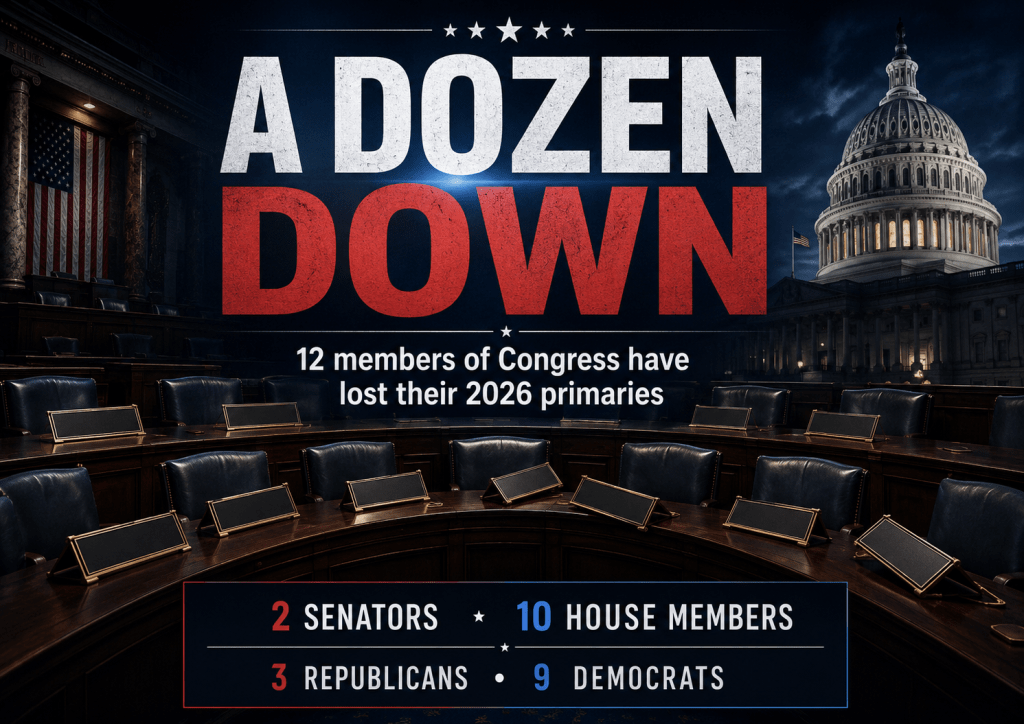
Twelve sitting members of Congress have lost their party’s nomination during the 2026 primary season — two senators and ten House members, spanning primaries in Texas, Louisiana, Kentucky, New York, Colorado, Michigan, Tennessee and Connecticut between March 3 and August 11.
The losses split 3–9 between the parties: three Republicans and nine Democrats (seven in the House, two — Sens. Bill Cassidy and John Cornyn — in the Senate). But the mechanisms behind the two parties’ losses differ substantially, and untangling them requires separating three distinct forces: presidential-endorsement pressure within the GOP, redistricting that forced incumbents into shared districts in Texas and Tennessee, and a wave of primary challenges from the Democratic Party’s left flank in urban and university-adjacent districts.
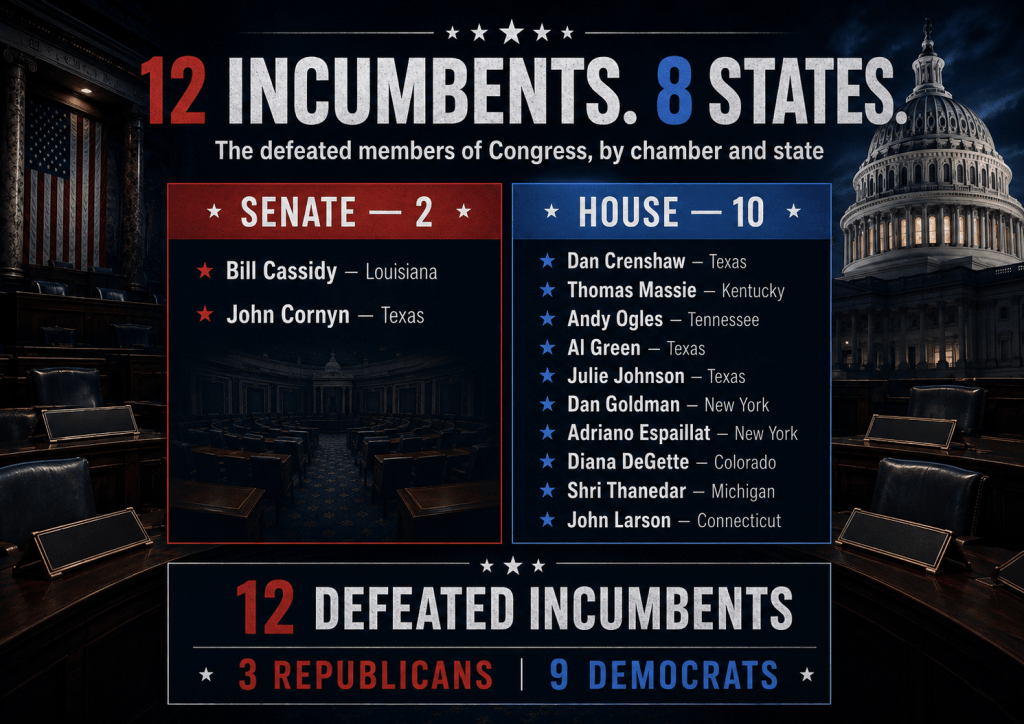
“Twelve sitting members of Congress have lost their party’s nomination during the 2026 primary season.”
The Senate: two Trump-era holdouts fall
Both Senate losses involved Republicans who had drawn President Trump’s public criticism over votes cast years earlier, and both races turned on his subsequent endorsement of a primary rival.
Sen. Bill Cassidy of Louisiana finished third in the state’s May 16 Republican primary, taking roughly 25 percent of the vote behind Rep. Julia Letlow (about 45 percent) and state Treasurer John Fleming (about 28 percent), according to results reported by the Associated Press. Because no candidate cleared 50 percent, the race proceeded to a June 27 runoff, which Letlow — who had Trump’s endorsement — went on to win. Cassidy was one of seven Senate Republicans who voted to convict Trump in his 2021 second impeachment trial; five years later, that vote was the central storyline of his defeat, and Trump said afterward that he considered it a settling of accounts. Cassidy also drew opposition from Health Secretary Robert F. Kennedy Jr.’s allies over his role blocking a surgeon general nominee.
Sen. John Cornyn of Texas advanced out of a three-way March 3 primary against state Attorney General Ken Paxton and Rep. Wesley Hunt, but fell short of a majority; he then lost the May 26 runoff to Paxton by a wide margin, roughly 64 percent to 36 percent, per Associated Press returns. Trump had withheld an endorsement through the initial primary before backing Paxton ahead of the runoff. Cornyn, first elected in 2002, becomes the first Texas Republican senator to lose a renomination bid. Paxton’s win was not without controversy of its own — he has faced years of ethics scrutiny in Texas, a point Cornyn’s campaign emphasized without success.
“At least for Republican primary voters, alignment with Trump is still paramount.”
House Republicans: three losses tied to redistricting and endorsement politics
Rep. Dan Crenshaw (Texas’ 2nd District) lost the state’s March 3 primary to state Rep. Steve Toth by a double-digit margin, after Sen. Ted Cruz endorsed Toth the week before Election Day. Crenshaw was the only Texas House Republican incumbent seeking re-election who had not received Trump’s endorsement; Trump remained neutral through Election Day and endorsed Toth only afterward. Unlike Massie or Ogles below, Crenshaw’s defeat was not tied to a specific break with Trump on major legislation — Toth’s campaign centered instead on questioning Crenshaw’s alignment with the president’s agenda more broadly.

Rep. Thomas Massie (Kentucky’s 4th District) lost a May 19 primary to Ed Gallrein, a former Navy SEAL Trump recruited to run against him, in what multiple outlets tracking ad spending — including AdImpact — reported as the most expensive U.S. House primary on record, with more than $32 million spent. Massie’s break with Trump predated the race by years and involved several issues: his vote against the 2025 reconciliation package, his opposition to U.S. involvement in strikes on Iran, and his role leading a bipartisan effort to force release of Justice Department files related to Jeffrey Epstein. Defense Secretary Pete Hegseth traveled to the district to campaign against Massie the day before the primary.
Rep. Andy Ogles (Tennessee’s 5th District) lost his primary to former state Agriculture Commissioner Charlie Hatcher in early August, despite having Trump’s endorsement. Trump subsequently transferred his support to Hatcher after the results were final, writing in a social media post that he had backed Ogles out of loyalty despite the incumbent having “virtually no chance of winning.” Ogles’ seat was one of several affected by Tennessee’s redrawn congressional map.
House Democrats: a season of left-flank challenges
The seven House Democratic losses cluster into two categories: redistricting-forced incumbent-versus-incumbent contests in Texas, and primary challenges from candidates aligned with the Democratic Socialists of America or backed by New York City Mayor Zohran Mamdani, a democratic socialist himself.
“The seven House Democratic losses cluster into two categories: redistricting-forced contests and challenges from the party’s left flank.”
Rep. Al Green (Texas’ 18th District) lost a May 26 runoff to Rep. Christian Menefee, in one of two genuine incumbent-versus-incumbent U.S. House races nationally in 2026, created by Texas’ mid-decade congressional redistricting. Menefee, the former Harris County attorney, had won a January special election for the same Houston-based seat after the death of Rep. Sylvester Turner, then defeated Green — who had represented the adjacent, now more Republican-leaning 9th District since 2005 — after redrawn lines placed both men’s homes in the 18th District. Menefee led the first round of the March primary, 46.0 percent to Green’s 44.2 percent, and went on to win the runoff decisively, with the Associated Press calling the race for Menefee at roughly 69 percent to 31 percent.
Rep. Julie Johnson (Texas’ 33rd District), elected in 2024, lost a May 26 runoff to Colin Allred, a former U.S. representative who did not hold office at the time of the race. Johnson’s district, like Green’s, was reshaped by the state’s new congressional map — her original 32nd District was redrawn into more Republican-leaning territory, prompting her to run instead in the newly configured 33rd.
Rep. Dan Goldman (New York’s 10th District) and Rep. Adriano Espaillat (New York’s 13th District) both lost June 23 primaries to challengers endorsed by Mamdani: former New York City Comptroller Brad Lander defeated Goldman by a wide margin, and organizer Darializa Avila Chevalier narrowly defeated Espaillat, chair of the Congressional Hispanic Caucus, by roughly three points. Both Lander and Avila Chevalier were substantially outspent by the incumbents they defeated. A third Mamdani-backed candidate, Claire Valdez, won an open New York City seat the same night without facing an incumbent.

Rep. Diana DeGette (Colorado’s 1st District), first elected in 1996, lost her June 30 primary to democratic socialist Melat Kiros by double digits. DeGette had cleared the state’s 30-percent convention-delegate threshold to appear on the primary ballot by a narrow margin months earlier.
Rep. Shri Thanedar (Michigan’s 13th District) lost his August 4 primary to state Rep. Donavan McKinney. Thanedar had publicly renounced Democratic Socialists of America membership in 2023; a former local DSA chapter co-chair disputed that characterization at the time, saying Thanedar had been expelled by a membership vote rather than resigning.
Rep. John Larson (Connecticut’s 1st District), in Congress since 1999, lost his August 11 primary to former Hartford Mayor Luke Bronin.
“The same headline — incumbent defeated — masks very different political forces underneath it.”
What the losses have in common — and what they don’t

Redistricting explains three of the twelve races directly: Texas’ new congressional map, drawn by the Republican-controlled legislature in 2025, altered or overlapped the districts held by Al Green and Julie Johnson, and Tennessee’s redrawn map affected Ogles’ seat, according to reporting cited above — though the specific boundary changes to TN-05 have not been independently verified against the Tennessee legislature’s map for this article. Crenshaw’s loss was not redistricting-driven. The remaining losses were primarily driven by ideological or loyalty-based primary challenges rather than by map lines: on the Republican side, by the incumbent’s relationship with Trump; on the Democratic side, by challenges from candidates aligned with the party’s progressive and democratic-socialist wing, several of them explicitly backed by Mamdani.
Additional primaries remain on the calendar through mid-September, meaning the total number of ousted incumbents could grow before the cycle concludes.

Sourcing note
Vote totals and race calls cited above are drawn from Associated Press projections and results as reported by NBC News, CNN, ABC News, PBS NewsHour, the Texas Tribune, Houston Public Media, Roll Call, Axios, Ballotpedia and Fox News Digital. Endorsement timing and direct quotations attributed to President Trump are drawn from his posts on Truth Social as reported by the outlets above; Election Desk has not independently verified the original posts beyond the news reports citing them. Kentucky’s 4th District ad-spending figures are attributed to AdImpact as reported by CNBC and the Associated Press. The characterization of Rep. Thanedar’s DSA membership status reflects a documented dispute between Thanedar and a former Detroit DSA chapter official and is presented here as a disputed claim rather than a settled fact. Tennessee’s 5th District redistricting reference is based on general news-report framing rather than a direct review of the state’s enacted map and should be treated as a lower-confidence claim pending primary-source confirmation. This list reflects primary results confirmed through August 13, 2026; additional state primaries are scheduled into September and could add to the total.


Leave a comment