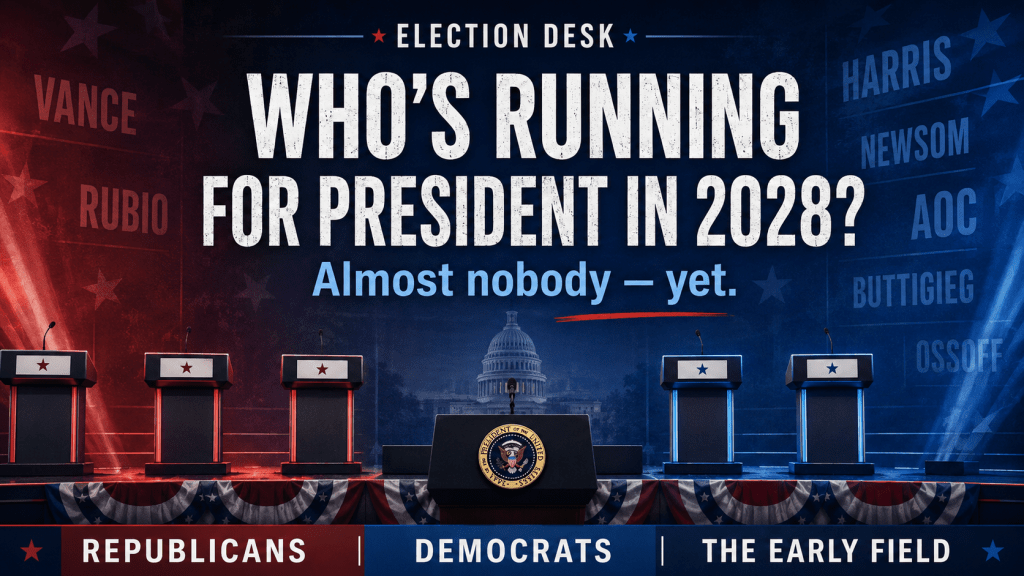
No candidate in either major party has formally launched a 2028 presidential campaign, but the list of people considering a run — and the polling testing them against each other — has grown steadily through 2026. Below is where things stand as of mid-August, drawing on the most recent published surveys. As with all polling this far from an actual primary, these numbers largely track name recognition rather than settled voter preference, and they have moved substantially from poll to poll.
“No candidate in either major party has formally launched a 2028 presidential campaign.”
Republicans: a Vance-Rubio contest, with wide variance between pollsters
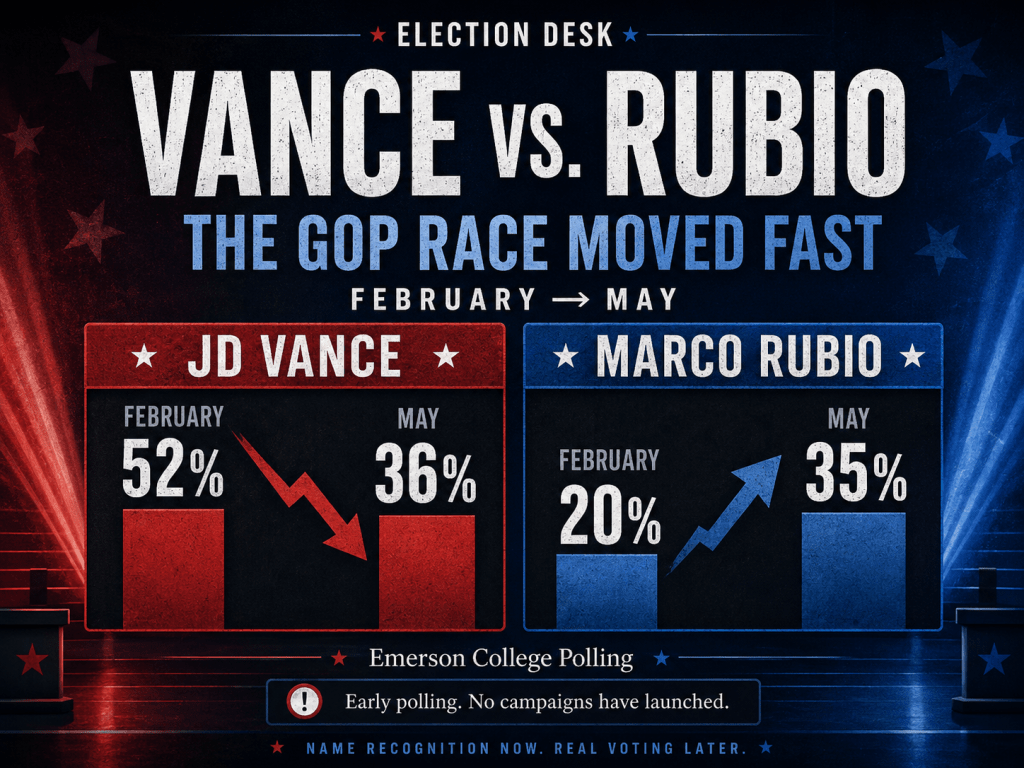
Vice President JD Vance has been the presumed early frontrunner since taking office, buoyed by Trump’s past comments calling him his likely successor. But Secretary of State Marco Rubio has closed the gap significantly in several surveys since spring.
An Emerson College Polling survey conducted May 24–25 among 432 likely Republican primary voters found Vance at 36% and Rubio at 35% — a shift from Emerson’s own February survey, which had Vance at 52% and Rubio at 20%. A University of New Hampshire Granite State Poll released around the same time showed a similar swing: Vance at 36%, Rubio up to 26% from 7% in February. Rubio also won a July straw poll of conservative activists at the Western Conservative Summit, taking 57% to Vance’s 21%.
Other polls tell a different story. A late-July polling average compiled from 13 national surveys over 50 days put Vance ahead by a wider 20-point margin, 39.3% to 18.9%. Some of the polls feeding into that average come from firms with a stated partisan lean — Big Data Poll and McLaughlin & Associates are Republican-aligned, Clarity Campaign Labs is Democratic-aligned — a distinction Election Desk flags rather than folds into blended averages, consistent with our standard sourcing practice.
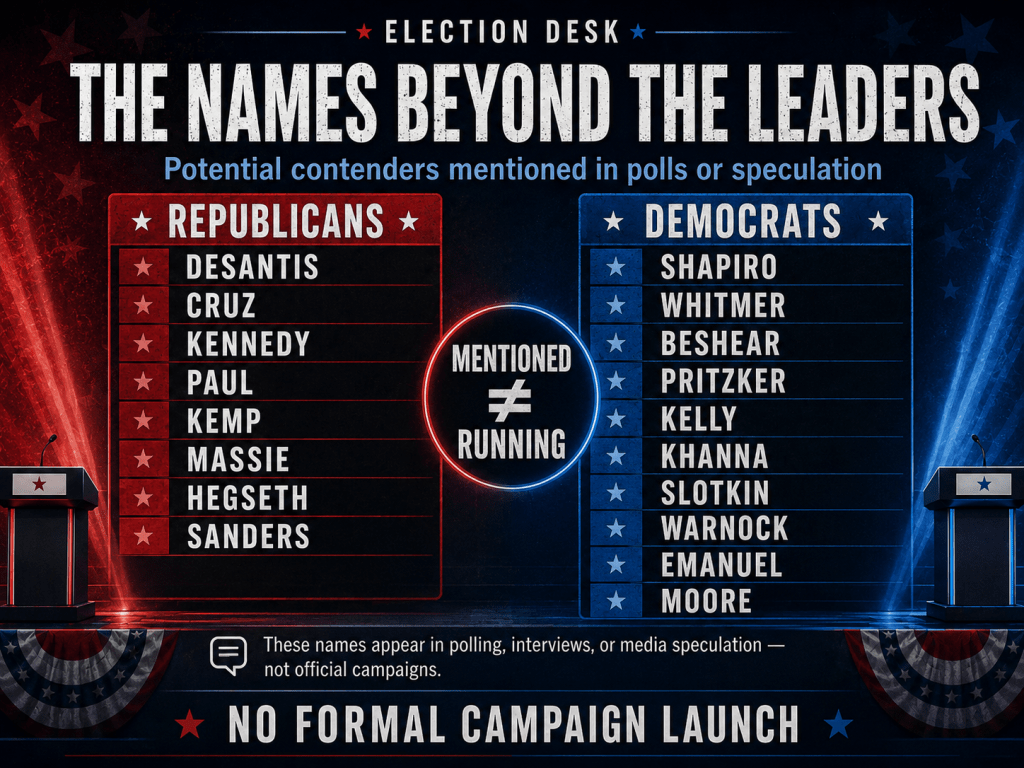
Behind Vance and Rubio, Florida Gov. Ron DeSantis and former U.N. Ambassador Nikki Haley have generally polled in the low single digits, though Haley has since publicly denied any interest in running. Other Republicans named in various surveys or reported to be weighing a bid include Sen. Ted Cruz of Texas, Louisiana Sen. John Kennedy, Kentucky Sen. Rand Paul, Georgia Gov. Brian Kemp, and Kentucky Rep. Thomas Massie, none of whom has taken formal steps toward a campaign. Defense Secretary Pete Hegseth and Arkansas Gov. Sarah Huckabee Sanders have also been named as potential contenders by multiple outlets without confirming interest themselves.
Democrats: five candidates have led five different polls since May
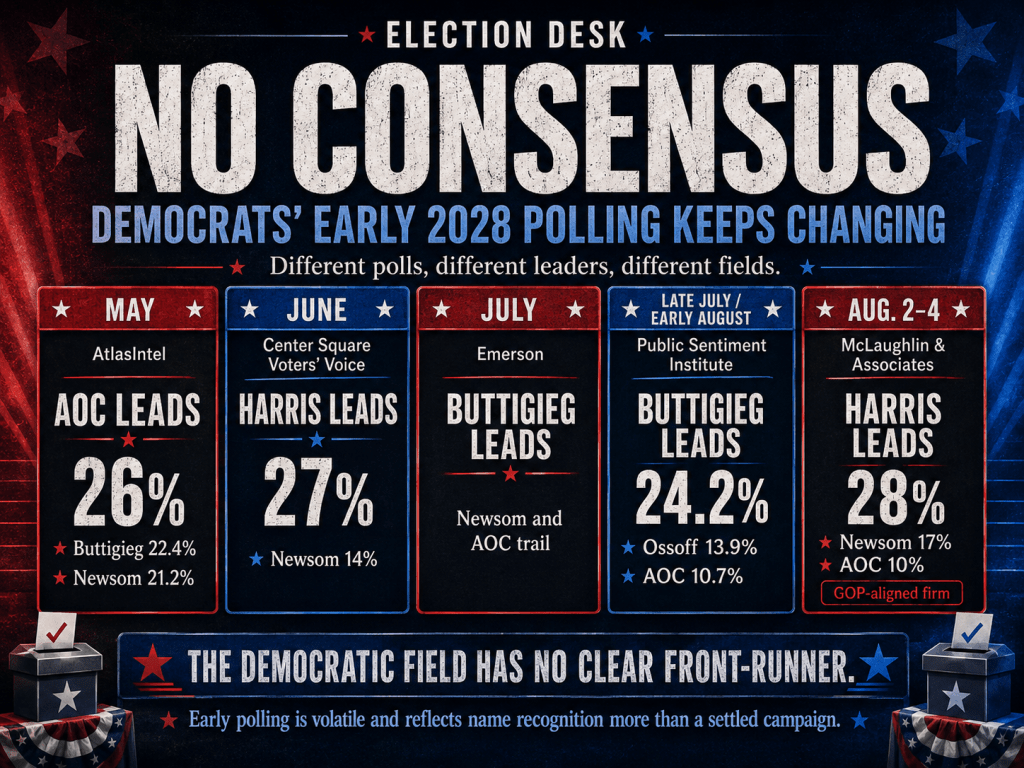
The Democratic field is more fragmented, and the polling has been especially volatile. Since May, at least five separate national or early-state surveys have each shown a different candidate in first place:
“Five separate national or early-state surveys have each shown a different candidate in first place.”
- A May AtlasIntel survey of 2,069 adults had Rep. Alexandria Ocasio-Cortez leading at 26%, ahead of former Transportation Secretary Pete Buttigieg (22.4%) and California Gov. Gavin Newsom (21.2%), with former Vice President Kamala Harris at 12.9%.
- A June Center Square Voters’ Voice poll had Harris in front at 27%, with Newsom at 14%.
- A July Emerson College survey showed Buttigieg leading, with Newsom and Ocasio-Cortez trailing.
- A late-July/early-August Public Sentiment Institute poll again found Buttigieg ahead at 24.2%, followed by Georgia Sen. Jon Ossoff at 13.9%, Ocasio-Cortez at 10.7%, Newsom at 10%, and Harris at just 5.1%.
- A McLaughlin & Associates poll conducted August 2–4 — a Republican-aligned firm, flagged accordingly — found Harris back on top at 28%, with Newsom at 17% and Ocasio-Cortez at 10%.
In New Hampshire specifically, an late-July University of New Hampshire poll found Ocasio-Cortez leading Buttigieg by a single point, 22% to 21%, with Arizona Sen. Mark Kelly, Newsom, and Vermont Sen. Bernie Sanders further back and Harris at just 5% — a marked shift from UNH’s own February and October 2025 polls, which had Buttigieg ahead.
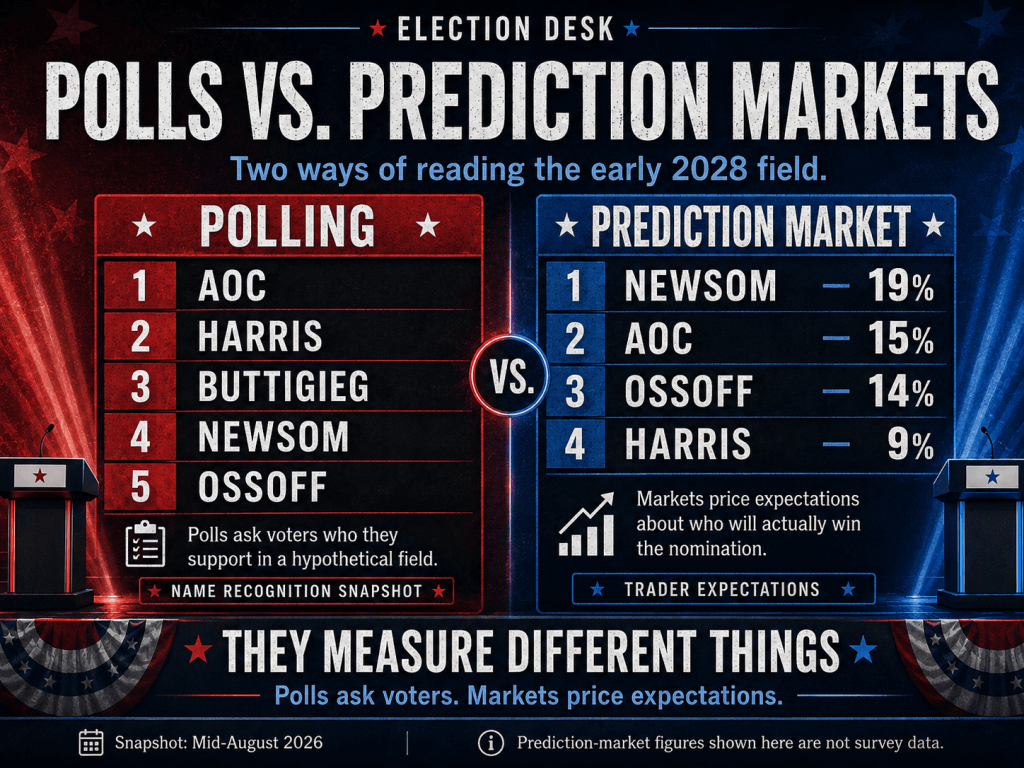
Prediction markets, for what they’re worth, diverge from the polling: as of mid-August, Polymarket priced Newsom as the most likely Democratic nominee at 19%, ahead of Ocasio-Cortez (15%), Ossoff (14%), and Harris (9%) — reflecting trader expectations about who consolidates support in an actual primary rather than name-recognition snapshots.
Other Democrats named in polls, reported interviews, or media speculation include Pennsylvania Gov. Josh Shapiro, Michigan Gov. Gretchen Whitmer, Kentucky Gov. Andy Beshear, Illinois Gov. JB Pritzker, California Rep. Ro Khanna, Michigan Sen. Elissa Slotkin, Maryland Sen. Chris Van Hollen, Georgia Sen. Raphael Warnock, and former ambassador Rahm Emanuel. None has filed with the FEC or launched a campaign; several, including Newsom, Shapiro, and Beshear, have said they won’t decide until after the 2026 midterms.
“None has filed with the FEC or launched a campaign.”
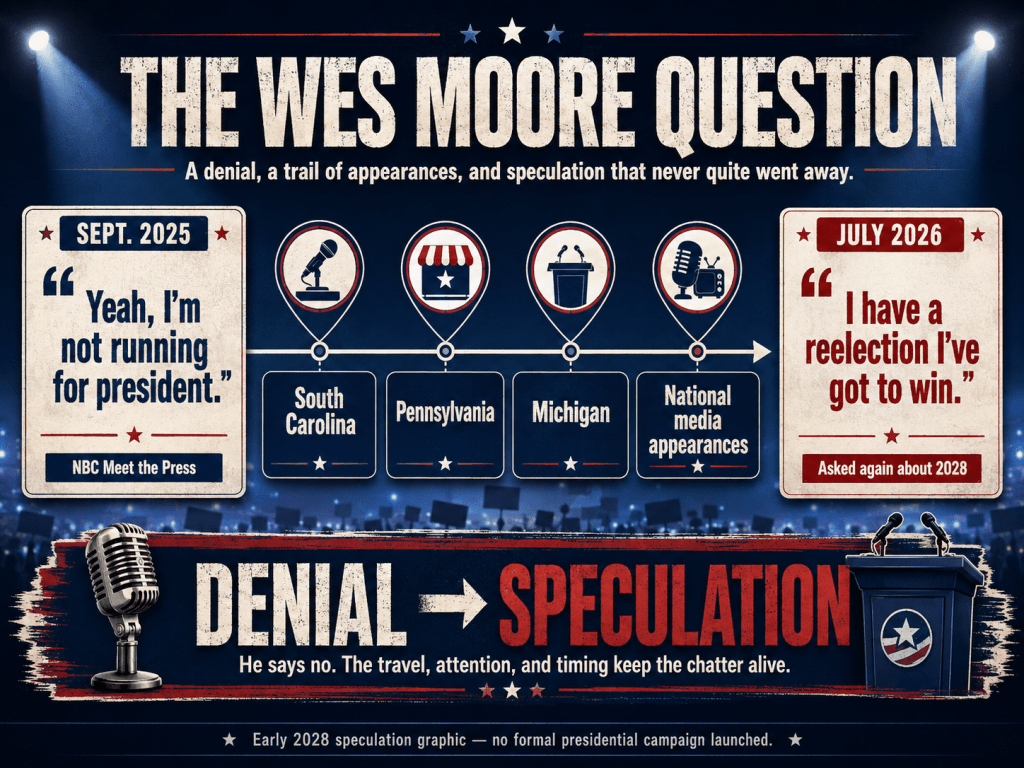
Maryland Gov. Wes Moore is a separate case worth noting on its own. He has repeatedly and explicitly ruled out a 2028 run, most recently telling NBC’s “Meet the Press” in September 2025, “Yeah, I’m not running for president.” But his conduct since has kept the speculation alive: commencement addresses and campaign stops in early-primary states South Carolina and New Hampshire-adjacent Pennsylvania, appearances in the swing state of Michigan, and heavy national media exposure, all while seeking reelection as governor in 2026. By July 2026, Moore had stopped repeating the denial outright, telling reporters in Michigan only that he has “a reelection I’ve got to win” when asked directly. He has polled in low single digits, generally near the back of the field, in the surveys that have included his name.
Third-party and independent names
2020 Libertarian nominee Jo Jorgensen filed an exploratory committee for the Libertarian nomination in May. Businessman Andrew Yang, who founded the Forward Party after his own 2020 Democratic run, has said in recent interviews that “the odds of my running again are high.” Musician and 2024 independent candidate Afroman has floated a possible Libertarian bid.
The caveat that applies to all of the above
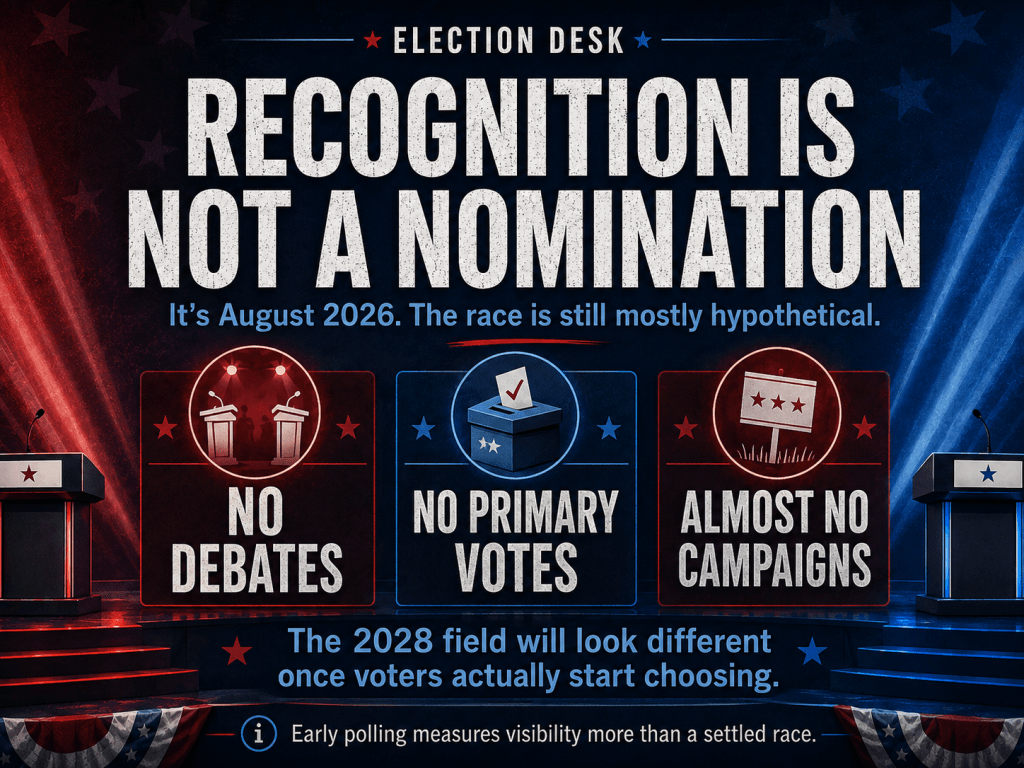
“These polls are measuring recognition and reputation more than settled preference.”
Every figure above should be read as an early signal, not a forecast. With no campaigns, debates, or advertising yet underway, these polls are measuring recognition and reputation more than settled preference — a dynamic underscored by how much they’ve moved, and how differently they’ve moved, from one survey to the next over just the past few months.
For Election Desk’s coverage of the process questions behind this field — FEC filing rules, the unsettled 2028 primary calendar, and what “exploratory committee” actually means — see our companion piece.
Sourcing note: Polling figures are attributed to the named pollster, field dates (where available), and sample size in each case. Polls from firms with disclosed partisan sponsorship or affiliation (McLaughlin & Associates, Big Data Poll, Clarity Campaign Labs) are identified as such; Election Desk does not blend these into cross-poll averages presented as neutral. Prediction-market figures (Polymarket) reflect trader pricing, not survey data, and are presented separately. Candidate activity and statements are drawn from named outlets including Fox News, Newsweek, the Boston Globe, The Hill, and Washington Times, with individual attributions embedded in text where a claim traces to a single source.


Leave a comment