More than two years out from the 2028 presidential election, no candidate from either major party has formally launched a campaign. That’s not unusual this far out — but the shape of the contest is unusual in one respect: for the first time since 1884, two consecutive presidential elections will be held without an incumbent on the ballot. President Trump is barred from a third term by the Twenty-Second Amendment, and no sitting vice president or former president is running to succeed him by default.
That has produced a wide, undefined field on both sides — and a wave of media speculation, informal polling, and “will they or won’t they” interviews well before the mechanics of an actual campaign have kicked in. Here’s what’s formally happened so far, and what the early numbers can and can’t tell voters.
What “running” actually means, legally
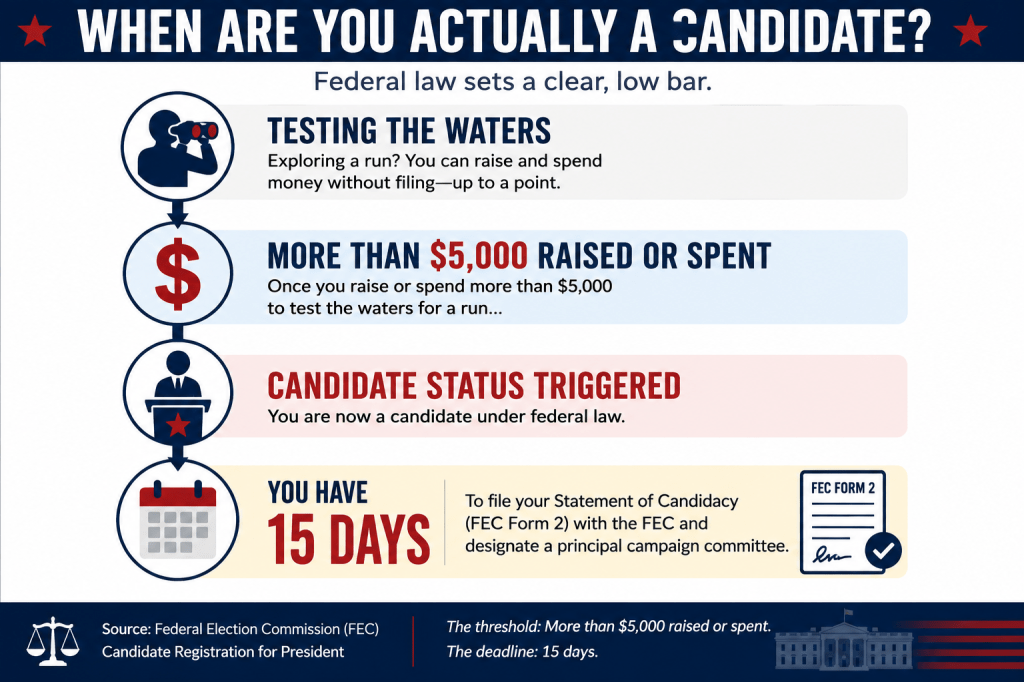
Federal law sets a specific, low bar for when someone becomes an official candidate. Under Federal Election Commission rules, an individual is not required to register until they raise or spend more than $5,000 testing the waters for a run. Once that threshold is crossed, the candidate has 15 days to file a Statement of Candidacy — FEC Form 2 — and designate a principal campaign committee.
That threshold is why the terminology in early coverage varies so much: “declared” candidates have filed Form 2; those with an “exploratory committee” are raising money to test viability without committing; and the much larger group described as having “expressed interest” or been the subject of “media speculation” have done neither, and may simply have answered a reporter’s question honestly.
As of this writing, only a small number of candidates have actually filed with the FEC for 2028 — mostly minor or long-shot candidates. Television writer Dan Greaney, best known for writing a 2000 episode of The Simpsons that depicted a future Trump presidency, filed a Statement of Candidacy and held a campaign announcement in June, running as a Republican. Former U.S. Border Patrol commander Gregory Bovino has been reported to be forming an exploratory committee, as has 2020 Libertarian nominee Jo Jorgensen, who announced hers in May. None of the widely discussed potential top-tier candidates — Vice President JD Vance, Secretary of State Marco Rubio, California Gov. Gavin Newsom, former Vice President Kamala Harris, or others — have filed anything with the FEC.
“The gap between ‘who’s polling’ and ‘who’s actually a candidate’ is normal at this stage.”
That gap between “who’s polling” and “who’s actually a candidate” is normal at this stage. At the equivalent point in the 2024 and 2016 cycles, no notable candidates had announced. Ahead of the 2020 cycle, three had. Most serious campaigns don’t formally launch until the year immediately preceding the election.
How “potential candidate” polls are built — and why they move so much
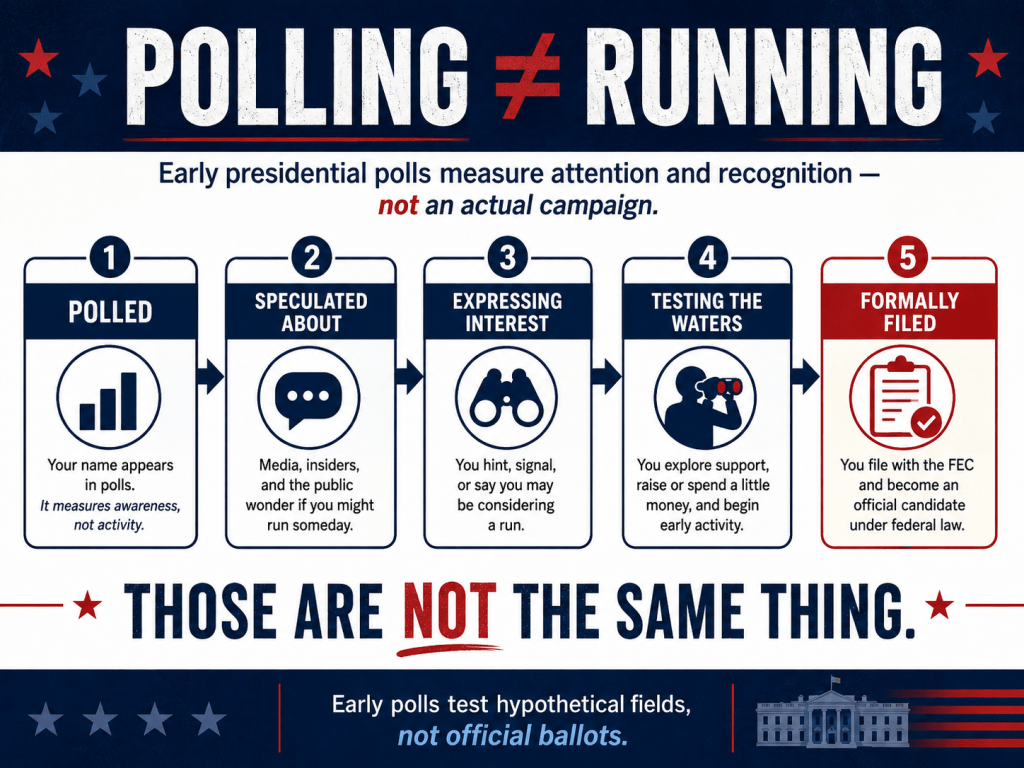
Because no campaigns exist yet, primary polling at this stage measures something different from a real primary: name recognition and general favorability among a hypothetical field selected by the pollster, not voter response to actual campaigns, debates, or advertising. Pollsters differ on which names they include, how they screen respondents (registered voters, likely voters, or all adults), and how large a field they test — one national survey offered respondents a list of 13 Democratic names, for instance, while others test five or six.
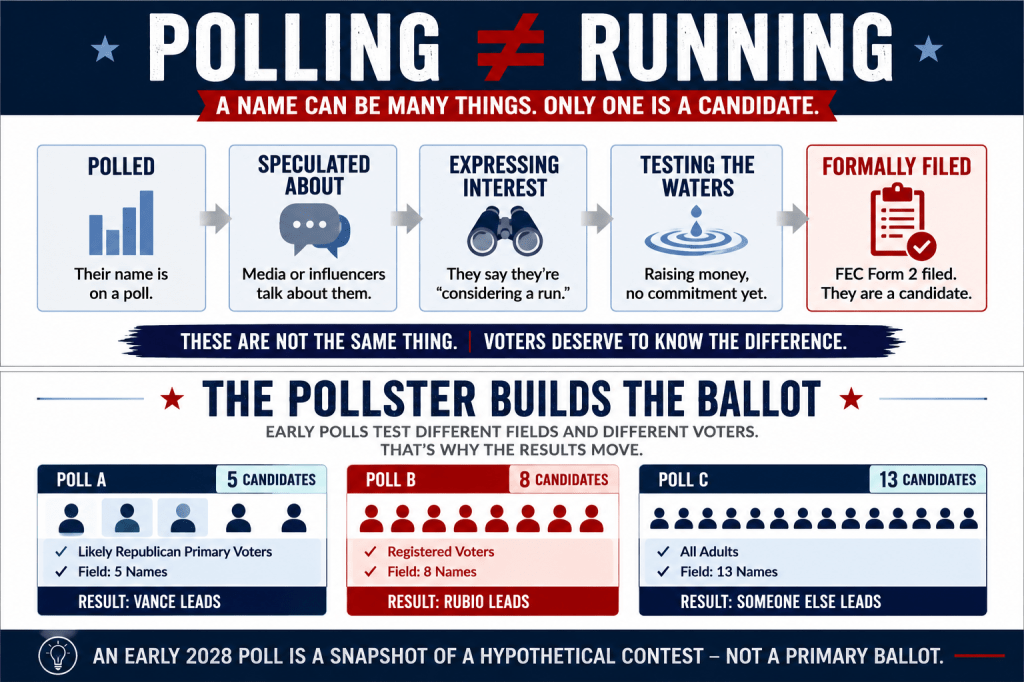
“Primary polling at this stage measures something different from a real primary: name recognition and general favorability among a hypothetical field selected by the pollster.”
That methodology matters because it produces results that can swing sharply between polls released weeks apart, without any change in the underlying “candidates’” public activity. A May Emerson College survey found Vance leading Rubio by roughly a point among likely Republican primary voters; a University of New Hampshire poll around the same time showed a similar gap. But other national surveys in the same window — including from pollsters with explicit partisan affiliations — showed considerably larger margins in either direction. On the Democratic side, five separate surveys since May have shown five different candidates in first place, depending on the pollster, the field tested, and the state.
Sourcing note: some polls circulating in this cycle are conducted by firms with a declared partisan affiliation (for example, McLaughlin & Associates is a Republican-aligned firm; Clarity Campaign Labs is Democratic-aligned). Election Desk treats these as directionally informative but flags them separately from nonpartisan academic and media pollsters, and does not average them into cross-poll comparisons.
The process fight nobody’s voting on yet: the primary calendar
One genuinely consequential process question is already being contested well ahead of any candidate filings: which state votes first. The Democratic National Committee stripped Iowa of its first-in-the-nation caucus status in 2023 and awarded South Carolina the leadoff spot for 2024; that decision is not settled for 2028. New Hampshire Democrats, who have not accepted a secondary role, are pushing to reclaim their traditional first-primary status, and Nevada Democrats have separately launched a bid to go first. DNC Chair Ken Martin said in an August 2025 interview that the party’s Rules and Bylaws Committee — which sets the calendar — would take up the question at a later meeting.
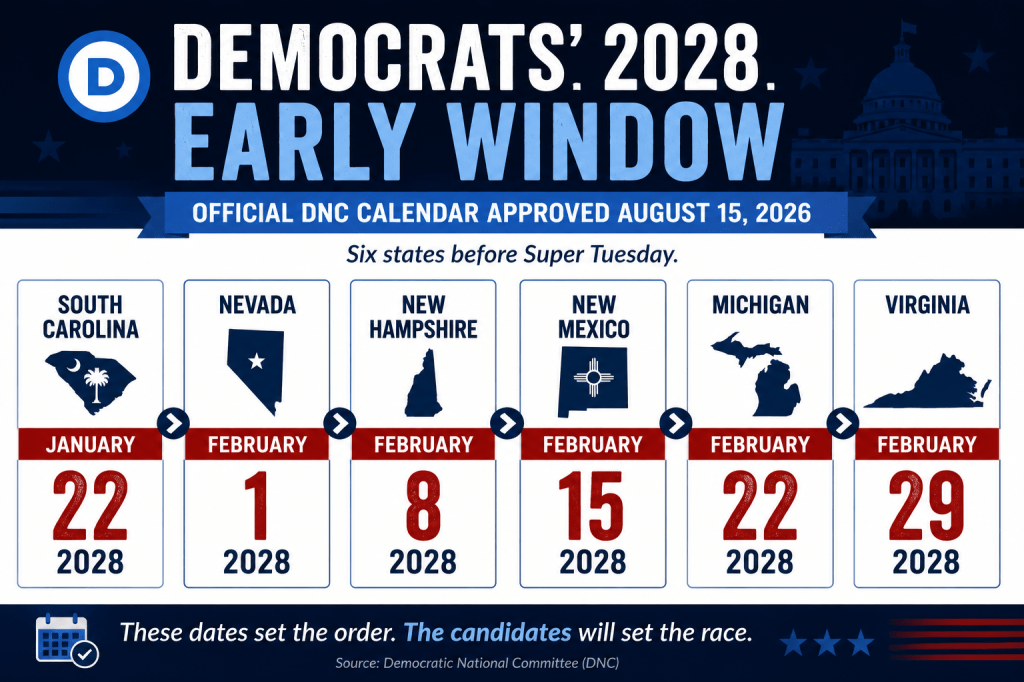
Separately, some DNC members, including Maryland Rep. Jamie Raskin, have raised the idea of using ranked-choice voting in the 2028 Democratic primaries, arguing it would reduce the number of “wasted” votes in a plurality system with a large field. No decision has been made on either the calendar or the voting method.
What’s ahead
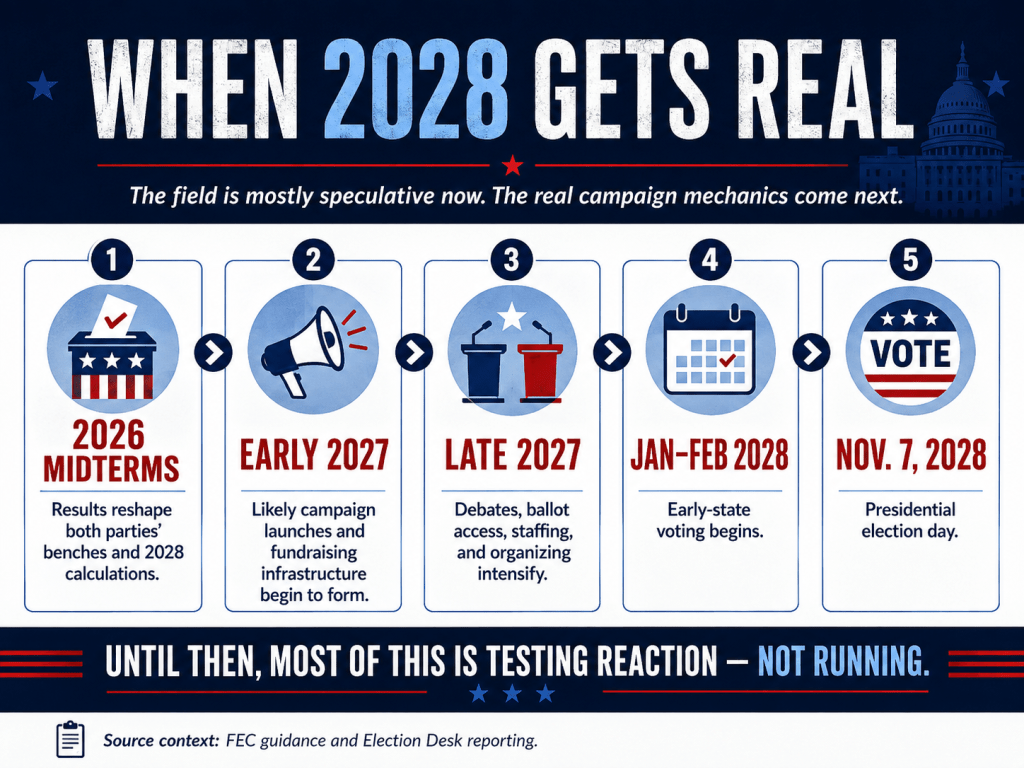
The clearest procedural marker to watch is the 2026 midterms. Several of the Democrats mentioned most often — Govs. Gavin Newsom, Josh Shapiro, and Andy Beshear among them — have said explicitly they won’t make a decision until after November, and Republican speculation is similarly tied to how the midterm results shape Trump’s own posture toward a successor. Under FEC rules, actual campaign infrastructure — committees, disclosed fundraising, ballot-qualification signature drives in early states — typically won’t begin building out until early 2027 at the soonest. Until then, most of what gets reported as 2028 “campaign” news is candidates testing public reaction rather than running.
“Until then, most of what gets reported as 2028 ‘campaign’ news is candidates testing public reaction rather than running.”
For Election Desk’s broader tracking of 2026 midterm races that will shape the 2028 landscape, see our ongoing primary coverage.
Sourcing note: Federal candidate-registration thresholds and filing procedures are drawn from FEC.gov’s official candidate registration guidance. Candidate activity (exploratory committees, statements of interest, denials of interest) is drawn from named outlets including Reuters, the Associated Press, Politico, Axios, NBC News, and NewsNation, with specific attributions in-line where a single claim originates from one source. Polling figures are attributed to the named pollster, field dates, and sample in each case; polls from firms with disclosed partisan affiliation are identified as such and not blended into cross-poll averages. Primary-calendar developments are drawn from DNC officials’ public statements as reported by NBC News and state party chairs’ public comments.


Leave a comment