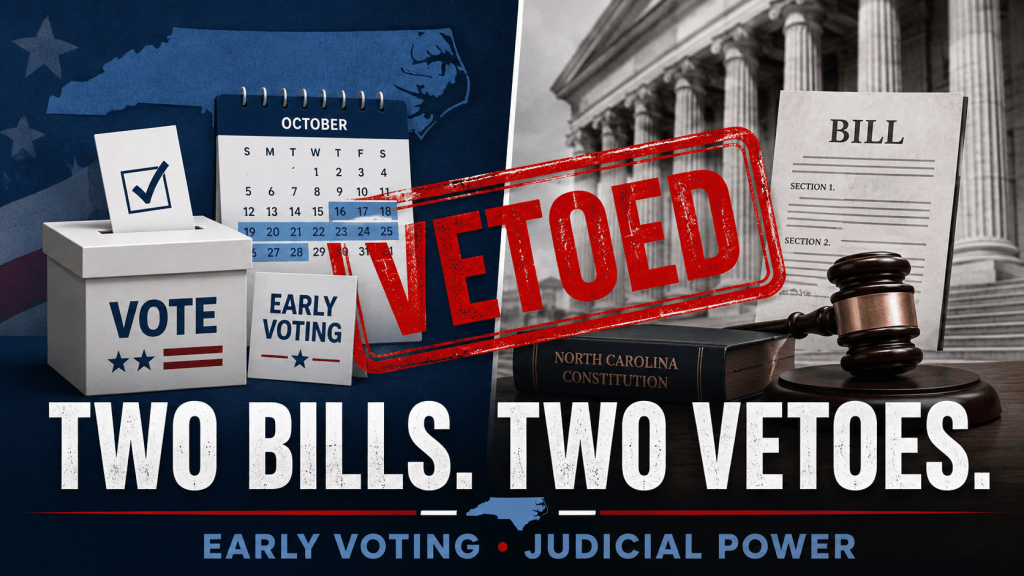
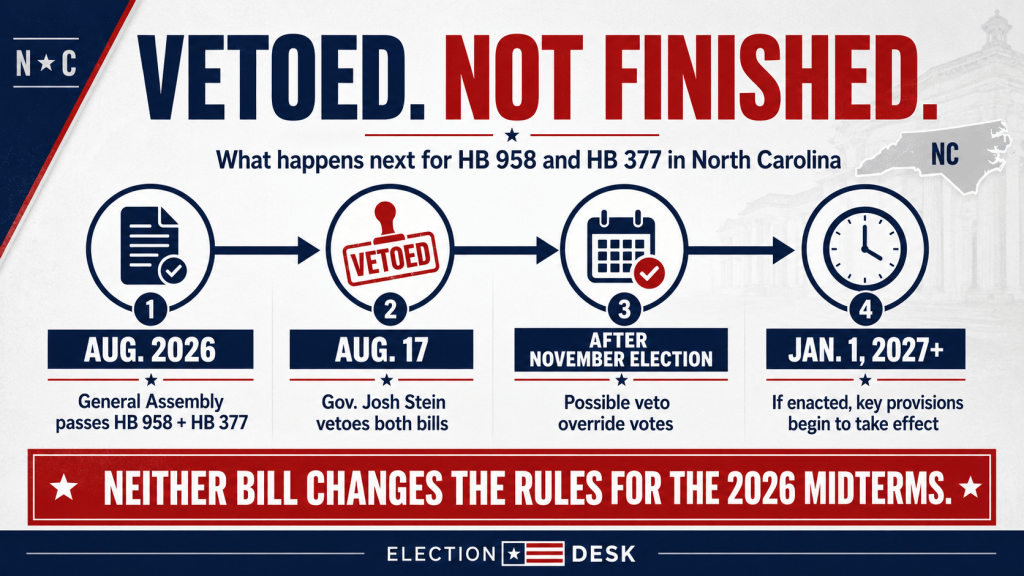
North Carolina Gov. Josh Stein vetoed two Republican-backed bills on Monday, Aug. 17 — one reshaping state election procedures and another expanding the authority of the state Supreme Court’s chief justice over trial judges. Both bills passed the General Assembly on party lines earlier this month, and both now return to a legislature that has said it will not reconvene for substantive business until after the November election.
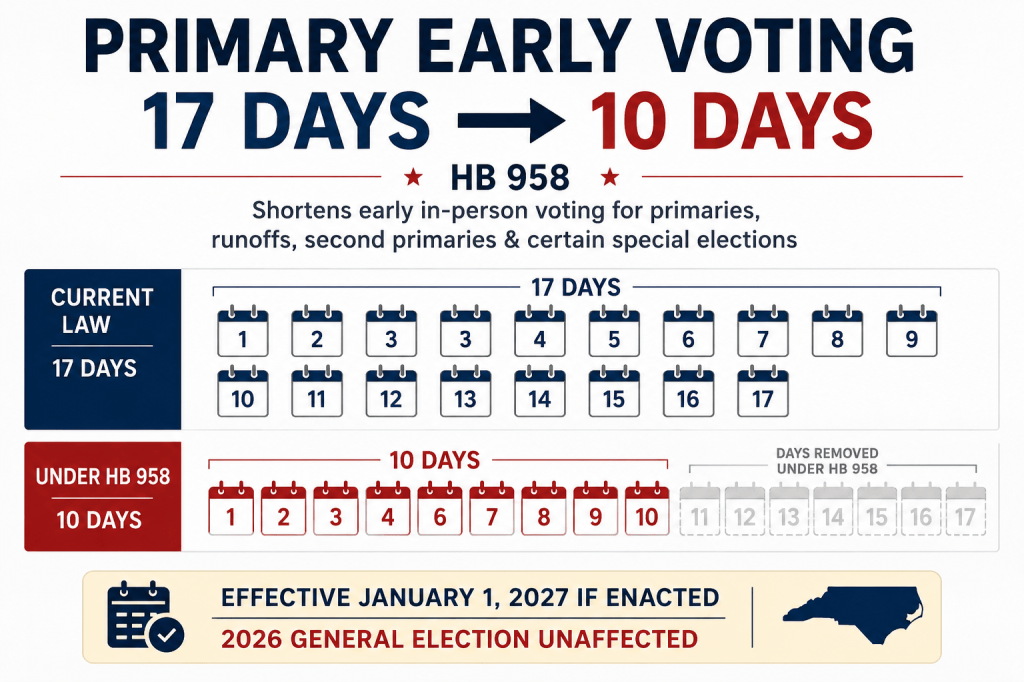
“The early-voting change would cut the primary window from 17 days to 10 — but would not take effect until 2027.”
House Bill 958: Early Voting, Ballot Challenges, Audits
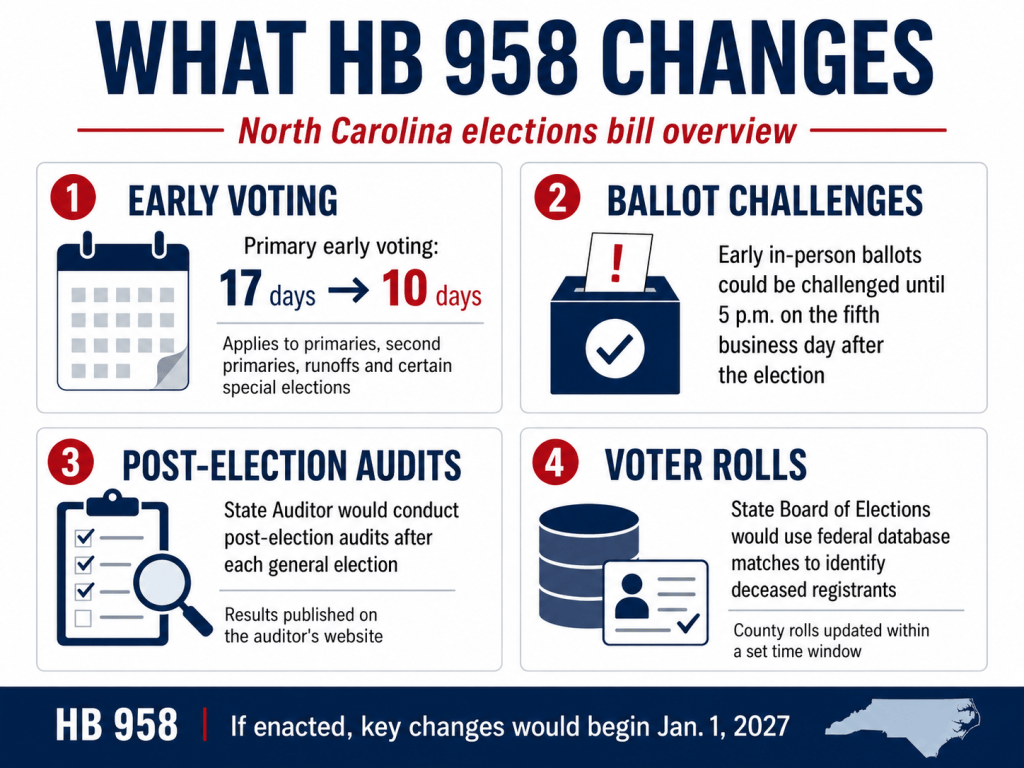
House Bill 958 is a 17-page elections measure that would, if it becomes law:
- Shorten the early in-person voting period for primaries, second primaries, and runoff elections from 17 days to 10 days (the same 10-day period would also apply to congressional-vacancy, special, and municipal elections where early voting is authorized). The change would not apply to general elections and would not take effect in time for the 2026 midterms; it is set to take effect Jan. 1, 2027.
- Allow ballots cast during early one-stop voting to be challenged until 5 p.m. on the fifth business day after the election — the same deadline already in place for mail-in absentee ballots.
- Direct state Auditor Dave Boliek to conduct post-election audits of election systems and controls after each general election, with results published on the auditor’s website. (Several news outlets described this as a rotating six-year, per-county audit cycle; that detail does not appear in the official legislative bill summary and should be verified against full bill text before being repeated as fact.)
- Require the State Board of Elections to use federal database matches to identify deceased registrants and remove them from county voter rolls within a set window.
“The fight over HB 958 is not just about when ballots can be cast. It also reaches ballot challenges, voter-roll maintenance and post-election audits.”
Stein, a Democrat, announced his intent to veto the bill in early August and formalized the veto Monday during a “Protect Our Vote” event at the Executive Mansion in Raleigh. In his veto statement, Stein said the bill “makes it harder for you to vote, introduces unnecessary chaos into our elections, and invites sore losers to try to overturn an election they lost.”
Bill supporters, including House Speaker Destin Hall, R-Caldwell, have said the changes are intended to strengthen election security and administrative efficiency. Republican legislators have argued that a 10-day primary early-voting window is adequate given typically lower primary turnout; Democrats and voting-rights groups countered that primaries often decide who ultimately holds office and that a shorter window could reduce participation. Democracy Docket, an advocacy outlet that focuses on voting-rights litigation and has characterized the bill as “anti-voting,” was among the groups highlighting the ballot-challenge provision, which Democratic lawmakers argued could enable coordinated post-election challenges by losing candidates.
The bill passed the House and Senate along party lines; all Democrats and unaffiliated Rep. Carla Cunningham voted against it. Rep. Hugh Blackwell, R-Burke, chair of the House Election Law Committee, said the bill “continues practical election reforms so we all can have greater confidence that every lawful vote in North Carolina is counted fairly and accurately,” and criticized Stein’s veto as putting “politics ahead of common sense.”
House Bill 377: Chief Justice’s Authority to Suspend Trial Judges
House Bill 377, titled “2026 Court Changes,” is a broader court-procedures bill that includes provisions on e-filing for adoption records, eviction-appeal rules, and clerk authority over uncontested divorces. Its most contested provision would let the state Supreme Court’s chief justice — currently Republican Paul Newby — suspend a district or superior court judge without pay while a Judicial Standards Commission investigation is pending, if the Commission finds a risk of “immediate and irreparable” harm to the public. The bill would also let the Supreme Court modify Judicial Standards Commission disciplinary recommendations rather than only accept, reject, or remand them, as under current law.
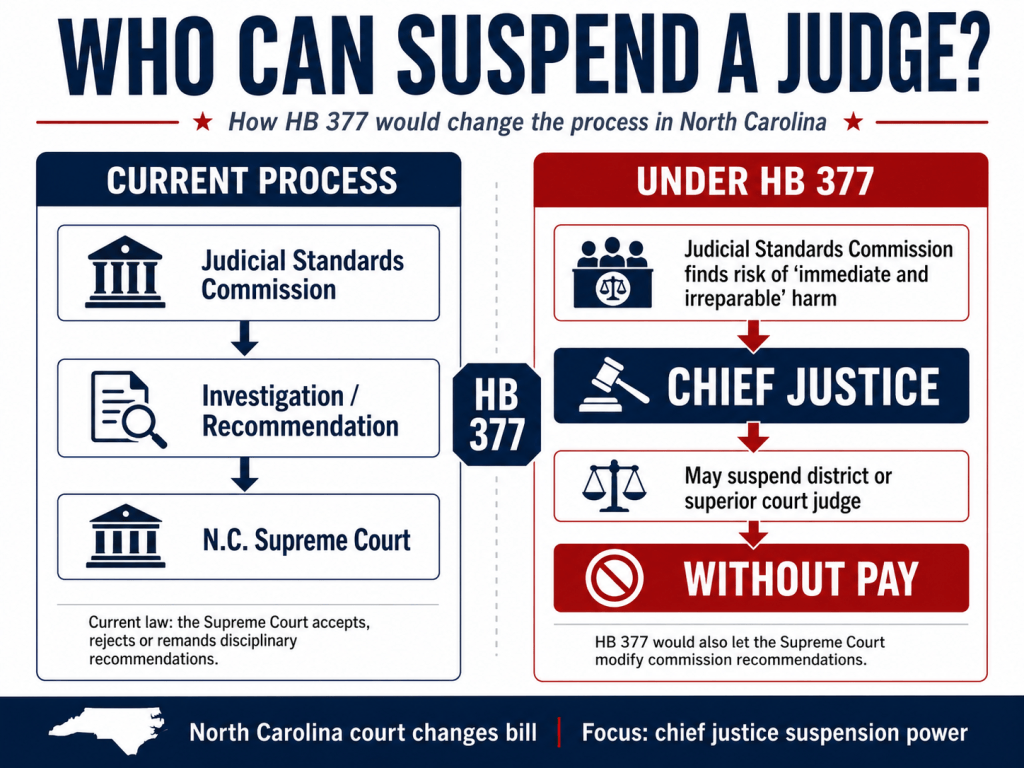
Stein vetoed the bill Monday, calling it a threat to judicial independence. “North Carolina voters elect the vast majority of our judges in our state, and removing judges from their posts should first and foremost be determined by the people,” he said in his veto statement, adding that the Judicial Standards Commission’s role in the process was “cold comfort” given that the chief justice and legislative leaders control most appointments to the commission.
“HB 377 would give North Carolina’s chief justice a power that reaches directly into the tenure of elected trial judges.”
Hall said the provision was needed to hold judges accountable, citing concerns about sentencing decisions in violent-crime cases. He has said Newby should be prepared to use the new authority against judges whose rulings Republicans view as too lenient. A spokesperson for Newby did not respond to multiple media requests for comment on the bill while it was pending.
North Carolina elects the large majority of its trial judges; supporters describe the bill as a check on judicial conduct, while opponents describe it as a mechanism that could be used to pressure judges over the substance of their rulings rather than misconduct.
What’s Ahead
Both bills now return to the General Assembly, which adjourned in early August and does not plan to take up substantive business until after the November election, with a possible return as early as Aug. 31. Hall has said Republicans intend to attempt overrides of both vetoes. Senate Republicans hold a veto-proof, three-fifths supermajority; House Republicans are one seat short of that threshold and would need at least one Democratic or unaffiliated member to join them to override either veto in that chamber.
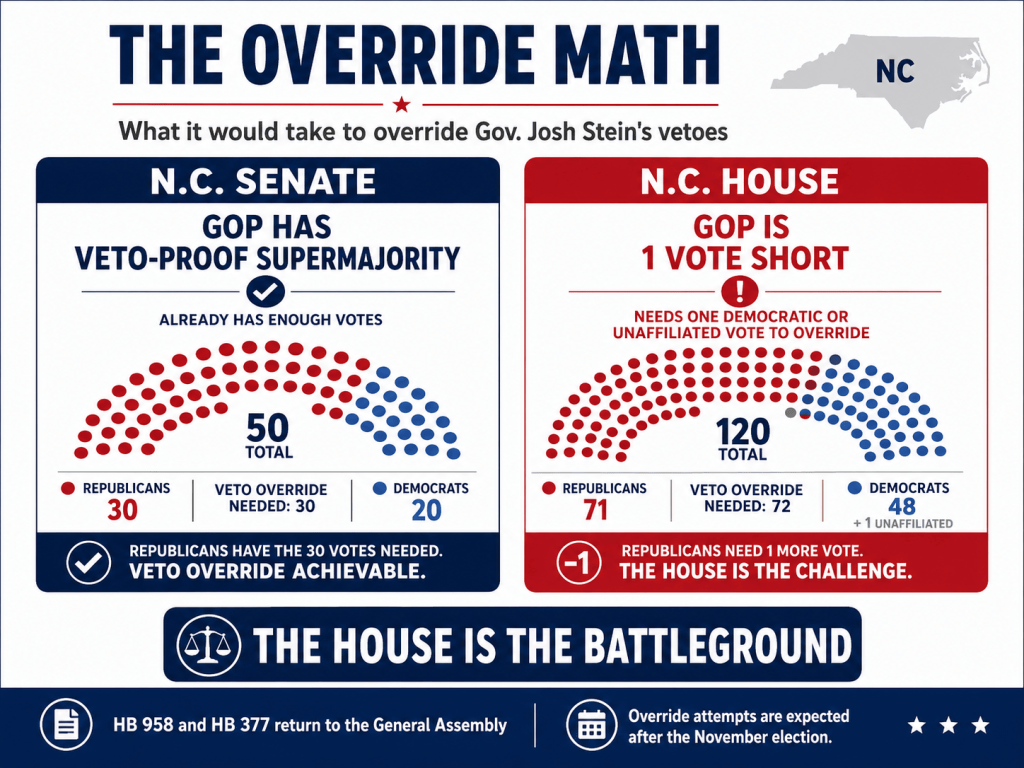
Carolina Public Press, an independent nonprofit outlet, has reported that Republicans are considered more likely to secure the House votes to override the HB 377 veto than the HB 958 veto — that assessment should be treated as one outlet’s analysis of the vote math rather than a settled outcome, since no override vote has yet occurred. Because neither bill would take effect before the 2026 midterms regardless of the override outcome, the immediate practical effect on this year’s elections is limited; the bills’ fate will determine the rules in place for the 2027–2028 election cycle, including the 2028 elections for three state Supreme Court seats, among them the seat currently held by Newby.
“The Senate has the votes to override Stein on its own. The House does not.”
For ongoing coverage of North Carolina’s 2026 election cycle and related litigation, see Election Desk’s North Carolina overview.
Sourcing note: This article draws on Gov. Stein’s official veto statements published by the North Carolina governor’s office (governor.nc.gov), the nonpartisan Legislative Analysis Division’s official bill summary for HB 958 (7th edition, ncleg.gov dashboard), contemporaneous reporting from WRAL, WUNC, WFAE, WHQR, NC Newsline, and Carolina Public Press (nonprofit/NPR-affiliated outlets), the Carolina Journal (a conservative-leaning outlet, cited here only for bill-text details and directly attributed Republican statements), and Yahoo/wire aggregation of AP-style reporting. Republican leadership statements are drawn from Speaker Destin Hall’s and Rep. Hugh Blackwell’s public statements as reported by multiple outlets.


Leave a comment