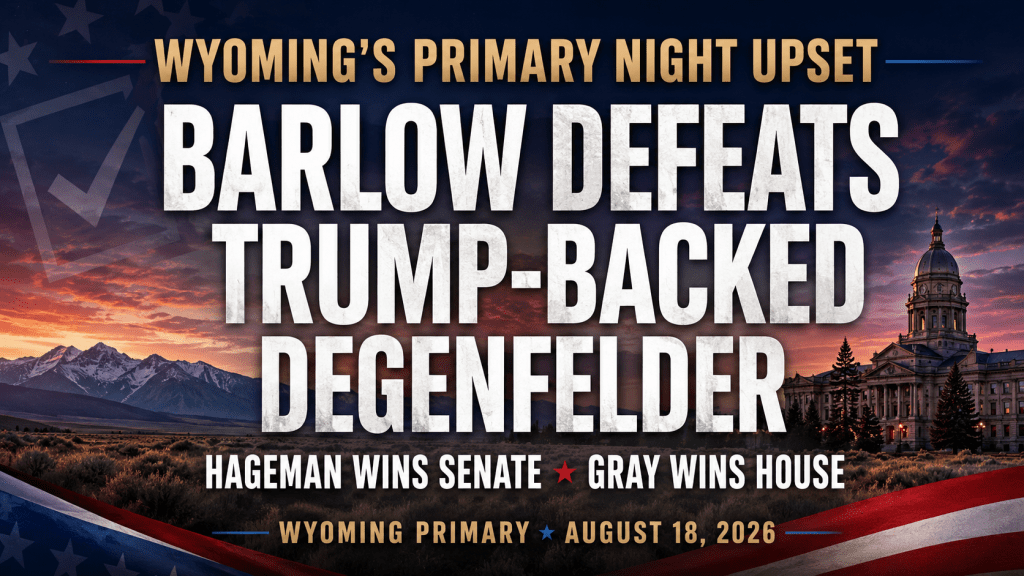
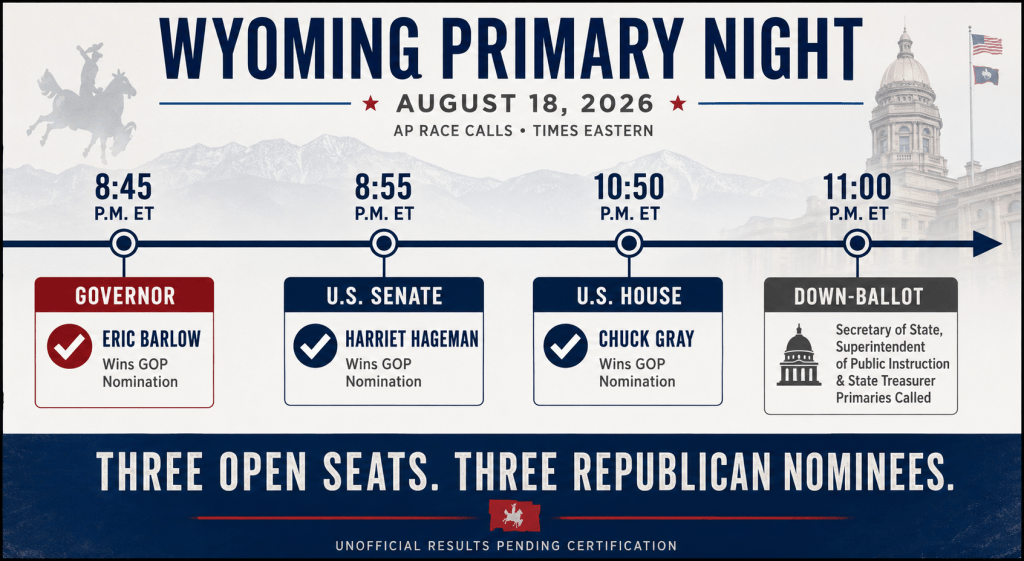
Wyoming’s first three-way open race for governor, Senate and House in 32 years produced one significant upset Tuesday, as state Sen. Eric Barlow defeated President Trump’s endorsed candidate for the Republican gubernatorial nomination.
Wyoming Republicans and Democrats voted Aug. 18 to fill an unusually large slate of open seats, set off by term-limited Gov. Mark Gordon’s departure, Sen. Cynthia Lummis’s retirement, and Rep. Harriet Hageman’s decision to run for Lummis’s seat rather than seek reelection to the U.S. House. The result was Wyoming’s first simultaneous open-seat race for governor, U.S. Senate and U.S. House since 1994, spread across a ballot that also included contested primaries for secretary of state, superintendent of public instruction and state treasurer.
Hageman and Wyoming Secretary of State Chuck Gray won their respective Republican nominations as expected. The night’s clearest upset came in the governor’s race, where Barlow, a state senator and veterinarian from Gillette, defeated both President Donald Trump’s endorsed candidate, State Superintendent of Public Instruction Megan Degenfelder, and the Wyoming Republican Party’s own endorsed candidate, retired Marine Corps Col. Brent Bien.
“The night’s clearest upset came in the governor’s race, where Barlow defeated both President Donald Trump’s endorsed candidate and the Wyoming Republican Party’s own endorsed candidate.”
Governor: Barlow defeats both Trump’s pick and the state party’s pick
Barlow won the four-candidate Republican primary with 45% of the vote, according to the Associated Press, with 99% of precincts reporting. Degenfelder finished second with 29.7%, followed by Bien with roughly 24% and professional bull rider Curt Blake with a small remaining share. The AP called the race for Barlow shortly before 9 p.m. with only about a fifth of the vote counted.
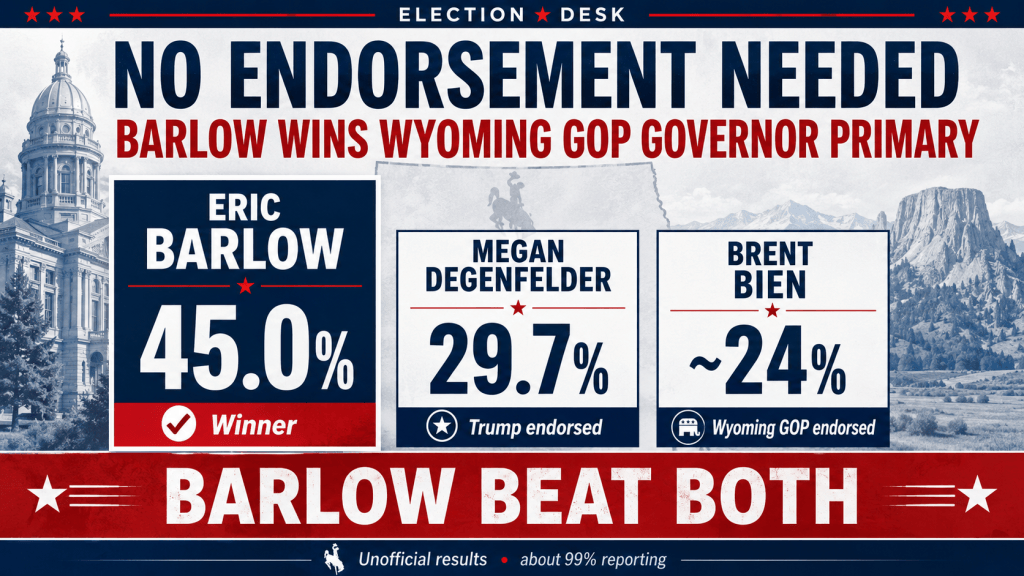
The result was notable chiefly for the split, and ultimately unsuccessful, nature of the party’s institutional backing. Trump endorsed Degenfelder, and the Wyoming Republican Party’s central committee endorsed Bien; Barlow secured neither. Barlow instead led the field in fundraising, collecting roughly $1.54 million in contributions and carried-over funds — about $380,000 more than Degenfelder — with 96% of his money coming from individual donors rather than loans or political action committees, according to a WyoFile analysis of campaign finance filings. Degenfelder drew the most PAC money in the race, including $290,000 from the group Fight Wyoming Fight, and financed part of her campaign through $522,000 in loans, most of it from her father.
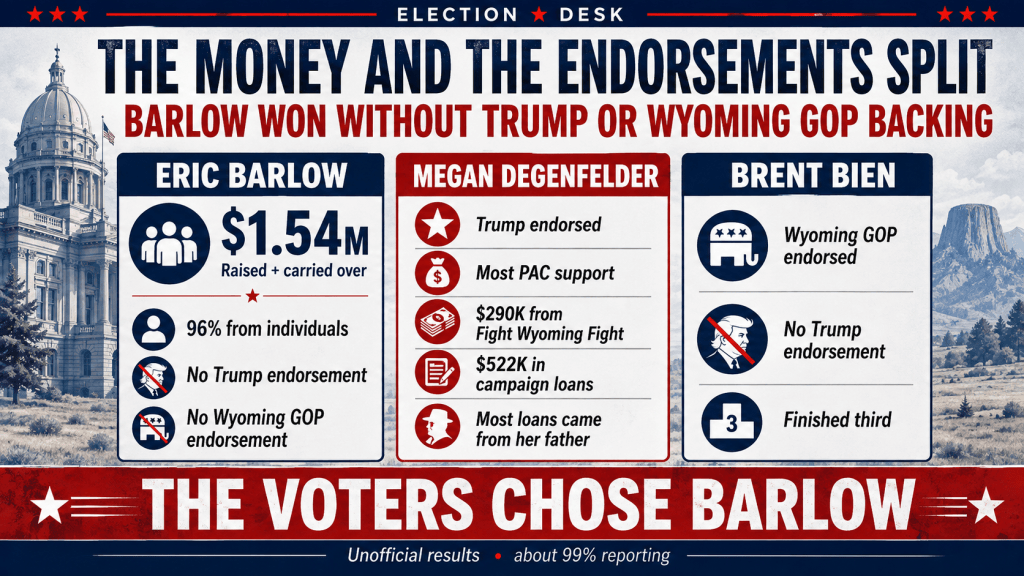
“Out-of-state money and outside voices tried to tell Wyoming how to vote.”
— Eric Barlow
Barlow, a rancher and former Wyoming House speaker who has served in the Legislature since 2013, campaigned on property tax reduction, energy development and expanded rural health care access. In a statement Tuesday night, he said “out-of-state money and outside voices tried to tell Wyoming how to vote” throughout the campaign. Degenfelder, conceding, thanked supporters and said she was “deeply grateful to the thousands of neighbors, friends, supporters, volunteers, and people who love Wyoming.”
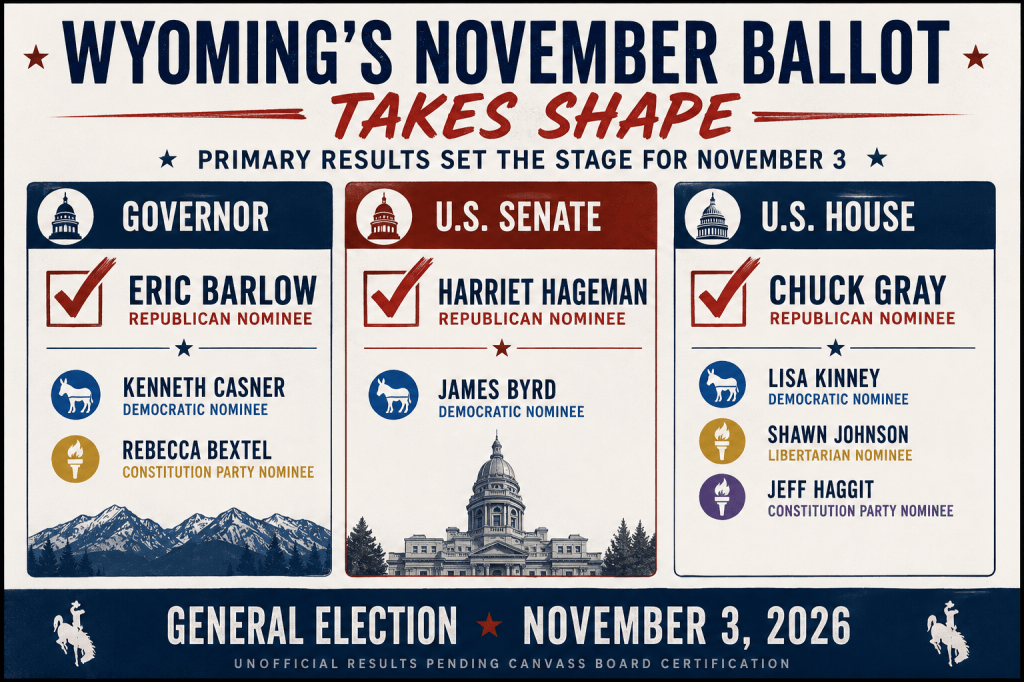
Barlow will face Democrat Kenneth Casner, who ran unopposed, and Constitution Party nominee Rebecca Bextel in the Nov. 3 general election. Wyoming Democrats have not won a statewide race since 2006.
U.S. Senate: Hageman wins big to succeed Lummis; Byrd wins Democratic side
Hageman, seeking to move from the U.S. House to the Senate seat Lummis is vacating, won the five-candidate Republican primary with 64.9% of the vote (83,794 votes) against four lesser-funded challengers: former Kirby Mayor Sam Mead, who finished second with 27.8% (35,875 votes); and Jimmy Skovgard, Jill Edwards and John Holtz, who each drew low single-digit shares. The AP called the race before 9 p.m., with roughly a quarter of the vote counted.
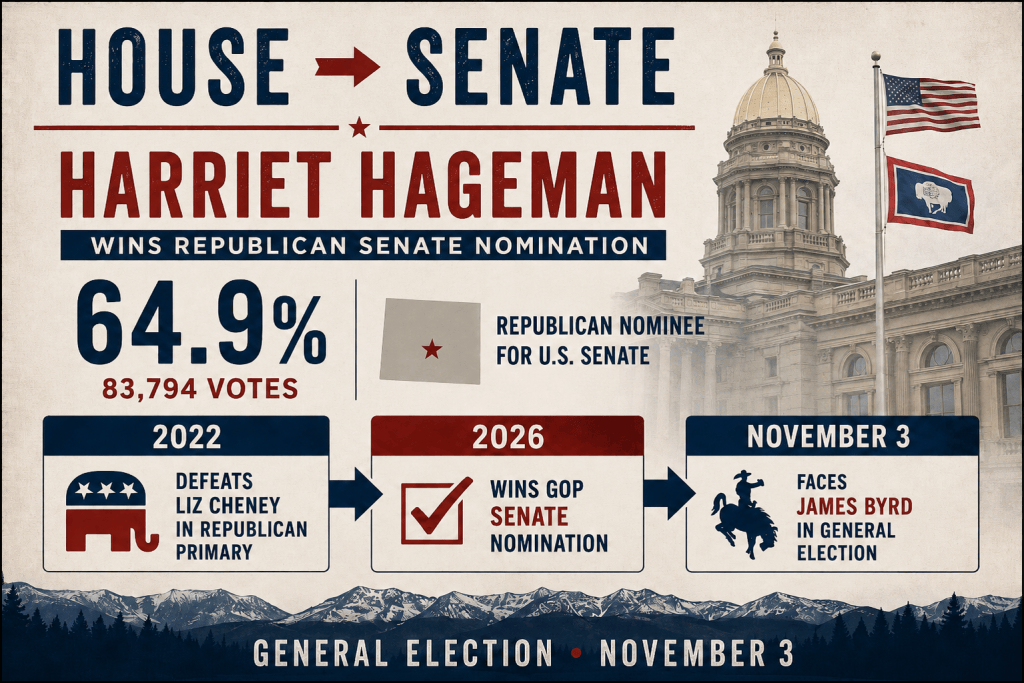
Hageman, who first won her House seat in 2022 by defeating then-Rep. Liz Cheney in a primary Trump backed after Cheney’s vote to impeach him, had the endorsement of Trump, Sen. John Barrasso and the retiring Lummis. Mead, whose great-grandfather Cliff Hansen served as both Wyoming governor and U.S. senator and whose uncle Matt Mead was governor from 2011 to 2019, ran on a platform criticizing what he described as Congress’s insufficient pushback against executive-branch overreach.
On the Democratic side, former state Rep. James Byrd defeated Billy Benavidez, 79.3% to 20.7%. Byrd, the son of the first Black woman to serve in the Wyoming Legislature, will face Hageman in November; Wyoming has not sent a Democrat to the U.S. Senate since 1970, and Trump carried the state by roughly 46 points in 2024, his largest margin in any state.
“Hageman won 64.9% of the Republican Senate vote as she moved from Wyoming’s lone House seat toward the seat Cynthia Lummis is vacating.”
U.S. House: Gray edges a nine-candidate field in the most expensive race on the ballot
The race to succeed Hageman in Wyoming’s lone U.S. House seat drew the most expensive primary field in the state this cycle, with several candidates relying on large personal loans to their campaigns. Gray, Wyoming’s secretary of state since 2023, won with 25.4% of the vote (31,222 votes) in a nine-candidate field, narrowly ahead of businessman and philanthropist Steve Friess at 20.4% (25,054 votes) and retired Bureau of Land Management employee Kevin Christensen at 17.6%. The remaining candidates — former Superintendent of Public Instruction Jillian Balow (10.3%), businessman Reid Rasner, Army veteran David Giralt, state Senate President Bo Biteman, former legislator Keith Goodenough and Richard Dodson — each finished at 10% or less. The AP called the race for Gray shortly before 11 p.m., with about 81% of the vote counted.
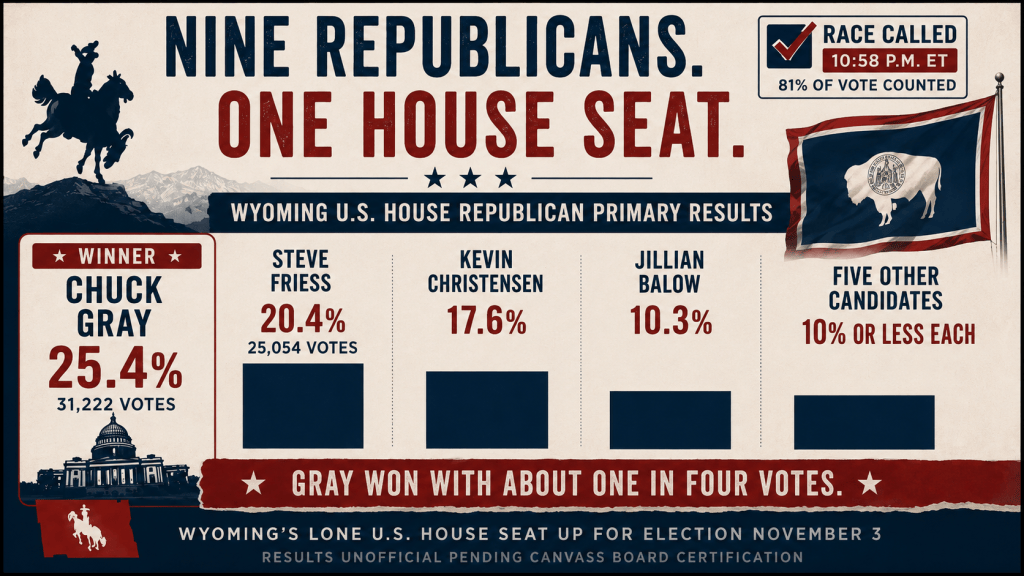
Neither Trump nor Hageman endorsed in the race. Gray, Friess and Rasner each loaned their own campaigns over $1 million; Gray’s campaign was also boosted by roughly $519,000 in outside spending from a PAC funded by his father. Gray previously launched a brief primary challenge to Cheney in 2021 before withdrawing after Trump endorsed Hageman instead.
“Chuck Gray won a nine-candidate Republican primary with just 25.4% of the vote.”
On the Democratic side, former state Senate Minority Leader Lisa Kinney defeated Lander newcomer Elena Del Real, 77.9% to 22.1%. Gray will face Kinney, Libertarian nominee Shawn Johnson and Constitution Party nominee Jeff Haggit in November; the seat is considered safely Republican.
Down-ballot: three more statewide offices go to contested Republican primaries
Wyoming voters also settled contested Republican primaries for secretary of state, superintendent of public instruction and state treasurer, all open seats.
Robert Short, a Converse County commissioner, won the Republican nomination for secretary of state with 45.6% of the vote, defeating state Rep. Rachel Rodriguez-Williams, R-Cody, who chairs the Wyoming Freedom Caucus and had the state party’s endorsement; she finished with 33%. Short will face Democrat Bryan McCarty, who ran unopposed, and Constitution Party candidate Tamara Trujillo in November.
In the race to succeed Degenfelder as superintendent of public instruction, Republican Steve Harshman led a three-candidate field with 57.9% of the vote, ahead of state Rep. Tom Kelly at 31.3% and Chad Auer at 10.8%. On the Democratic side, Ana Cordova defeated Sergio Maldonado Sr., 62.9% to 37.1%.
Incumbent state Treasurer Curt Meier turned back a primary challenge from state Rep. Scott Smith, 68.3% to 31.8%; no Democrat filed for the office. State Auditor Kristi Racines was unopposed.
Ahead
“Wyoming’s first simultaneous open races for governor, U.S. Senate and U.S. House in 32 years produced one major upset at the top of the ticket.”
Results remained officially unofficial as of this writing, pending certification by county and state canvassing boards; the AP’s reported vote counts for most statewide races stood at 99% of precincts as of Wednesday morning. Wyoming Senate and House legislative primaries — several of which pitted Freedom Caucus-aligned incumbents against more centrist challengers — were decided the same night and will be covered separately once full results are confirmed. All primary winners advance to the Nov. 3 general election, where Wyoming’s heavily Republican statewide electorate makes GOP nominees strong favorites in most races, with the governor’s and Senate races drawing the most attention given the scale of Tuesday’s upset in the top of the ticket.
Sourcing and methodology note
Vote totals and percentages in this article are drawn primarily from a single Associated Press results roundup published by the Wyoming Tribune Eagle on the evening of Aug. 18, 2026, which reported figures at approximately 99% of precincts counted for the Governor, U.S. Senate, U.S. House, secretary of state, superintendent of public instruction and state treasurer primaries; this was cross-referenced against parallel reporting from WyoFile, Wyoming Public Media, Cowboy State Daily and Oil City News, which was largely consistent apart from minor differences reflecting earlier snapshots in the count (for example, Bien’s exact governor-primary vote share was not restated in the final AP roundup and is calculated here from raw vote totals reported separately by Cowboy State Daily). Campaign finance figures for the governor’s race are drawn from a WyoFile analysis of filings with the Wyoming Secretary of State’s office. Historical claims (Wyoming’s Senate voting history, the 2022 Hageman-Cheney primary, the scale of Trump’s 2024 margin in the state) are drawn from Associated Press, Fox News and Wyoming Public Media reporting cited above. Results throughout this article are unofficial pending canvassing board certification.


Leave a Reply