Florida voters set the November ballot Tuesday in a primary shaped by a court-tested congressional map, an appointed U.S. senator seeking her first electoral win, and a wave of incumbent losses nationally that reached the state’s 7th Congressional District.
Florida Republicans and Democrats went to the polls Aug. 18 to select nominees for governor, a U.S. Senate special election, and all 28 U.S. House seats, along with down-ballot statewide and legislative races. The primary closed out a campaign season defined by term-limited Gov. Ron DeSantis’s exit, a new congressional map drawn during an April special session, and a national pattern of primary voters ousting sitting members of Congress.
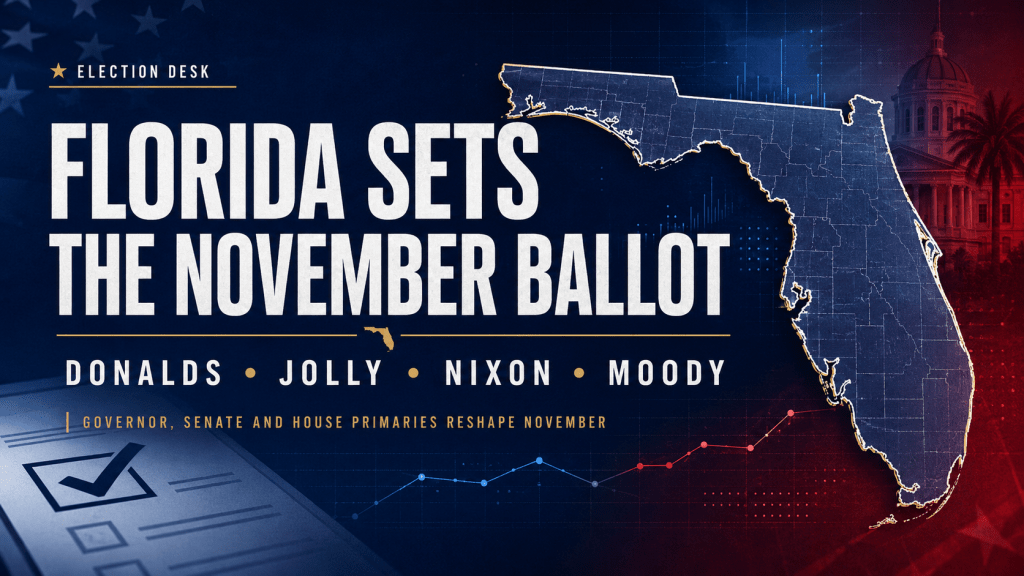
U.S. Rep. Byron Donalds and former U.S. Rep. David Jolly won their parties’ nominations for governor. Appointed U.S. Sen. Ashley Moody won renomination on the Republican side of the Senate special election, while state Rep. Angie Nixon defeated better-funded rival Alex Vindman for the Democratic nomination. In the U.S. House, Republican Rep. Cory Mills of the 7th District lost his renomination bid amid ongoing House Ethics Committee and Justice Department investigations, while Democratic Reps. Debbie Wasserman Schultz and Jared Moskowitz held off primary challengers in newly configured districts.

Governor: Donalds and Jolly head to a competitive November
Donalds, a three-term congressman from Naples who serves on the House Financial Services Committee and the House Oversight and Government Reform Committee, won the Republican nomination with 47.8% of the vote with 99% of precincts reporting, according to the Associated Press. He defeated Lt. Gov. Jay Collins, former Florida House Speaker Paul Renner and businessman James Fishback in a field of 11 Republican candidates. The AP called the race shortly after 8 p.m. ET.
Donalds entered the race as the clear front-runner after receiving President Donald Trump’s endorsement early in the campaign and built a substantial fundraising advantage over his rivals. State campaign finance reports showed Donalds’s campaign and political committee raising roughly $10.2 million in a recent three-month stretch, more than 10 times the roughly $1 million Jolly’s campaign had raised since entering the race in late April — figures drawn from different reporting periods but indicative of a wide overall gap. DeSantis did not endorse in the primary. Collins, DeSantis’s own lieutenant governor and the beneficiary of the governor’s public support, ran a distant second in most public polling.
Jolly, a former Republican member of Congress from the Tampa Bay area who left the party and became a Democrat, won the Democratic nomination with 61% of the vote with 99% reporting, defeating former state Rep. Dottie Joseph and four other Democratic candidates in a six-candidate field. Jolly’s clearest potential rival for the nomination, Orange County Mayor Jerry Demings, suspended his campaign in June after disclosing a cancer diagnosis. Jolly is the second consecutive Florida Democratic gubernatorial nominee to be a former Republican, following 2022 nominee Charlie Crist.
The Donalds-Jolly matchup sets up a test of whether Florida’s rightward shift over the past decade — Trump carried the state by 13 points in 2024, and Republicans hold every statewide office and both legislative chambers — extends to a genuinely competitive governor’s race, or whether Democrats can be competitive in a midterm environment. Public polling through the summer showed a range of outcomes, from single-digit Donalds leads to contests within the margin of error; a University of North Florida poll released in the campaign’s final weeks put Donalds ahead of Jolly 46% to 41%.
“Florida’s rightward shift now faces a different test: whether it extends to an open governor’s race in a midterm year.”
U.S. Senate special election: Nixon’s upset headlines the Democratic side
The Senate race was a special election for the final two years of the six-year term Marco Rubio won in 2022, before he resigned to become secretary of state. DeSantis appointed Moody, then serving as state attorney general, to the seat in January 2025. Tuesday’s primary was Moody’s first time appearing before Senate voters.
Moody won the Republican primary with just under 80% of the vote, according to results reported at the time the Democratic race was called, defeating Army veteran Chris Gleason, physician Neelam Perry and minister Ernie Rivera.
On the Democratic side, Nixon, a Jacksonville state representative and member of the Democratic Socialists of America, defeated Vindman, a retired Army lieutenant colonel and former National Security Council aide, by a margin of 55.7% to 44.3% with 88% of the vote counted, according to the AP. Nixon’s roughly 660,000 votes outpaced Vindman’s approximately 530,000.
The result was notable chiefly for the financial mismatch between the candidates. Vindman, who gained national prominence testifying in President Trump’s first impeachment inquiry in 2019, raised $16.27 million through July 29 and entered the primary’s final stretch with $7.26 million still on hand, according to FEC filings. Nixon raised just under $975,000 over the same period and had roughly $265,000 in cash on hand. Nixon carried endorsements from U.S. Reps. Maxwell Frost, Ilhan Omar, Rashida Tlaib and Ayanna Pressley, along with a bloc of Florida legislative Democrats; Vindman did not agree to debate her during the primary.
“Nixon raised just under $975,000. Vindman raised $16.27 million.”

Florida Democrats have not won a U.S. Senate race in the state since 2012, and Republicans have not lost a Senate general election there since. Vindman posted a statement Tuesday night saying he would support Nixon’s campaign heading into November.
“Florida Democrats have not won a U.S. Senate race in the state since 2012.”
U.S. House: an incumbent falls in FL-07, and a redrawn map reshapes South Florida contests
House primaries played out against the backdrop of a new congressional map that the Florida Legislature passed in an April special session and DeSantis signed into law May 4. The map is expected to produce a 24-4 Republican-to-Democratic split among Florida’s 28 seats, redrawing four previously Democratic-held districts into Republican-leaning territory. That redistricting shaped several of Tuesday’s most closely watched primaries, particularly in South Florida.

“The new congressional map is expected to produce a 24-4 Republican-to-Democratic split.”
FL-07 (Volusia/Seminole area): Rep. Cory Mills, seeking a third term, lost the Republican nomination to Ryan Elijah, a former local television news anchor, by a margin the AP and NBC News reported at roughly 46% to 34% with the bulk of the vote counted. Mills has faced a House Ethics Committee investigation into allegations of sexual misconduct and campaign finance violations, along with a separate Justice Department inquiry into his finances; he has denied wrongdoing. Trump endorsed Mills in February but left him out of a round of endorsements for other Florida House Republicans posted in the campaign’s final days, and DeSantis said publicly he did not support Mills’s renomination. Elijah was endorsed by Florida GOP Reps. Anna Paulina Luna and Mike Haridopolos and will face Democratic nominee Bale Dalton in a district Trump carried by 12 points in 2024. Analysts had said Mills’s renomination would have given Democrats a stronger opening in the district; Mills’s loss is expected to keep the seat more solidly Republican-leaning heading into November. Mills is the 11th sitting House member — seven Democrats and four Republicans — to lose a primary this cycle, according to Brookings Institution tracking cited by CNN, the highest total in a non-redistricting year since 1948.
“Mills is the 11th sitting House member to lose a primary this cycle.”

FL-20 (Broward/Miami-Dade, new district): Rep. Debbie Wasserman Schultz, whose previous district was redrawn into Republican-leaning territory under the new map, ran instead in the open 20th District — a longtime Black-majority seat vacated by former U.S. Rep. Sheila Cherfilus-McCormick, who resigned after being indicted on charges related to alleged theft of COVID-relief funds. Cherfilus-McCormick has denied wrongdoing and was also a candidate on Tuesday’s ballot, seeking to reclaim the seat. Wasserman Schultz won the Democratic primary with 45.3% of the vote in a five-candidate field that also included Dale Holness, who finished second with 23.1%, Cherfilus-McCormick, and 2 Live Crew founder Luther Campbell. Wasserman Schultz’s decision to run in the district drew criticism from some Black Democratic officials in the run-up to the primary. She will face Republican nominee Brent Andersen in November.
FL-25 (Broward/Palm Beach/Miami-Dade): Rep. Jared Moskowitz won renomination with 63.5% of the vote against Oliver Larkin, a former union organizer running to Moskowitz’s left, who took 36.5%. Moskowitz will face Republican nominee Scott Singer in a district considered competitive in November.
FL-27 (Miami-Dade): Republican Rep. Maria Elvira Salazar won her primary against attorney V. Michael Arias and will face Democratic nominee Eliott Rodriguez, a former television news anchor who defeated former federal prosecutor Robin Peguero for the Democratic nomination.
FL-24 (Miami-Dade/Broward): Oliver Gilbert III won a seven-candidate Democratic primary in the heavily Democratic, open district; he will face Republican nominee T.E. Brown in November.
FL-22: Pia Dandiya won the Democratic primary with 68.6% of the vote; Casey Askar won a multi-candidate Republican primary with 30.9%.
FL-26: Both parties’ nominees, Republican Rep. Mario Diaz-Balart and Democrat Nicole Locklin, ran unopposed in their primaries.

Ahead
Full, precinct-level canvass results from Florida’s 67 county supervisors of elections had not yet been certified as of this writing; several races, including the Democratic Senate primary and the FL-07 Republican primary, were reported at less than 100% of the expected vote at the time this article was prepared, and vote shares in those contests may shift modestly before certification. The U.S. Justice Department deployed election monitors to polling sites in Miami-Dade County on primary day; Election Desk has not independently confirmed the scope or stated purpose of that deployment and will follow up separately. General election matchups in several additional U.S. House and state legislative primaries, along with the Florida Cabinet races for chief financial officer and commissioner of agriculture, were finalized Tuesday and will be covered separately.
Sourcing and methodology note
Vote percentages and “percent reporting” figures in this article are drawn from Associated Press vote counts as relayed by NBC News, CNN, CBS News Miami, the Tampa Bay Times, Florida Phoenix and NPR/WUSF reporting published between the evening of Aug. 18 and midday Aug. 19, 2026. Where outlets reported slightly different topline percentages for the same race at different points in the count (for example, Governor-race Republican primary figures ranging from roughly 47.8% to 49% across outlets and timestamps), this article uses the AP-sourced figure closest to full reporting. The FL-07 Republican primary is a similar case: NBC News reported Elijah leading Mills 46%–34% at more than 80% of the expected vote counted; Roll Call reported 47%–34% at more than 95% counted; RedState reported 47%–31% at 93% of precincts reporting. This article uses the NBC figure as the most recently updated at time of writing, but readers should treat the Mills-Elijah margin as provisional, likely in a range of roughly 12 to 16 points, pending certification. Fundraising figures for the U.S. Senate Democratic primary are drawn from FEC filings through July 29, 2026, as reported by Florida Phoenix; the Governor’s-race fundraising comparison draws on two non-identical reporting windows (Donalds’s trailing three months vs. Jolly’s fundraising since entering the race in late April), as disclosed in the text above. Congressional redistricting figures (the 24-4 projected partisan split) are drawn from Wikipedia’s aggregation of Cook Political Report, Inside Elections and Sabato’s Crystal Ball ratings, cross-referenced against contemporaneous reporting on the April 2026 special session map. Byron Donalds’s committee assignments were confirmed directly against clerk.house.gov and his official House website rather than campaign materials. Candidate vote totals for minor candidates receiving less than 5% in multi-candidate fields are omitted from the accompanying chart and from most in-text figures; where this article states a race is not yet fully counted, readers should treat all associated percentages as provisional pending certification. No partisan-affiliated or campaign-commissioned polling is cited in this article; all polling references describe independent academic or media-commissioned surveys (University of North Florida Public Opinion Research Lab, Emerson College) and are clearly attributed by name.
For continuing coverage of Florida’s 2026 election cycle, see Election Desk’s Florida overview page.


Leave a comment