Alaska’s nonpartisan top-four primary sent a clearer signal in its U.S. Senate and House races Tuesday than in a 17-candidate governor’s contest, where the final two of four general-election slots remained uncalled as counting continued into Wednesday.
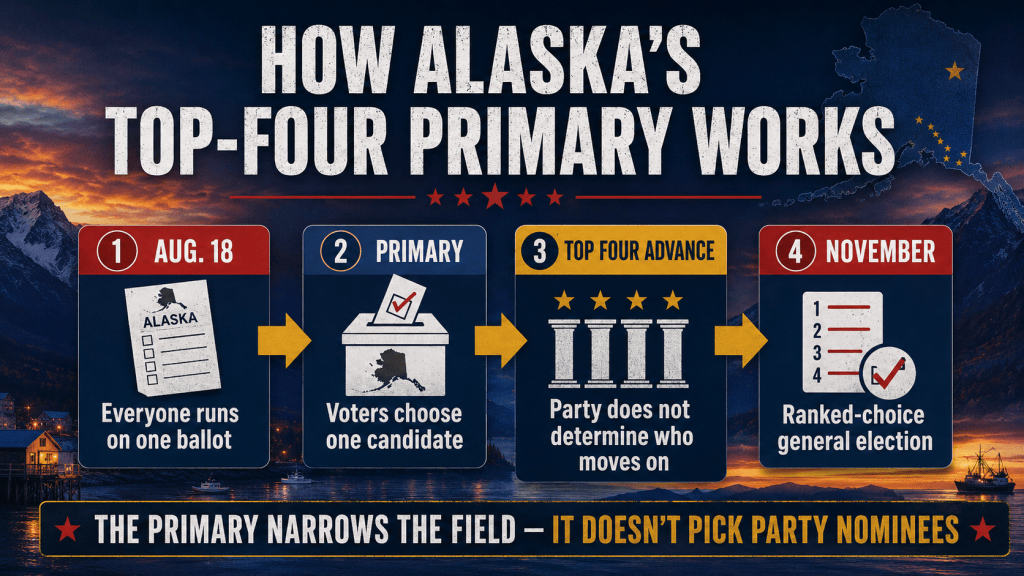
Alaska held its statewide primary Aug. 18 alongside Wyoming, voting on an open governor’s race, a competitive U.S. Senate primary, the state’s lone U.S. House seat, 50 of the state Legislature’s 60 seats, and a ballot measure to reinstate limits on campaign contributions. Under the nonpartisan blanket primary system Alaska voters adopted in 2020, all candidates for a given office appear together on one ballot regardless of party, and the top four vote-getters advance to a ranked-choice general election in November — meaning Tuesday’s results determine which candidates move on, not outright nominees.
Counting continues through Aug. 28, the deadline for postmarked absentee ballots to arrive, with certification set for Aug. 31. As of Wednesday morning, the Associated Press had called two of the four advancing slots in the governor’s race and both leading candidates in the Senate and House races, but final fields in all three contests remained subject to change as additional ballots are processed.
“Tuesday’s results determine which candidates move on, not outright nominees.”
Governor: two Democrats lead an unusually large Republican field, with two seats still contested
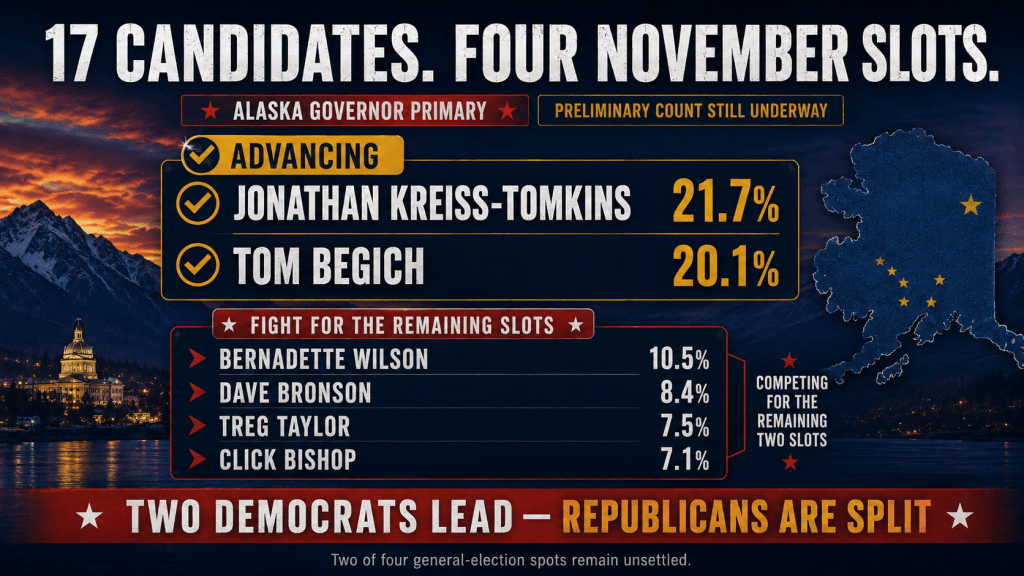
Seventeen candidates — two Democrats, twelve Republicans and three independents — ran to succeed term-limited Gov. Mike Dunleavy. As of Wednesday morning, with roughly 94% of precincts reporting, former state Rep. Jonathan Kreiss-Tomkins led the field with 21.7% of the vote, followed by former state Sen. Tom Begich at 20.1%. Both are Democrats, and the AP had called both as advancing to November.
“Seventeen candidates — two Democrats, twelve Republicans and three independents — ran to succeed term-limited Gov. Mike Dunleavy.”
The remaining two general-election slots had not been called. Anchorage businesswoman Bernadette Wilson held third with 10.5%, followed by former Anchorage Mayor Dave Bronson at 8.4%. Two more Republicans remained within range of catching them: former Attorney General Treg Taylor, at 7.5%, and former Labor Commissioner Click Bishop, at 7.1% — a gap of roughly 1,300 votes between Bronson and Taylor as of the most recent count. Cook Political Report has rated the race “likely Republican,” with analyst Matthew Klein writing in an April preview that ranked-choice dynamics, Dunleavy’s weak approval numbers and a fractured Republican field had left the contest less safely in GOP hands than it might otherwise be — what Klein called a “convoluted free-for-all” among Republican candidates.
“The fight for the remaining two spots is close enough among several Republican candidates that the field may not be finalized for days.”
Kreiss-Tomkins is the field’s top fundraiser, having raised more than $2 million; his campaign has drawn scrutiny for accepting substantial donations from out-of-state technology-industry donors, including several individuals who work at the AI company Anthropic. He has proposed a moratorium on new data centers in Alaska. Begich, whose father and brother both served Alaska in Congress as Democrats and whose nephew is sitting Republican Rep. Nick Begich III, has campaigned on increasing the state’s share of oil and gas revenue. Wilson, a first-time candidate who owns a garbage-hauling business and has been active in Alaska Republican politics for decades, pledged before the election to drop out if she did not finish as the top Republican vote-getter; as of Wednesday, she remained the leading Republican, but has not withdrawn or issued a statement on her plans as other Republicans continue to post competitive numbers behind her. Bronson was Anchorage’s mayor from 2021 to 2024 before losing his reelection bid.
Alaska Democrats last won the governorship in 1998.
U.S. Senate: Peltola leads Sullivan, with the count roughly 80% complete
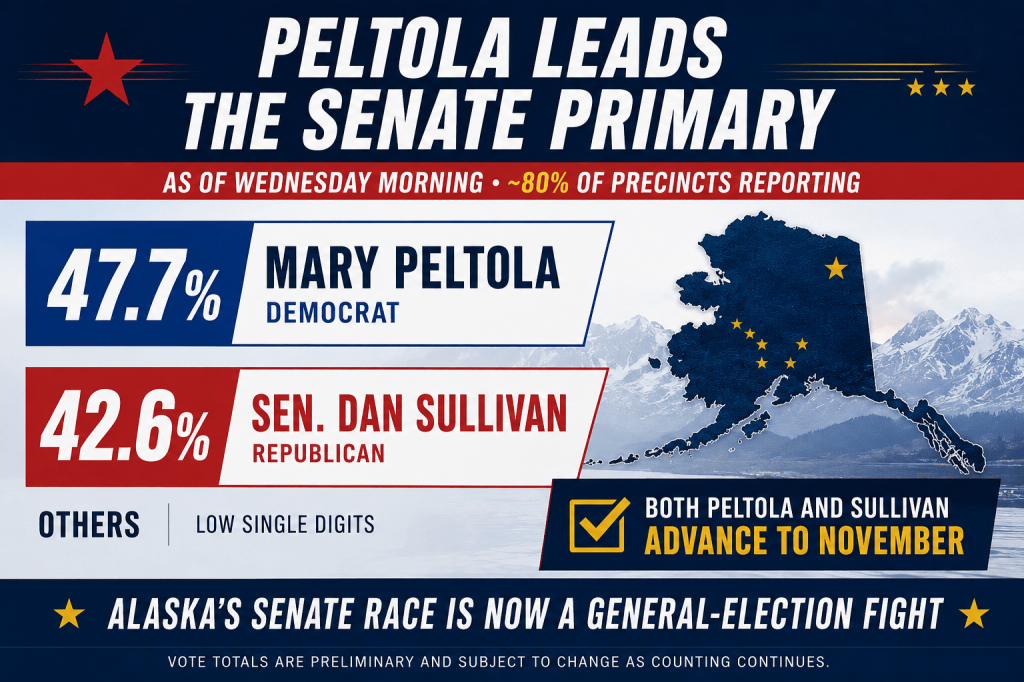
Former U.S. Rep. Mary Peltola, a Democrat, led incumbent Republican Sen. Dan Sullivan 47.7% to 42.6% as of the most recent update, with about 80% of precincts reporting. Two other candidates — including a separate candidate who also happens to be named Daniel Sullivan, not to be confused with the incumbent — trailed in the low single digits. A later count reported by Radio Kenai, citing state election data, showed Peltola’s lead widening somewhat relative to earlier election-night returns, though updated exact percentages were not available at publication.
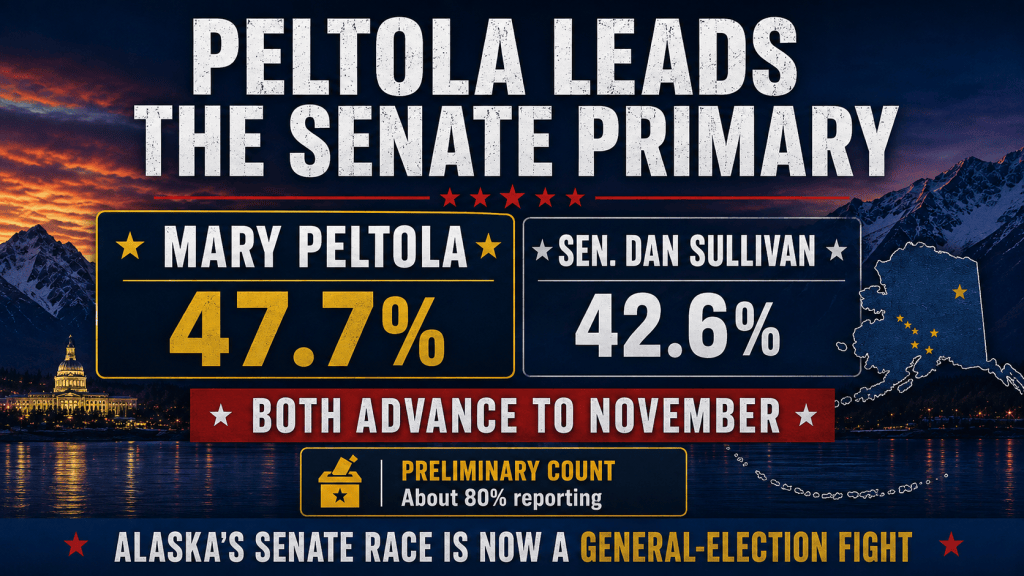
“Peltola led the incumbent senator even as both secured places in Alaska’s ranked-choice general election.”
Sullivan, seeking a third term, has emphasized his role in securing federal funding for the Coast Guard, the military and North Slope oil and gas development, along with his support for the tax legislation enacted under the One Big Beautiful Bill Act. Peltola, who represented Alaska’s at-large House seat from 2022 to 2024 before losing to Nick Begich III, has criticized Sullivan’s support for federal Medicaid reductions under that same law and argued that Congress is overrepresented by wealthy members disconnected from working Alaskans’ concerns. Both Peltola and Sullivan are considered near-certain to advance to the top-four general election field regardless of how the remaining count resolves, given the size of their combined lead over the rest of the field; neither has been formally confirmed as advancing by the AP as of this writing.
No Democrat has represented Alaska in the Senate since 2015, and Peltola remains the only Alaska Democrat to win statewide office since Mark Begich’s 2008 Senate victory.
U.S. House: Begich leads Hill, with two protest candidacies further back
Incumbent Republican Rep. Nick Begich III led independent Bill Hill, 45% to 30.1%, with about 80% of precincts reporting in the 15-candidate field. Matt Schultz, a Democrat who suspended his campaign last month and endorsed Hill but remains on the ballot, held roughly 7.9%; Eric Hafner followed with 3.7%.
Begich, who defeated then-Rep. Peltola in 2024, is seeking a second term. As with the Senate race, Begich and Hill’s combined vote share puts them in a strong position to advance to November regardless of how the remaining count resolves, though the AP had not formally called either as advancing at publication time.
Ballot Measure 1
Alaska voters were also asked whether to reinstate limits on campaign contributions to state and local candidates. Current law technically caps such contributions, but the limits have gone unenforced since a 2021 ruling by the 9th U.S. Circuit Court of Appeals found the existing caps unconstitutionally low. As of the most recent count, the measure was passing by a wide margin, with roughly 70% in favor.
“Roughly seven in ten voters backed restoring limits on campaign contributions.”
Ahead
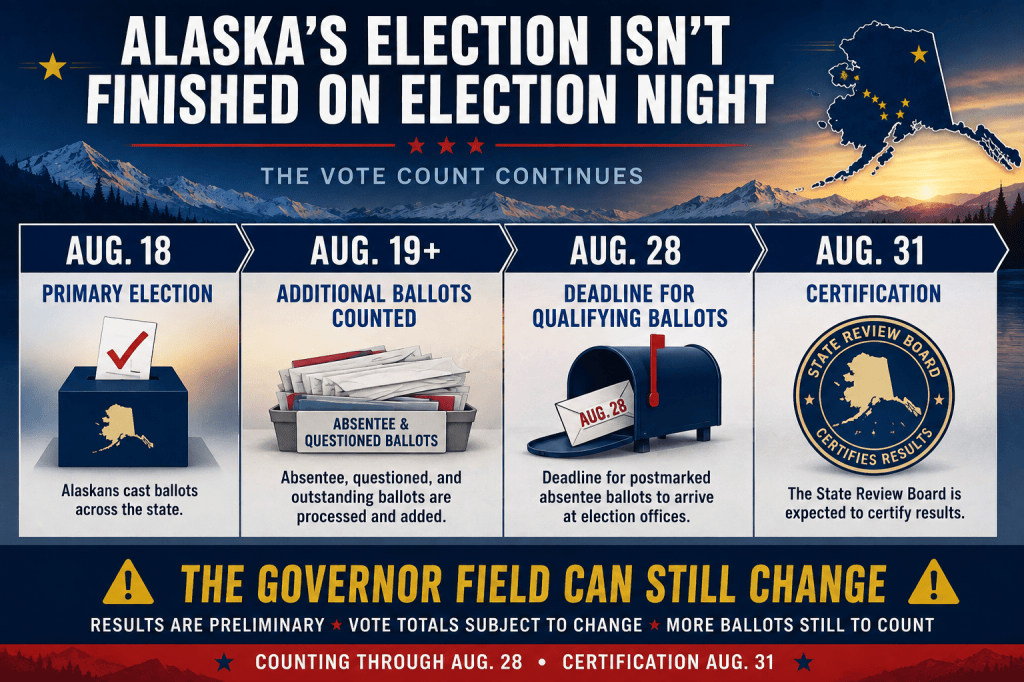
Vote-counting continues through Aug. 28 for outstanding absentee and questioned ballots, with the State Review Board expected to certify results Aug. 31. The governor’s race remains the least settled of Tuesday’s contests: two of four general-election slots are called, and the fight for the remaining two spots is close enough among several Republican candidates that the field may not be finalized for days. Bernadette Wilson has said she will withdraw if she is not the leading Republican vote-getter once counting is complete; as of this writing, she leads that group, but her campaign has not issued a further statement. Election Desk will follow up with a confirmed four-candidate field for governor, Senate and House races once the AP formally calls the remaining slots.
Sourcing and methodology note
Vote totals and percentages in this article are drawn from Alaska Division of Elections preliminary results as reported by Alaska Public Media, Alaska Beacon, the Anchorage Daily News and Radio Kenai between the evening of Aug. 18 and midday Aug. 19, 2026; because Alaska’s count was still roughly 80–94% complete across the three featured races as of publication, all vote shares in this article should be treated as provisional and are sourced to the most recent update available at the time of writing, with the reporting percentage noted alongside each figure. Where an outlet reported both an early and a later snapshot for the same race (for example, governor’s-race figures moving from a 49%-counted update to a 94%-counted update over the course of the evening), this article uses the later, more complete figure throughout. Candidates for governor, Senate and House who had not been confirmed by the AP as advancing to November are explicitly flagged as such in the text and in the accompanying chart; this reflects the state of the count at publication and may be outdated by the time of reading. Biographical details for candidates (fundraising, endorsement history, prior officeholding) are drawn only from claims explicitly stated in the cited local reporting; where a commonly known fact about a candidate could not be located in this reporting round, it was omitted rather than assumed. No partisan-affiliated or campaign-commissioned polling is cited in this article.


Leave a Reply