
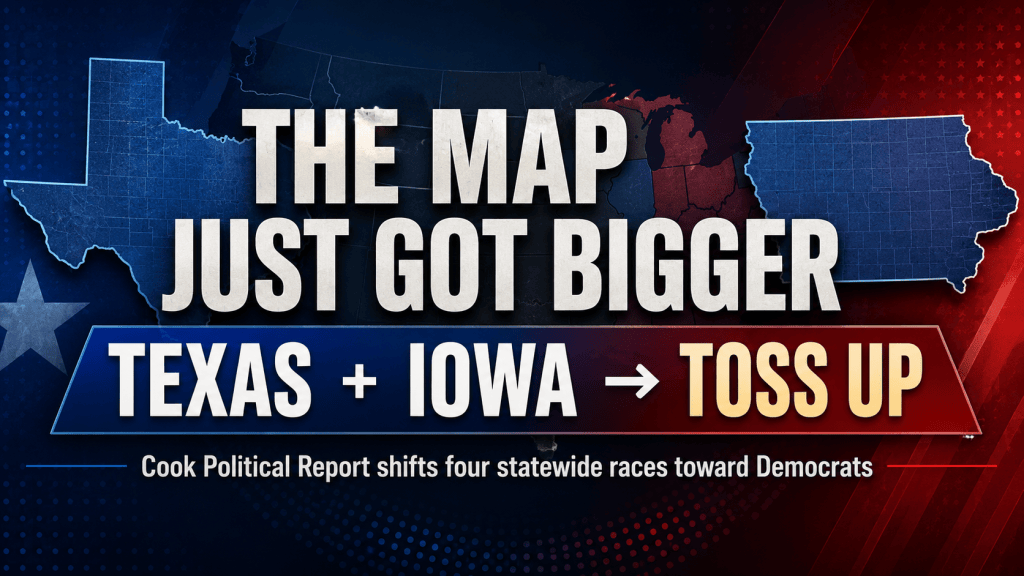
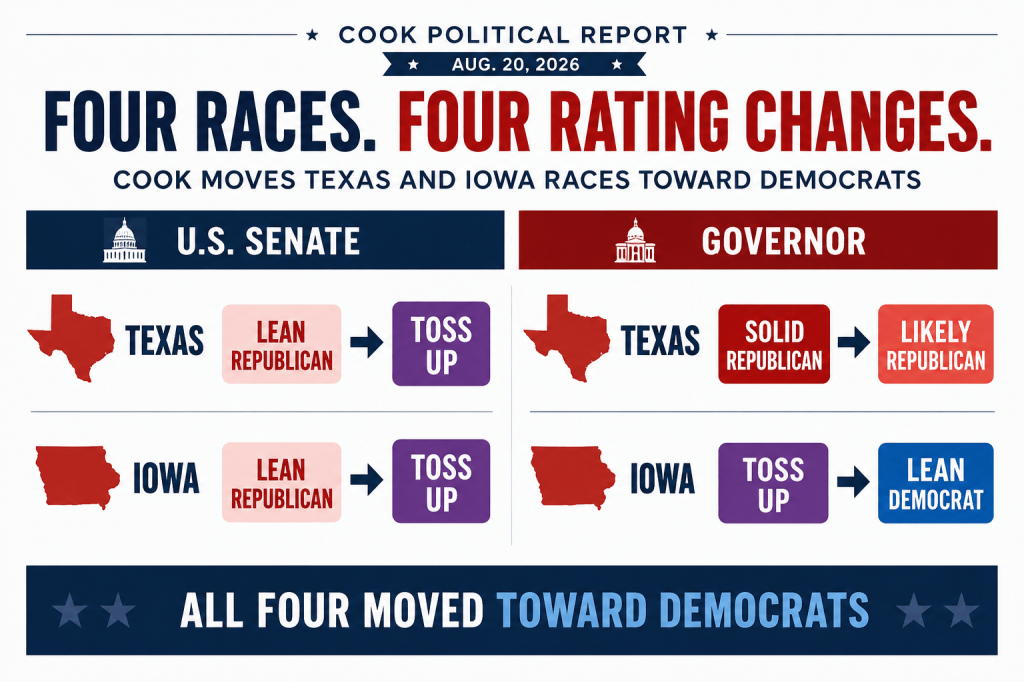
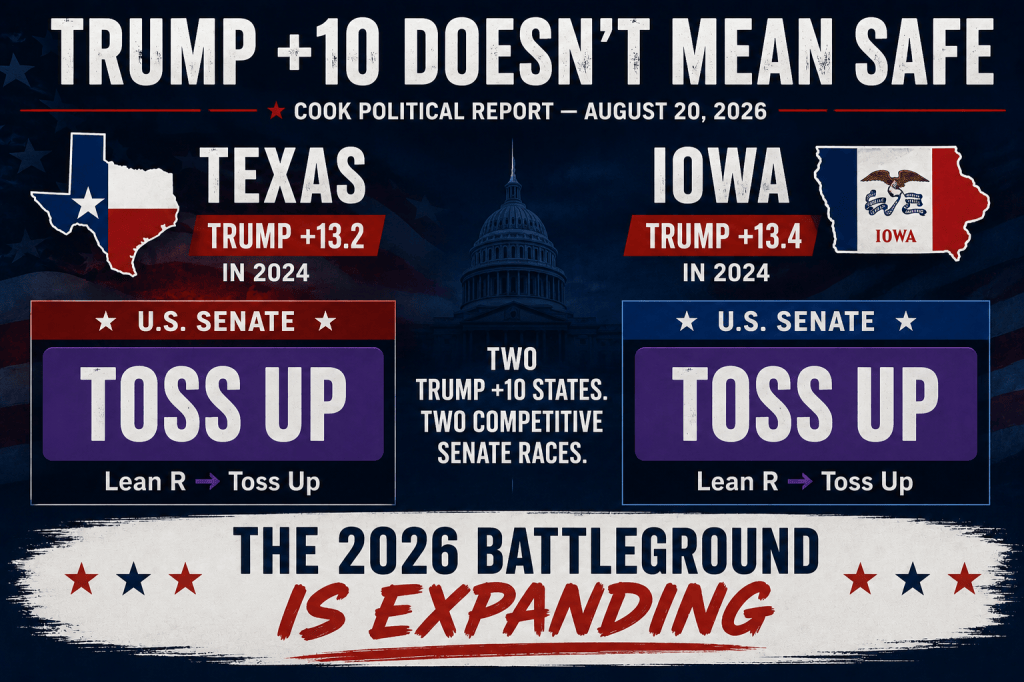
The nonpartisan Cook Political Report on Thursday moved the Texas and Iowa Senate races from Lean Republican to Toss Up, and shifted both states’ governor races in Democrats’ direction.
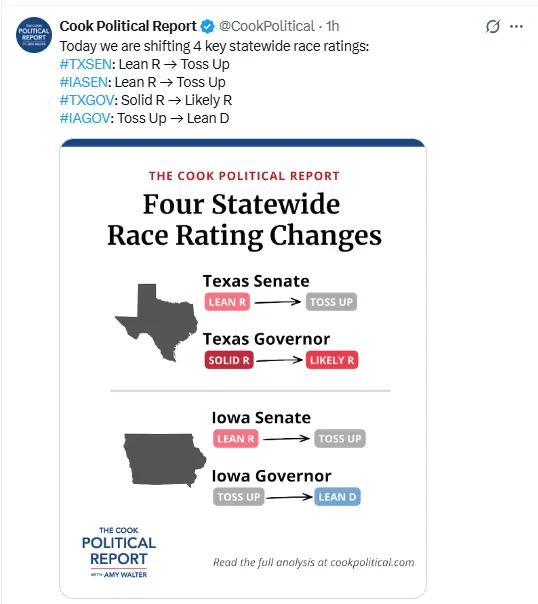
The changes, published by the outlet’s Senate and Governors editor Jessica Taylor, affect four statewide races in two states President Trump carried by double digits in 2024. Texas’s governor race moved from Solid Republican to Likely Republican, while Iowa’s governor race moved from Toss Up to Lean Democrat.
“Texas and Iowa’s Senate races are now in Cook’s most competitive category: Toss Up.”
The Senate races
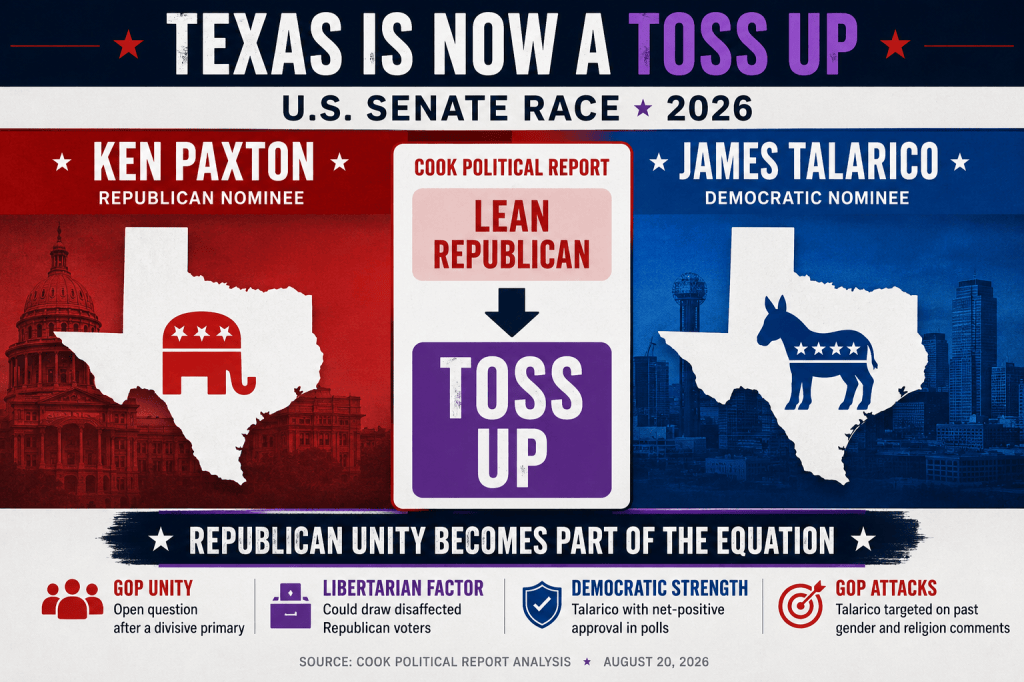
In Texas, the shift reflects growing scrutiny of Republican nominee Ken Paxton, the state’s attorney general, whose favorability numbers have lagged behind a generic Republican in the state’s GOP polling, according to Taylor’s analysis. Paxton faces Democratic state Rep. James Talarico, whose campaign has posted net-positive approval ratings in recent surveys. Taylor also flagged an open question about Republican unity behind Paxton: national Senate GOP leadership spent heavily during the primary to try to defeat him in favor of Sen. John Cornyn, and it remains unclear how much of that infrastructure will now mobilize on Paxton’s behalf in the general election.
Taylor’s analysis also noted liabilities on the Democratic side. Talarico has drawn Republican attacks over past comments on gender and religion, which the GOP is expected to spend heavily to highlight in the general election. Taylor also pointed out that a Libertarian candidate on the ballot could pull disaffected Republican votes away from Paxton without those voters crossing over to Talarico, a dynamic that could work in Democrats’ favor.
“The question in Texas is no longer simply whether Republicans have the advantage — but whether the party fully reunites behind Ken Paxton.”
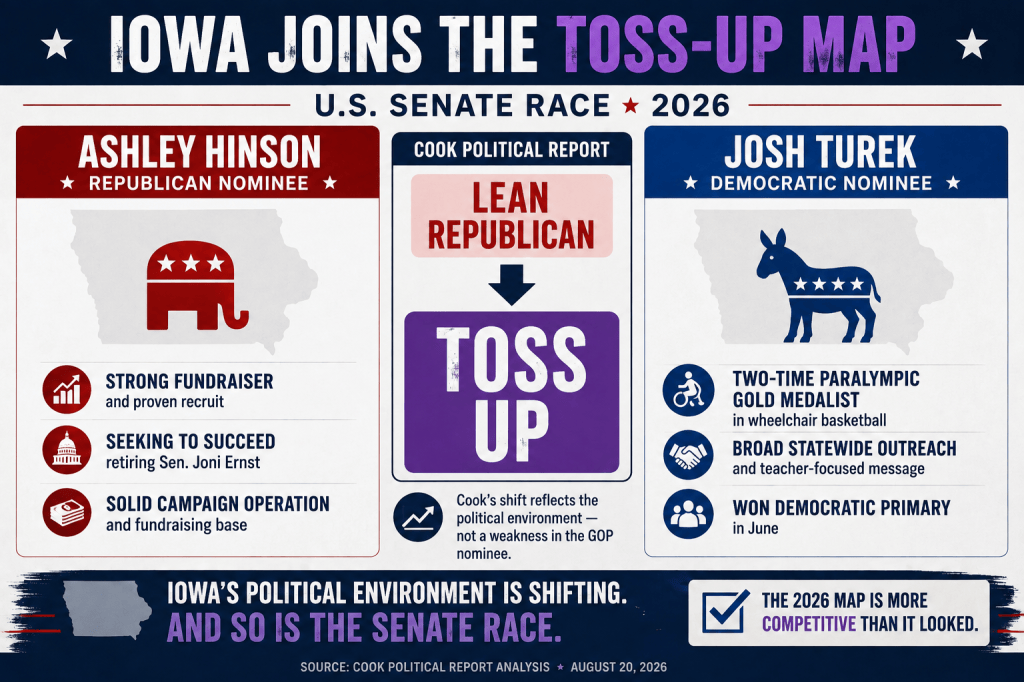
In Iowa, Taylor was explicit that the move away from Republicans is not a reflection on the GOP nominee. Rep. Ashley Hinson (R), who is seeking to succeed retiring Sen. Joni Ernst, remains a strong fundraiser and recruit in Cook’s assessment. Instead, the shift reflects a changing political environment in a state where three of four U.S. House seats are considered competitive this cycle and the open governor’s race has moved toward Democrats. Taylor pointed to rising fertilizer and diesel prices, along with tariffs, as pressures on Iowa’s agriculture-dependent economy. Hinson faces Democratic state Rep. Josh Turek, a two-time Paralympic gold medalist in wheelchair basketball who won his party’s nomination in June.
“Cook’s Iowa shift is less about Ashley Hinson than about the political environment surrounding her.”
The governor’s races
Both governor’s races are open seats. In Texas, Gov. Greg Abbott is seeking an unprecedented fourth term against Democratic state Rep. Gina Hinojosa of Austin; recent public polling has shown the race within single digits, though Abbott retains a large financial advantage. Cook’s move from Solid to Likely Republican keeps the race outside its most competitive categories but acknowledges a tightening contest.
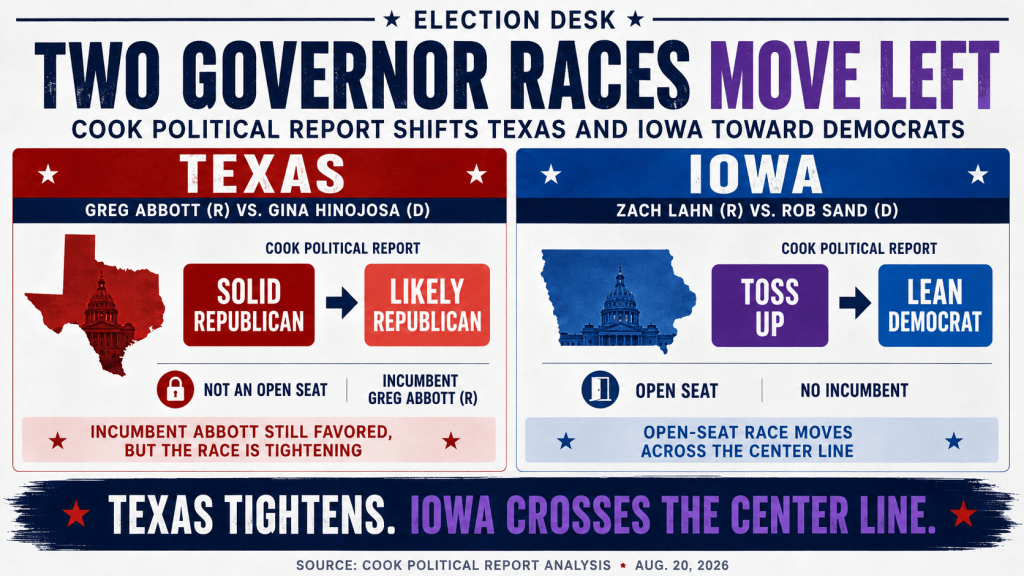
In Iowa, Gov. Kim Reynolds’ decision not to seek a third term created the state’s first open governor’s race since 2006. Republican businessman Zach Lahn faces Democratic state Auditor Rob Sand, who ran unopposed in his primary and has campaigned heavily across the state. Cook’s move to Lean Democrat is a notable marker for a state Republicans have controlled at the gubernatorial level for more than a decade.
“Iowa’s move to Lean Democrat is a notable marker in a state Republicans have controlled at the gubernatorial level for more than a decade.”
What’s ahead
Taylor’s analysis frames the changes as part of a broader thesis: in a wave-election environment comparable to 2006, states Trump carried by double digits are not automatically insulated from competitive Senate and gubernatorial contests. Taylor’s write-up notes that Republicans still retain a structural advantage given the makeup of the 2026 Senate map, and that Democrats need nearly every competitive race to break their way to win a majority — but the outlet’s framing suggests Democrats have plausible paths in states well outside the traditional battleground list heading into the Labor Day stretch of the campaign.
“States Trump carried by double digits are no longer automatically outside the competitive map.”
For continuing coverage of the 2026 Senate and gubernatorial races, visit Election Desk’s Federal Elections and State Elections overview pages.
Sourcing note: This article is based on Cook Political Report’s Aug. 20, 2026 analysis, “Texas and Iowa Senate Races Move to Toss Up; Races for Governor Also Move in Democrats’ Direction,” by Jessica Taylor (cookpolitical.com), supplemented by reporting from The Hill and primary-source confirmation of candidate names and race status via Ballotpedia, Iowa Public Radio, and the Austin American-Statesman. Cook Political Report’s underlying race-page analysis is subscriber-only; this article relies on the outlet’s publicly available lede and reported summaries of its reasoning rather than the full subscriber text.


Leave a comment