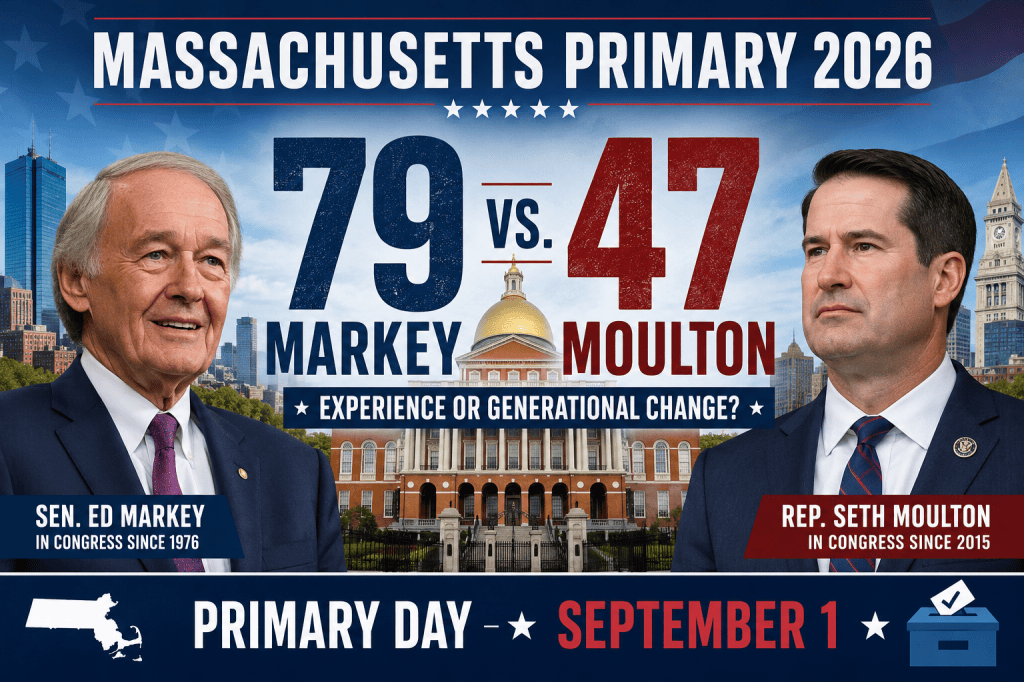
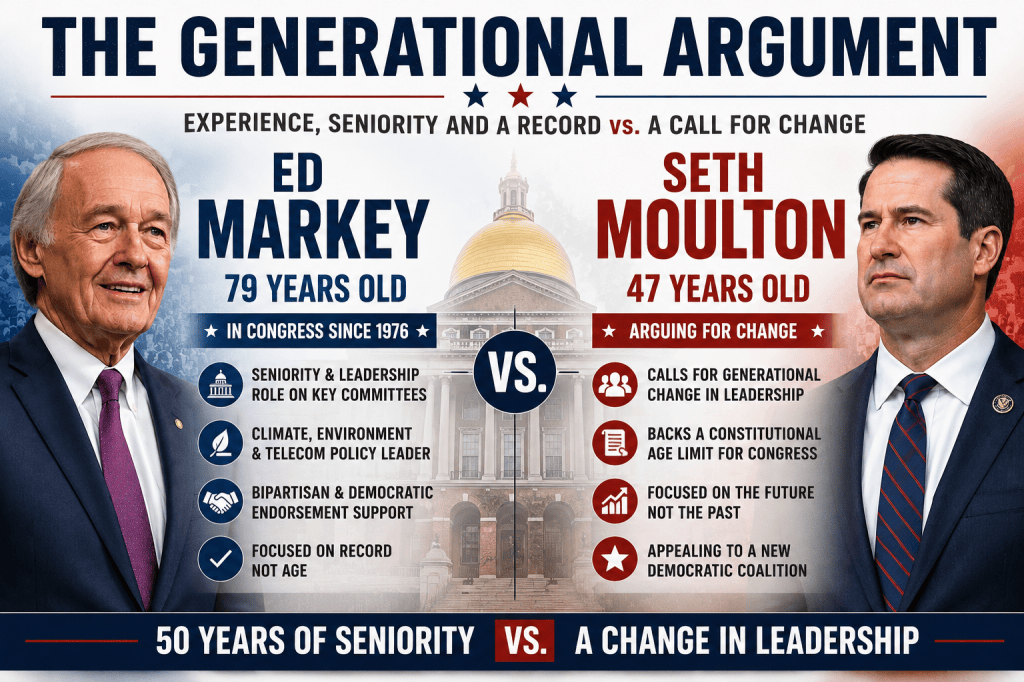
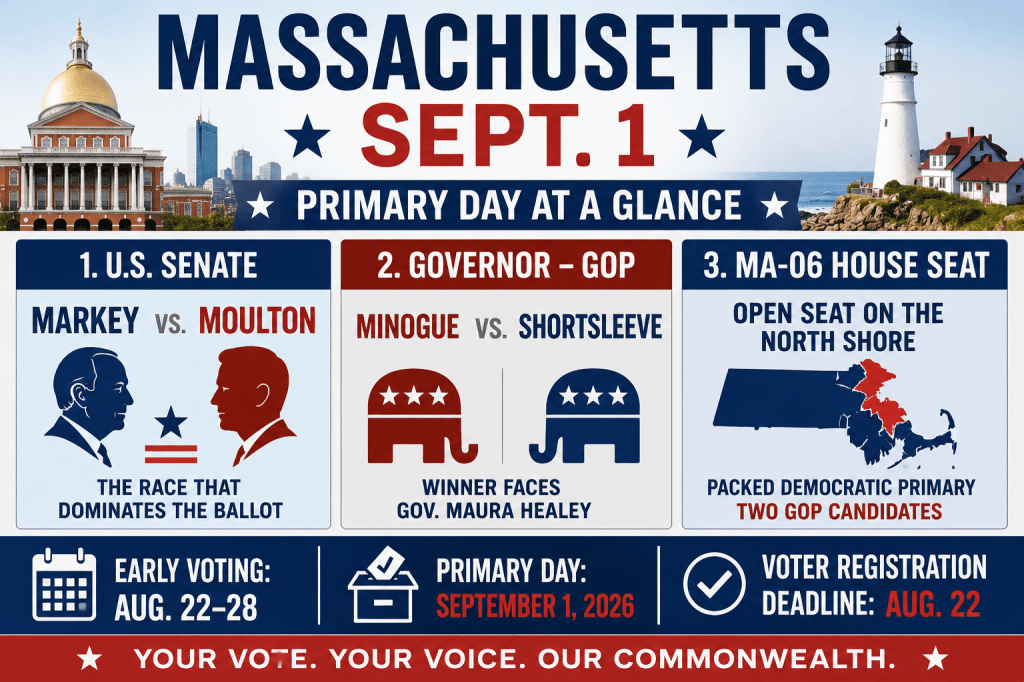
Massachusetts voters go to the polls September 1 for a primary election built around a single marquee question: whether 79-year-old Sen. Ed Markey, in Congress since 1976, should be renominated for a third full term over U.S. Rep. Seth Moulton’s argument that the party needs generational change. Down-ballot, an incumbent governor faces no primary opposition, Republicans are settling a contested nomination to face her, and a packed field is competing for a rare open U.S. House seat on the North Shore.
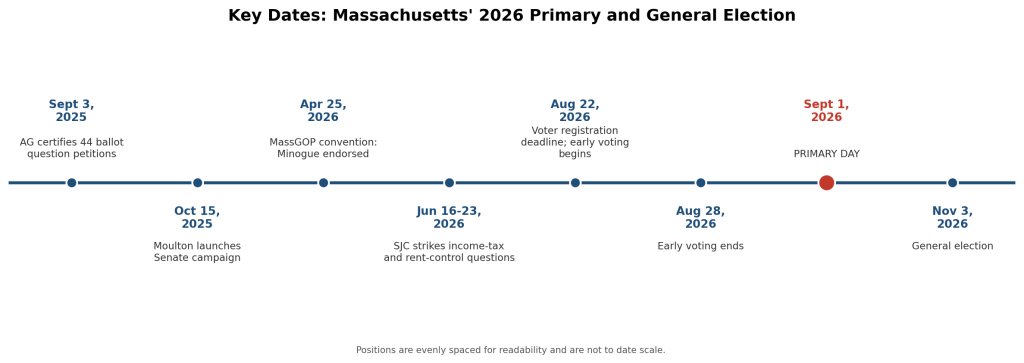
Early in-person voting runs August 22–28, and the voter registration deadline is August 22. Massachusetts uses a fusion of party primaries: Democratic and Republican contests appear on separate ballots, and unenrolled voters may choose either one at the polls.
“Massachusetts voters go to the polls September 1 for a primary election built around a single marquee question: whether 79-year-old Sen. Ed Markey should be renominated over U.S. Rep. Seth Moulton’s argument that the party needs generational change.”
U.S. Senate: An Age-and-Tenure Argument That Has Not Moved the Polls
Moulton, 47, entered the race in October 2025 arguing directly that Markey’s age and half-century in Congress make him the wrong choice “to meet this moment,” and he has since backed a constitutional amendment establishing an age limit for members of Congress. Markey has declined to make age a centerpiece of his own campaign, instead emphasizing his committee seniority, endorsements spanning the party’s progressive and moderate wings, and his record on climate and telecommunications policy.
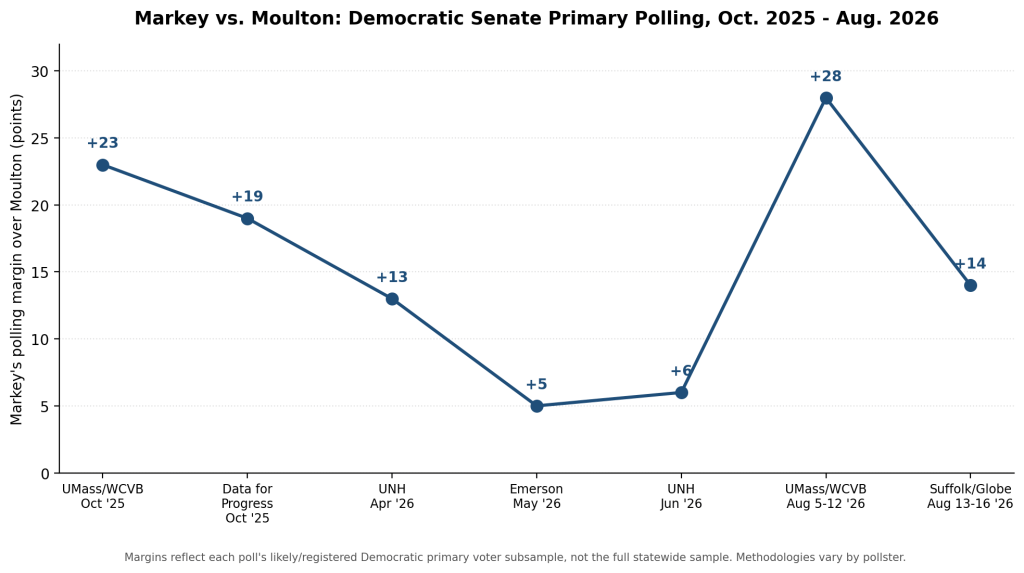
Public polling has shown a wide range of results but has never shown Moulton ahead. An early UMass Amherst/WCVB survey in October 2025 found Markey leading by 23 points among likely Democratic primary voters; a Data for Progress poll conducted the same month put his lead at 19. The race appeared to tighten substantially by early summer 2026 — a University of New Hampshire Survey Center poll found Markey’s edge narrowing from 13 points in April to just 6 points in June, with a rising share of undecided voters, and an Emerson College poll in May found an even narrower 5-point gap.
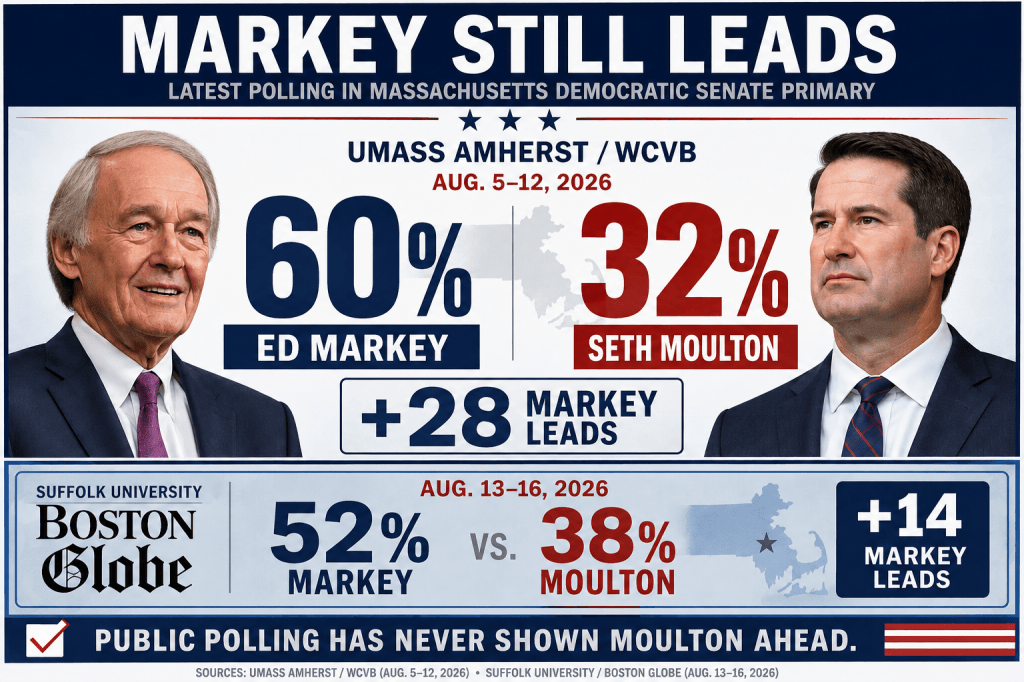
That trend reversed sharply in August. A UMass Amherst/WCVB poll conducted August 5–12 found Markey holding a 28-point lead over Moulton, 60% to 32% — a sharp break from the closer polling of earlier in the summer. A Suffolk University/Boston Globe poll conducted a few days later, August 13–16, found a tighter but still comfortable 14-point Markey lead, 52% to 38%. Pollsters offered differing explanations for Markey’s apparent consolidation. UMass poll director Tatishe Nteta told Newsweek that Moulton has yet to offer Democratic primary voters a rationale for changing leadership beyond Markey’s age and tenure, and that argument “is not resonating with the Democratic electorate.” A Moulton campaign spokesperson pushed back on the polling itself, telling reporters that public surveys have “a recent history of being wildly wrong” and citing recent statewide polling misses elsewhere.
“That trend reversed sharply in August.”
No Republican has won a Massachusetts U.S. Senate race since 2010, and both Markey and Moulton lead prospective Republican nominee John Deaton by wide margins in general-election trial heats. Deaton, a cryptocurrency-industry attorney who was the GOP’s 2024 Senate nominee, is unopposed for the Republican nomination. Nathan Bech, who previously sought the Republican nomination, is running as an independent.
“Public polling has shown a wide range of results but has never shown Moulton ahead.”
Governor: An Uncontested Democratic Nomination, a Contested Republican One
Gov. Maura Healey and Lt. Gov. Kim Driscoll face no Democratic primary opposition as they seek a second term. The competitive contest is on the Republican side, where the field narrowed to two candidates after the party’s April convention in Worcester: businessman Mike Minogue, former CEO of the medical device company Abiomed, who won the party’s endorsement with just over 70% of delegate votes, and Brian Shortsleeve, a former chief administrator of the MBTA under Gov. Charlie Baker, who cleared the 15% delegate threshold to reach the ballot with roughly 15.5%. A third contender, former Housing and Economic Development Secretary Mike Kennealy, fell just short of that threshold and suspended his campaign.
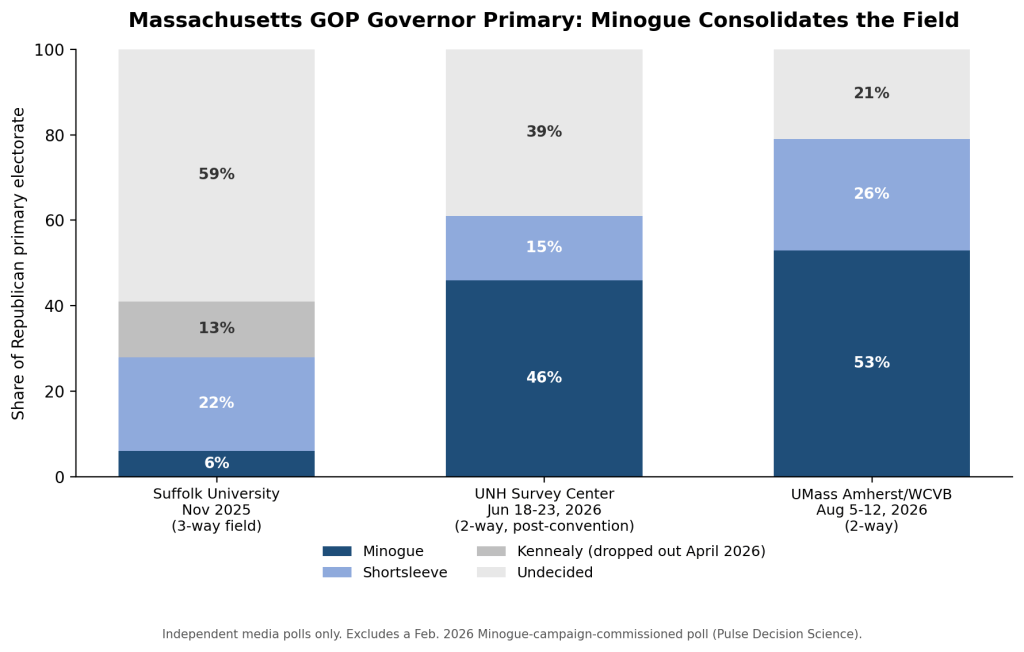
Minogue has substantially outspent his rival, including more than $7 million in self-funding in the first quarter of 2026 alone, and has led every public poll of the primary since the spring. A UMass Amherst/WCVB poll conducted August 5–12 found Minogue leading Shortsleeve 53% to 26% among likely Republican primary voters, with UMass co-director Raymond La Raja noting that Minogue has “consolidated support across most parts of the Republican primary electorate.” Minogue has declined to debate Shortsleeve during the primary, saying he is focused on the general election; Shortsleeve has run television ads criticizing Minogue over election-integrity and voter-ID positions.
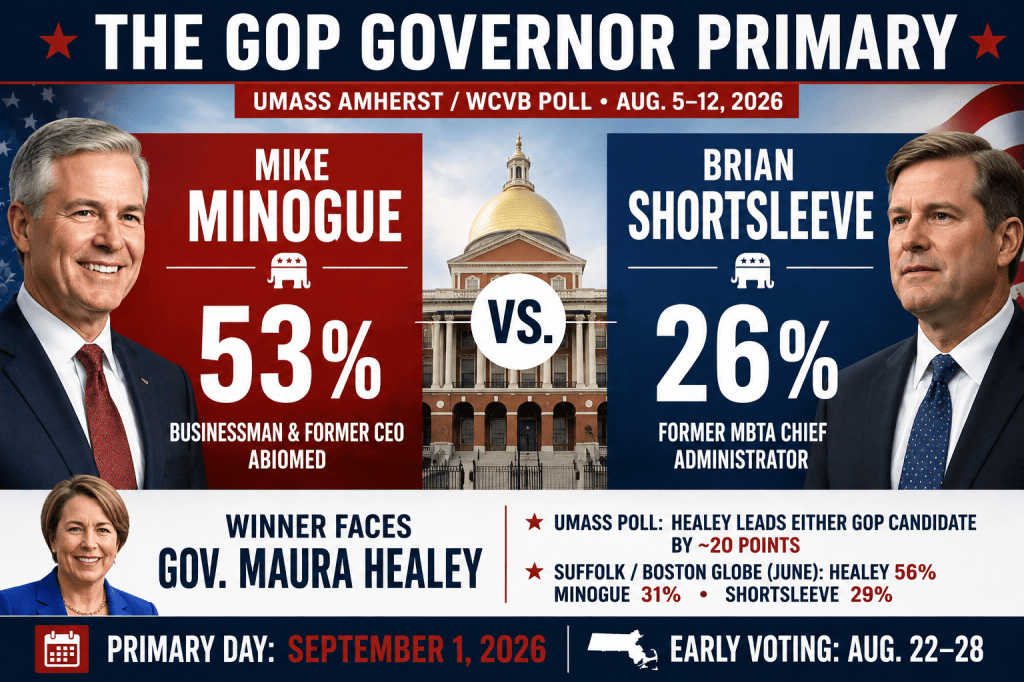
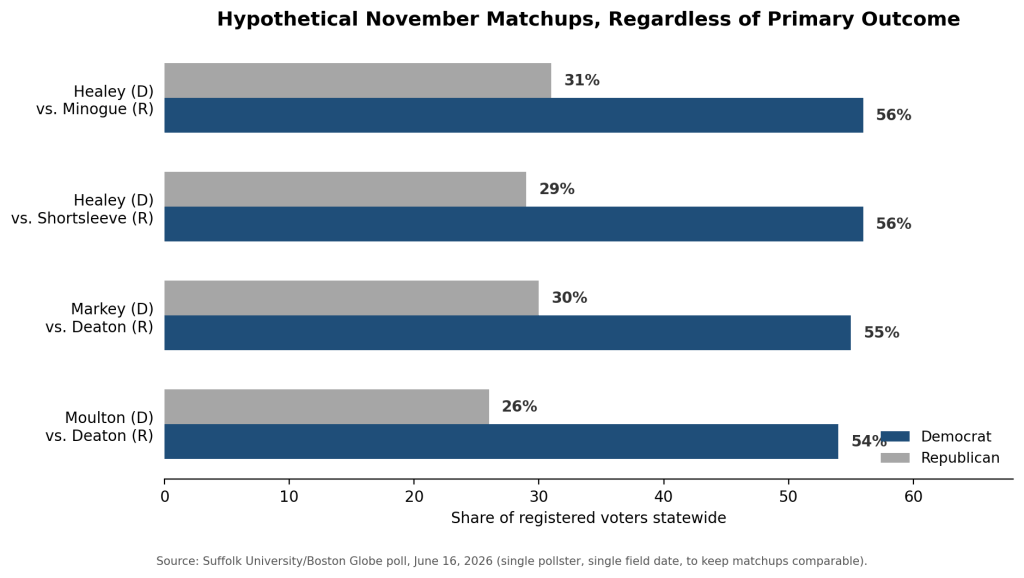
Whoever wins faces a difficult November. The same UMass poll found Healey leading either Republican by roughly 20 points, and a June Suffolk University/Boston Globe poll showed similarly large margins, with Healey leading Minogue 56% to 31% and Shortsleeve 56% to 29% among registered voters statewide.
“Whoever wins faces a difficult November.”
U.S. House: A Packed Field for Moulton’s Open Seat

Moulton’s decision to run for Senate rather than seek reelection has opened Massachusetts’ 6th Congressional District, covering the North Shore, to its first competitive primary in years. The Democratic primary has drawn at least seven candidates, including Dan Koh, a former Andover Select Board member and chief of staff to former Boston Mayor Marty Walsh, and Topsfield Town Moderator Jamie Zahlaway Belsito, along with several other local officials. Two Republicans, John Field and Micah Jones, are also on the September ballot, though the district is not considered competitive in November.
“Moulton’s decision to run for Senate rather than seek reelection has opened Massachusetts’ 6th Congressional District to its first competitive primary in years.”
Elsewhere in the delegation, several incumbents face primary challengers, though none of Massachusetts’ nine U.S. House seats — all currently held by Democrats — is considered competitive in the general election. Reps. Richard Neal, Jake Auchincloss, Katherine Clark, Stephen Lynch and Bill Keating are all facing primary opposition this cycle. In the state’s 1st District, Neal faces a challenge from Jeromie Whalen of South Hadley.
Down the Ballot: A Contested Suffolk DA Race
One of the more closely watched local contests statewide is the Suffolk County district attorney’s race, a three-way Democratic primary between incumbent Kevin Hayden, former DA and former U.S. Attorney Rachael Rollins, and attorney Linda Champion. Rollins held the DA post from 2019 until she left in early 2022 to become U.S. Attorney for Massachusetts; Hayden, appointed to fill the vacancy, went on to win the seat outright in his own right later that year. Rollins resigned as U.S. Attorney in 2023 after federal watchdog reports found she had improperly tried to influence her successor’s 2022 race; she is now seeking to reclaim the DA post she left. Both Rollins and Hayden have faced ethics findings tied to that 2022 contest — Rollins from Justice Department investigators, Hayden from the state Ethics Commission, which fined him $5,000 over a campaign-adjacent press release.
“The September 1 results will set the stage for a general election ballot that is unusually complicated even by Massachusetts standards.”
Ahead: A Record Ballot Awaits in November
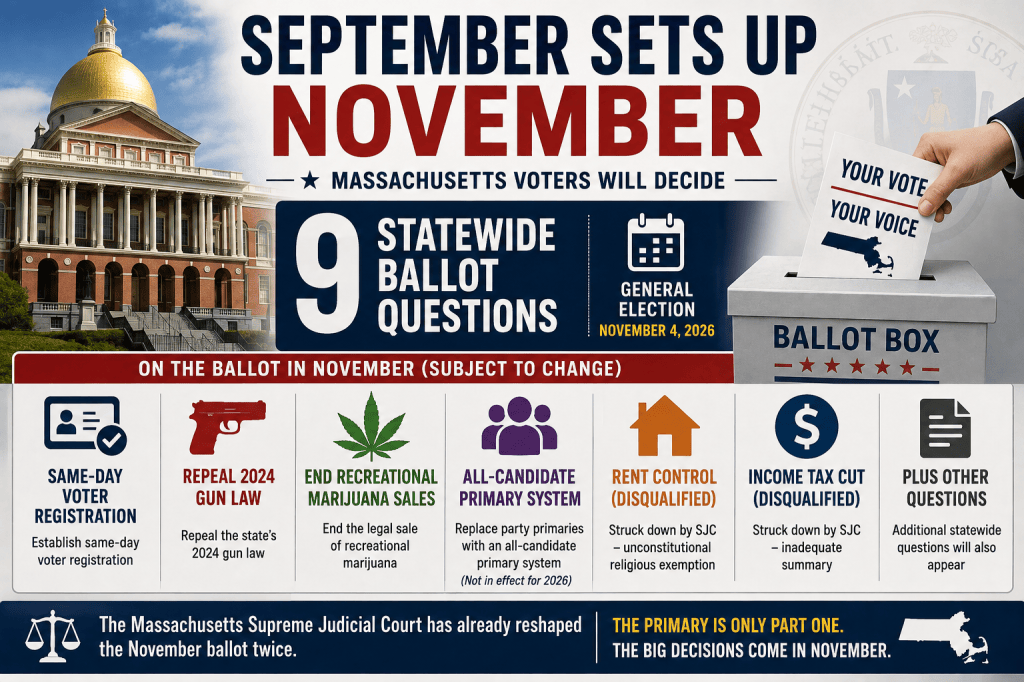
The September 1 results will set the stage for a general election ballot that is unusually complicated even by Massachusetts standards. Voters will decide up to nine statewide ballot questions in November, a number that traces back to a record 44 initiative petitions certified by Attorney General Andrea Campbell’s office in September 2025. The state’s Supreme Judicial Court has already reshaped that lineup twice: in June, it struck a proposed cut to the state income tax over an inadequate summary of the measure, and separately disqualified a statewide rent-control initiative because an exemption for religious facilities ran afoul of the state constitution’s bar on ballot questions touching religion. Surviving questions include proposals to establish same-day voter registration, repeal the state’s 2024 gun law, end recreational marijuana sales, and replace party primaries with an all-candidate primary system — a change that, if approved, would not take effect in time to affect this cycle’s contests.
Sourcing note: Polling figures are drawn from original pollster releases and reporting from Axios Boston, WBUR, GBH, Boston.com, and Newsweek, and are attributed to the specific pollster and field dates in each case; no cross-poll average is presented given differing methodologies and likely-voter models. Candidate filings and primary ballot status are drawn from the Massachusetts Secretary of the Commonwealth’s certified candidate lists and Ballotpedia’s race pages. The Suffolk DA race timeline is drawn from WBUR, GBH, and Ballotpedia reporting on Kevin Hayden’s and Rachael Rollins’s respective tenures. Ballot-question status reflects Massachusetts Supreme Judicial Court rulings in Cella v. Attorney General (rent control) and the companion income-tax ruling, both issued in June 2026, as reported by CommonWealth Beacon, WBUR, and Greenberg Traurig’s legal analysis.


Leave a Reply