
Delaware voted September 15, the last state to hold a primary before November’s midterms. The results set the state’s ballot for a U.S. Senate race, its lone U.S. House seat, and several statewide offices — with Democratic incumbents advancing comfortably in most contests and Republicans settling a competitive three-way U.S. House primary.
U.S. Senate: Coons and Katz advance
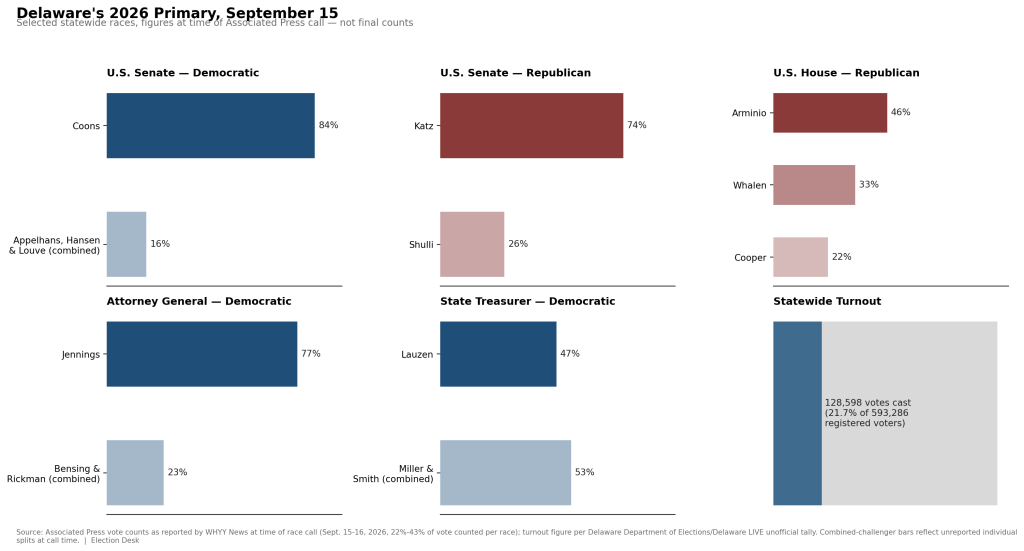
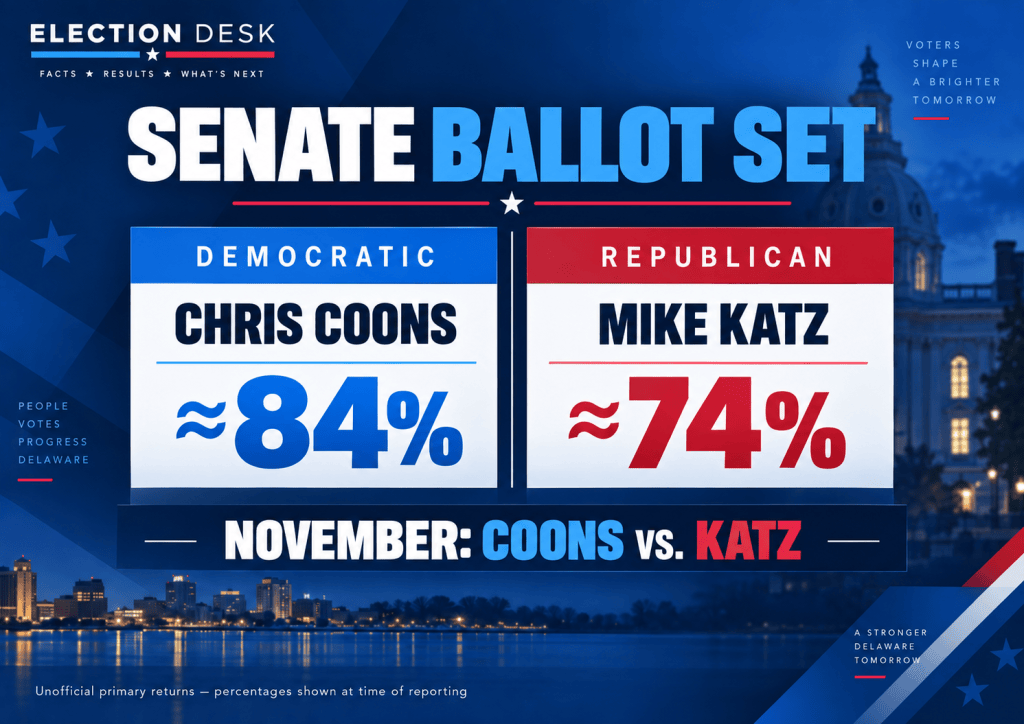
Democratic Sen. Chris Coons, seeking a fourth term, defeated three primary challengers — University of Delaware history professor Jeff Appelhans, naval architect Mary Louve, and businessman Eric Hansen, who appeared on the ballot as “E. No-Trump Hansen” after changing his name. The Associated Press called the race for Coons shortly after 8 p.m.; he held about 84 percent of the vote as counting continued. Coons was first elected to the Senate in 2010 and has significantly outraised his rivals, reporting roughly $6.9 million raised this cycle compared with about $1,500 for Appelhans; neither Hansen nor Louve filed campaign finance reports this cycle.
On the Republican side, Dr. Mike Katz — a pediatric critical care anesthesiologist, former state senator, and commercial real estate owner — defeated John Shulli, a U.S. Army Reserve colonel and part-time instructor at the U.S. Army War College, by roughly 74 percent to 26 percent. Shulli had the backing of former national security adviser Michael Flynn and state Rep. Lyndon Yearick; Katz was endorsed by the Delaware Republican Party and former U.S. Attorney Julianne Murray.
Coons and Katz will meet in November. Delaware Republicans have not won a U.S. Senate race in the state since 1994, and Delaware’s last Republican senator, William Roth, left office in 2001 — meaning Katz would be the first Republican to represent Delaware in the Senate in 25 years if elected.
“Coons and Katz will meet in November.”
U.S. House: Arminio wins a three-way GOP primary
Delaware’s lone, at-large U.S. House seat has been held by Democrats since 2010. Rep. Sarah McBride, elected in 2024, ran unopposed for her party’s nomination and will seek a second term.
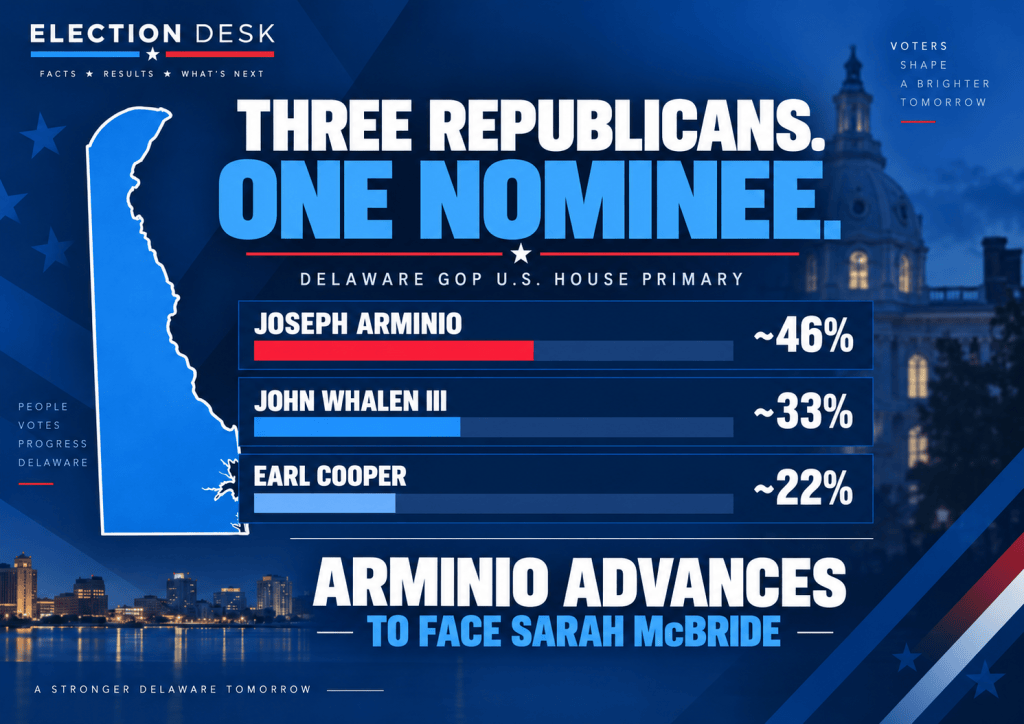
On the Republican side, Joseph Arminio — a Wilmington native with a doctorate in political science from MIT who has taught at American University and Lincoln University — won a contested three-way primary over John Whalen III and Earl Cooper. The Associated Press called the race for Arminio at roughly 9 p.m., with Arminio at about 46 percent, Whalen at 33 percent, and Cooper at 22 percent. Arminio has campaigned chiefly on economic issues, including what he calls an “American Prosperity Plan” aimed at reducing public and private debt, as well as reduced U.S. involvement in foreign conflicts and stricter immigration enforcement.
“Arminio’s contested primary win gives Republicans a nominee who first had to unify a divided base before turning to the general election.”
Down-ballot: an attorney general primary and an open treasurer’s race
Two-term Attorney General Kathy Jennings defeated two first-time candidates — Dwayne Bensing, legal director of the ACLU of Delaware, and Patty Rickman, a small-business owner — to win her party’s nomination for a third term, taking roughly 77 percent of the vote. She’ll face Republican David Graham in November.
Graham’s path to the nomination was itself unusual: Delaware Republicans did not field an attorney general candidate by the state’s regular July 14 filing deadline, and Graham, an Army and Delaware National Guard veteran, subsequently asked the state party to nominate him through Delaware’s process for filling ballot vacancies. As of this article’s publication, Delaware LIVE News — which draws its candidate data directly from the Department of Elections — listed Graham’s spot on the November ballot as provisional, pending confirmation that the party’s nomination met all statutory requirements.
In the open race for state treasurer, where two-term incumbent Colleen Davis did not seek reelection, Democrat Ted Lauzen — an investment manager who has emphasized protecting the state’s AAA credit rating and increasing transparency in how Delaware invests taxpayer funds — led a three-candidate field with about 47 percent of the vote as the race was called, ahead of economist Michael Alexander Smith and business owner Mike Miller. Lauzen will face Republican Michael Ramone, a former state representative who ran unopposed, in November.

Down the ballot further: a light primary calendar
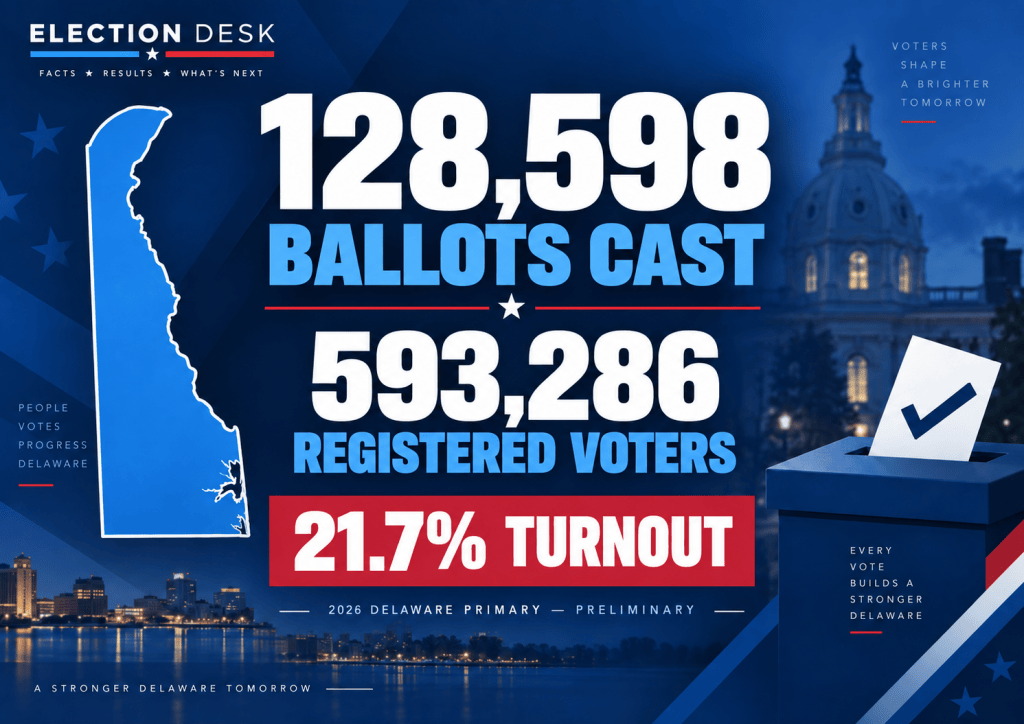
Most of Delaware’s competitive action happened at the statewide level. Of the state’s 41 House districts and dozen-plus Senate districts up this cycle, only a handful drew primary challenges, and House District 8 was the only one statewide with contested primaries on both sides — Democratic incumbent Sherae’a “Rae” Moore and Republican Gary Taylor each won nominations there and will face off in November. Statewide turnout was about 21.7 percent of Delaware’s 593,286 registered voters, or roughly 128,600 ballots cast, according to preliminary Department of Elections figures reported by Delaware LIVE News.
“Statewide turnout was about 21.7 percent of Delaware’s 593,286 registered voters.”
Ahead
“With Delaware’s results in, the primary calendar for the 2026 midterms is complete nationwide.”
With Delaware’s results in, the primary calendar for the 2026 midterms is complete nationwide. Coons enters the general election as a heavy favorite in a state Democrats have carried in every recent statewide federal race, though Katz’s business and medical background gives Republicans a credentialed nominee to test that advantage. Arminio’s contested primary win, by contrast, gives Republicans a nominee who first had to unify a divided base before turning to a McBride campaign that begins the general election with a substantial fundraising lead.

Sourcing note: Vote percentages in this article reflect Associated Press returns as reported by WHYY News at the time each race was called on the night of September 15–16, 2026, when between roughly 22 and 43 percent of the vote had been counted depending on the race; they are not final tallies, and margins may narrow or shift somewhat as counting is completed and results are certified by the Delaware Department of Elections. Where more than one challenger’s individual vote share was not available at time of publication, this article reports their combined total. The Republican attorney general nomination remained procedurally unresolved at publication, as described above.
Explore more election law and process coverage at Election Desk →
 Election Desk
Leave a comment