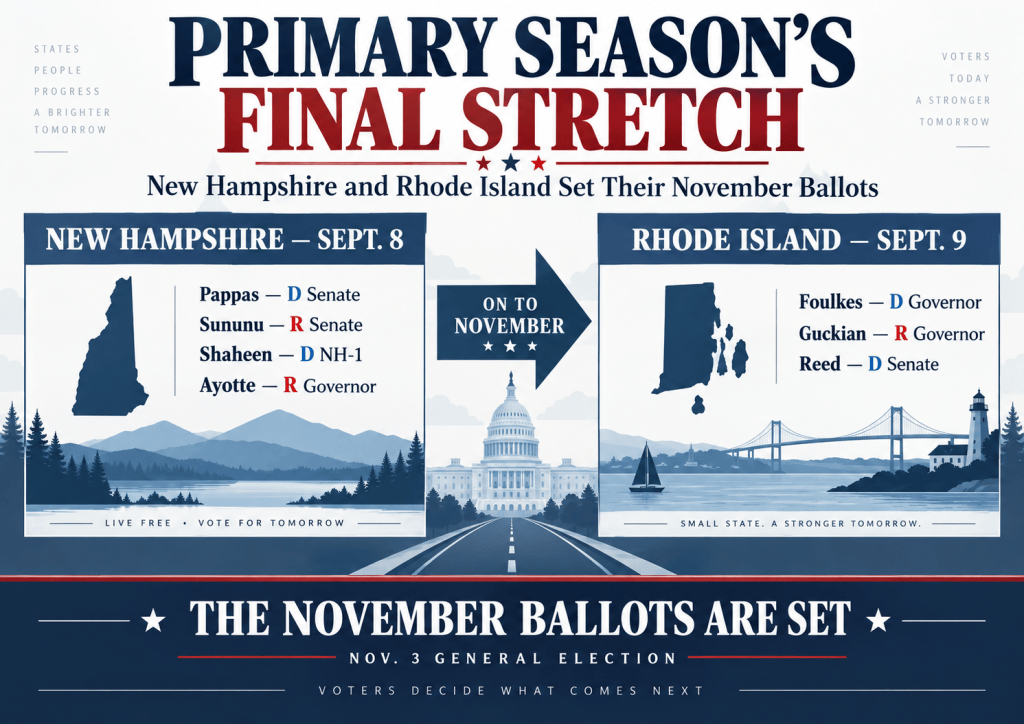
Voters in New Hampshire and Rhode Island wrapped up one of the final stretches of the 2026 primary calendar this week, settling nominations for two open U.S. Senate seats, a marquee gubernatorial rematch, and a crowded open U.S. House race. One contest — Rhode Island’s Republican primary for governor — took nearly a week and a formal review to resolve.
New Hampshire voted September 8; Rhode Island followed September 9. Both states have now set their fields for the November 3 general election.
“Both states have now set their fields for the November 3 general election.”
New Hampshire: an open Senate seat draws a marquee matchup
New Hampshire’s primary centered on the open U.S. Senate seat being vacated by three-term Democratic Sen. Jeanne Shaheen, who chose not to seek reelection.
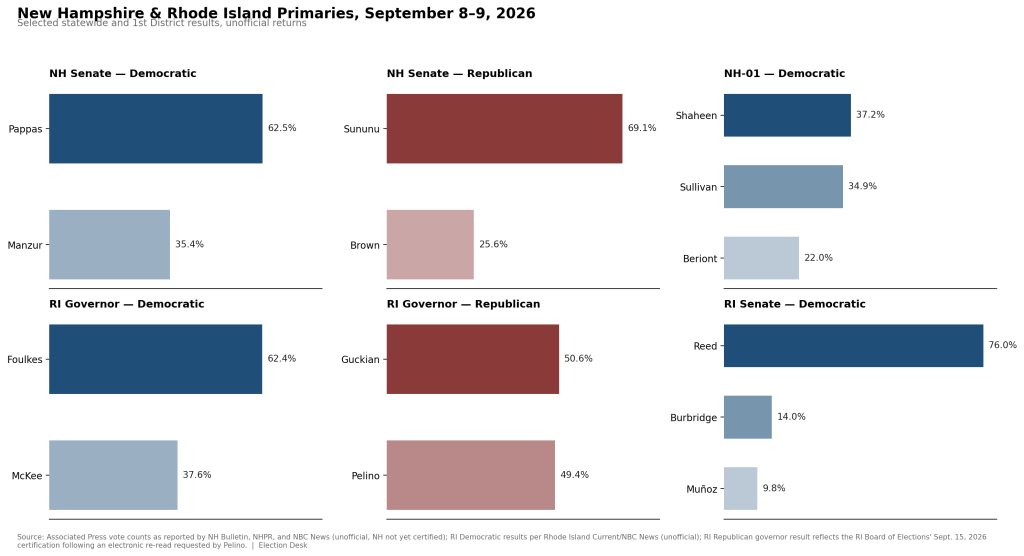
Democratic Rep. Chris Pappas won his party’s nomination over Karishma Manzur, a scientist and member of the Democratic Socialists of America, taking roughly 62–63 percent of the vote to Manzur’s mid-30s, according to unofficial returns. Manzur had narrowed the gap in some late polling, with one University of New Hampshire survey putting her within 13 points of Pappas, but the primary-night margin was closer to 27 points.
On the Republican side, former Sen. John E. Sununu — who represented New Hampshire in the Senate from 2003 to 2009 — defeated former Massachusetts Sen. Scott Brown, winning roughly 69 percent to Brown’s 26 percent. President Trump endorsed Sununu ahead of the primary.
Pappas and Sununu will face off in November for a seat both parties consider central to the fight for Senate control. New Hampshire has not voted for Trump in a presidential election, but Republicans see Sununu — whose father and brother both served as the state’s governor — as one of their stronger recruits nationally this cycle.
“Pappas and Sununu will face off in November for a seat both parties consider central to the fight for Senate control.”

Governor: Ayotte advances unopposed on the Democratic side
Republican Gov. Kelly Ayotte defeated two lesser-known primary challengers, Shaun Fife and Robert McClory, to secure her party’s nomination for a second term. Democrat Cinde Warmington, a former New Hampshire Executive Councilor who lost the 2024 Democratic gubernatorial primary, ran unopposed. The two will meet in a rematch of dynamics from that earlier race; Ayotte defeated a different Democrat, Joyce Craig, in the 2024 general election by roughly 9 points.
1st Congressional District: the closest race of the night
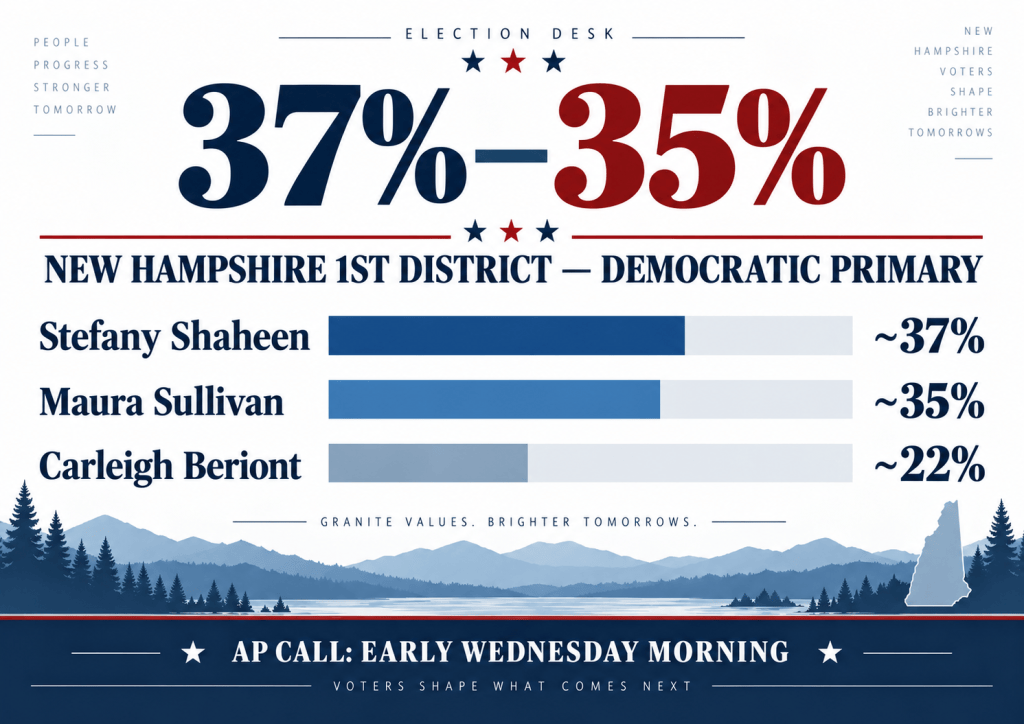
The most competitive contest in New Hampshire’s primary was the Democratic race for the 1st Congressional District, the seat Pappas is vacating. Stefany Shaheen — a former Portsmouth city councilor and the daughter of the retiring senator — narrowly defeated Maura Sullivan, a Marine Corps veteran and former Obama administration official, by roughly 37 percent to 35 percent. Progressive candidate Carleigh Beriont, chair of the Hampton Select Board, took about 22 percent in a late surge. The Associated Press did not call the race until early Wednesday morning, after roughly 88 percent of the vote had been counted.
Shaheen will face Republican Anthony DiLorenzo, a Portsmouth businessman who won his party’s primary with roughly 51 percent of the vote over Hollie Noveletsky and Brian Cole, in the November general election.
“The Associated Press did not call the race until early Wednesday morning, after roughly 88 percent of the vote had been counted.”
Rhode Island: a sitting governor loses, a Senate veteran cruises
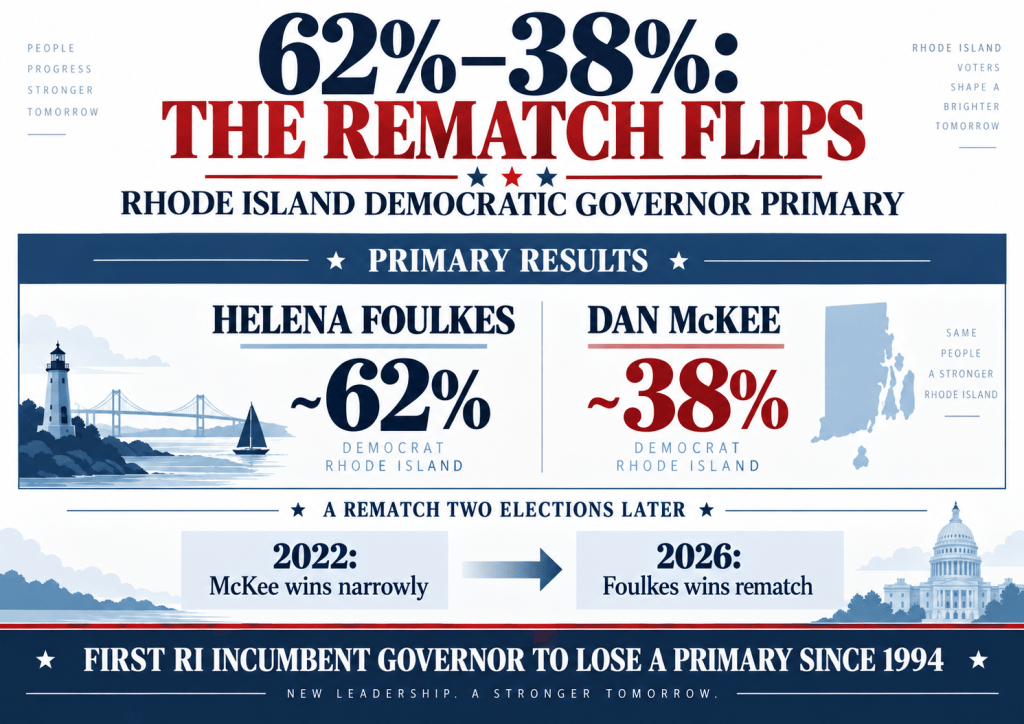
Rhode Island’s primary produced the more surprising result of the two states: Gov. Dan McKee, seeking a full second term, lost the Democratic nomination to Helena Buonanno Foulkes, a former CVS Pharmacy executive, by roughly 62 percent to 38 percent.
It was a rematch of the 2022 Democratic primary, which McKee won by about three points in a five-way field. This time, Foulkes led public polling throughout the race and outspent McKee on television advertising by a roughly 3-to-1 margin, according to the ad-tracking firm AdImpact. The contest turned substantially on McKee’s handling of the prolonged closure and reconstruction of the Washington Bridge connecting Providence to the East Bay, an issue Foulkes made central to her campaign.
McKee’s loss is notable in historical terms: it is the first time a sitting Rhode Island governor has lost a primary since 1994, and Rhode Island officials and national outlets described it as the first primary defeat of a sitting U.S. governor anywhere in the country in eight years. McKee had become governor in 2021 after Gina Raimondo left to become U.S. Commerce Secretary.
Foulkes will face the winner of Rhode Island’s Republican primary, along with independent candidates Ken Block, Jay Gotra, and C.D. Reynolds, in November.
“It is the first time a sitting Rhode Island governor has lost a primary since 1994.”
Republican governor primary: a week-long review before Guckian is confirmed
Unlike the Democratic contest, the Republican primary for governor was not settled on election night. Aaron Guckian, a former aide to ex-Gov. Don Carcieri, who carried the state party’s endorsement, held a narrow lead over Elaine Pelino, a first-time candidate with a large social-media following among Trump supporters. Unofficial returns from the Rhode Island Board of Elections showed Guckian ahead by roughly 51 percent to 49 percent, with the margin narrowing from an initial 279 votes to 271 as counting continued.
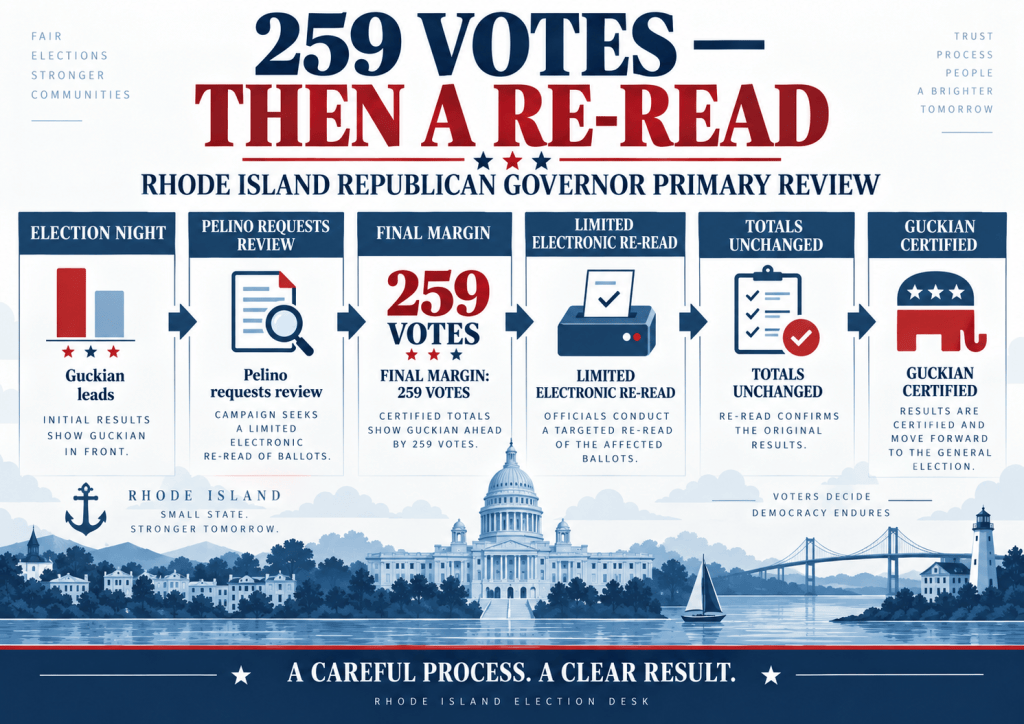
Rhode Island does not have automatic recounts; a trailing candidate must formally request one, and the review method available depends on how close the margin is under state law. Pelino requested a review the day after the primary. The state Board of Elections determined the following week that her final certified margin — 259 votes — was too wide to qualify for a full manual re-feeding of ballots, which requires trailing by 231 votes or fewer in a race this size, but narrow enough to qualify for a more limited electronic re-read of the machines’ memory devices. That re-read, conducted September 15, produced identical vote totals to election night. The Board of Elections certified Guckian as the Republican nominee at that meeting, along with the rest of the state’s September 9 primary results.
“The re-read, conducted September 15, produced identical vote totals to election night.”
Pelino has not conceded, saying the process left her without enough time to examine the underlying ballot data and arguing the state should move its primary earlier to allow more time for review. Guckian said the outcome confirmed the original count.
Senate: Reed easily wins a sixth-term nomination
In Rhode Island’s other statewide primary, Sen. Jack Reed — in the Senate since 1997 — defeated two long-shot challengers from his left, Connor Burbridge and Luis Daniel Muñoz, by a wide margin, taking roughly three-quarters of the vote. Reed will face Republican Ray McKay, who ran unopposed, and independent Michael Bahry in November.
“One state produced a marquee Senate matchup. The other removed an incumbent governor and needed nearly a week to finish another race.”
Ahead

Both states now turn to eight weeks of general-election campaigning before the November 3 midterms. The New Hampshire Senate race between Pappas and Sununu is expected to be one of the most closely watched and heavily funded contests in the country this fall, with control of the U.S. Senate potentially at stake. In Rhode Island, Foulkes enters the general election as the heavy favorite against Guckian in a state that has not elected a Republican to statewide office since 2006. Rhode Island’s primary drew turnout of just over 20 percent of registered voters statewide — the highest for a state primary in at least a decade, according to the Department of State — a sign of the intensity both parties’ contests generated.
Sourcing note: New Hampshire vote totals and percentages reflect unofficial Associated Press returns as relayed by the New Hampshire Bulletin, New Hampshire Public Radio, and NBC News, the most complete public counts available as of publication; New Hampshire’s Secretary of State has not yet posted certified township-level results. Figures cited from different points on election night varied by a few percentage points as ballots continued to be tallied; where sources diverged, this article uses the most recent, highest-completion figures available. Rhode Island Democratic primary results reflect Associated Press returns as relayed by Rhode Island Current and NBC News. The Rhode Island Republican gubernatorial primary result reflects the Rhode Island Board of Elections’ certification of September 15, 2026, following a candidate-requested electronic review; that account is corroborated by contemporaneous reporting from The Boston Globe and WPRI.
Explore more election law and process coverage at Election Desk →
 Election Desk
Leave a comment