An Election Desk explainer
A new report is circulating this week that doesn’t look at a ballot, a machine, or a legislature. It looks at law school faculty rosters — and argues that who teaches election law quietly shapes who litigates it, and who wins.
What it is
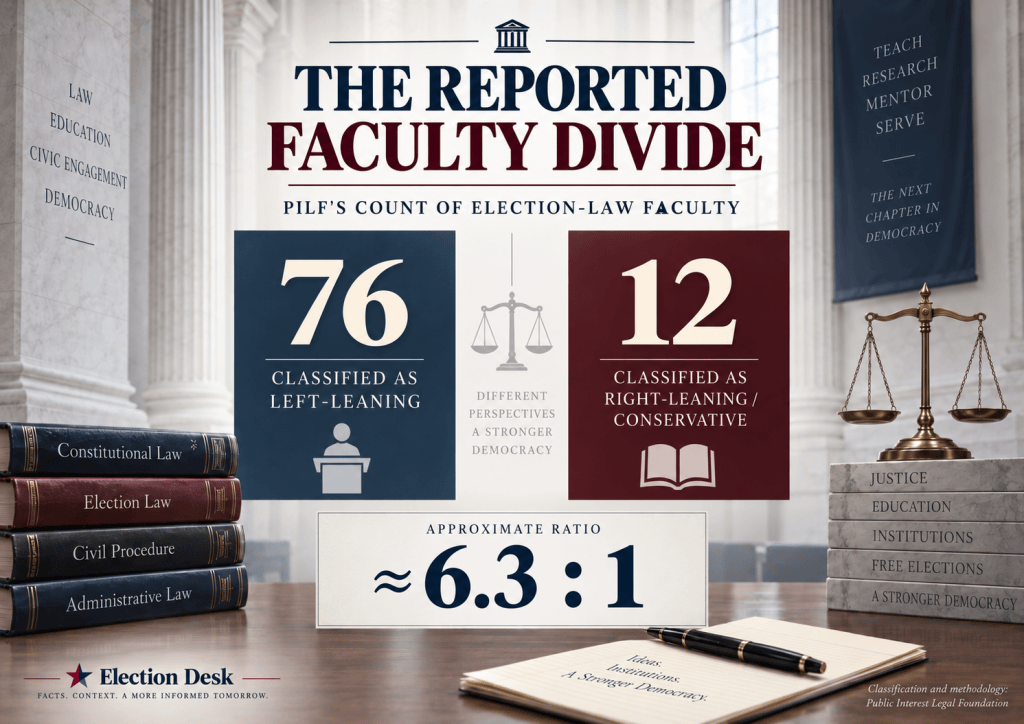
“Among the relatively small number of schools that offer election-law classes at all, professors PILF classifies as left-leaning outnumber those it classifies as right-leaning or conservative by roughly 76 to 12.”
The Public Interest Legal Foundation (PILF), a conservative legal group, says it reviewed election-law course offerings and faculty at all 198 ABA-accredited law schools in the country. Its finding: among the relatively small number of schools that offer election-law classes at all, professors PILF classifies as left-leaning outnumber those it classifies as right-leaning or conservative by roughly 76 to 12 — close to 7-to-1. PILF also says about 70% of election-law classes nationally are taught by professors it places on the left.
PILF President J. Christian Adams frames the imbalance as structural rather than incidental, calling it:
“An absolute dangerous imbalance.”
The report also notes that most existing election-law centers cluster at schools in states that lean Democratic, including New York and California, and that course descriptions at several schools address topics like felony disenfranchisement, racial and partisan gerrymandering, and proposals to restructure the Electoral College.
What actually changes
Nothing changes on its own — this is a report, not a rule, statute, or court filing. But PILF’s argument is about pipeline, not a single case: law students take the election-law classes that exist, are taught by the professors who are there, and a disproportionate share of them go on to work at voting-rights nonprofits and firms that litigate election-integrity laws. Adams says that shows up physically in courtrooms — he pointed to a Galveston County, Texas redistricting hearing where lawyers on one side reportedly filled the jury box in addition to counsel’s table, putting the ratio at roughly five to one.
“PILF’s argument is about pipeline, not a single case.”
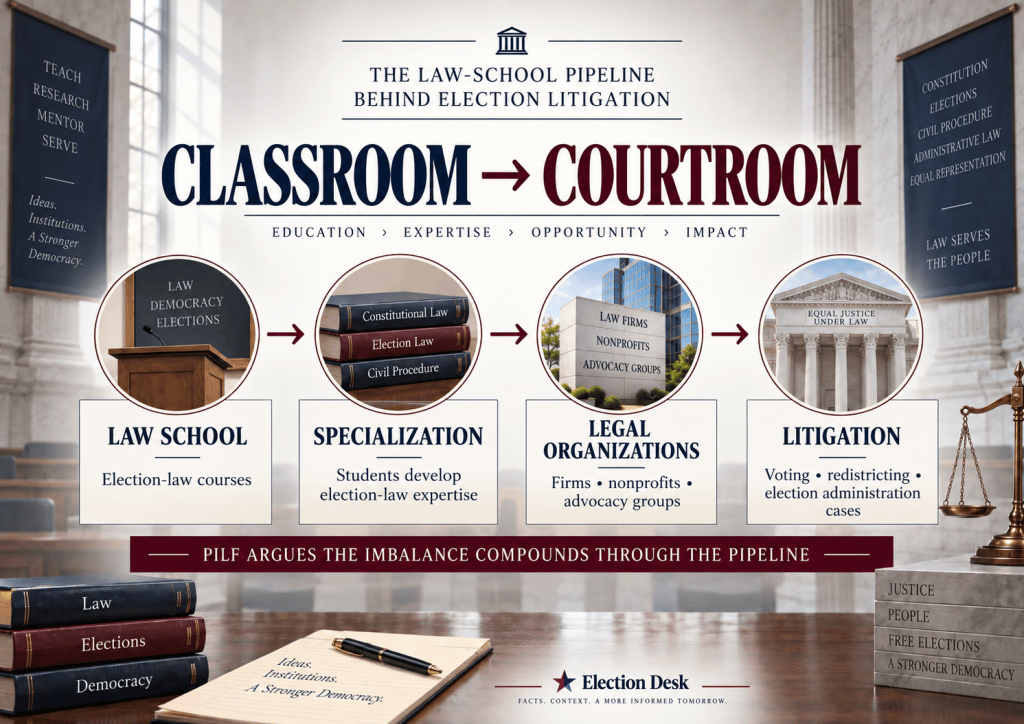
The report is explicit that it is not claiming every professor it counted as left-leaning pushes a particular legal outcome, or that ideology alone decides how election cases come out. Its narrower claim is about resources and depth of bench: fewer specialized colleagues, fewer academic centers, and less institutional infrastructure on one side of election litigation than the other.
“Its narrower claim is about resources and depth of bench: fewer specialized colleagues, fewer academic centers, and less institutional infrastructure on one side of election litigation than the other.”
Where it stands
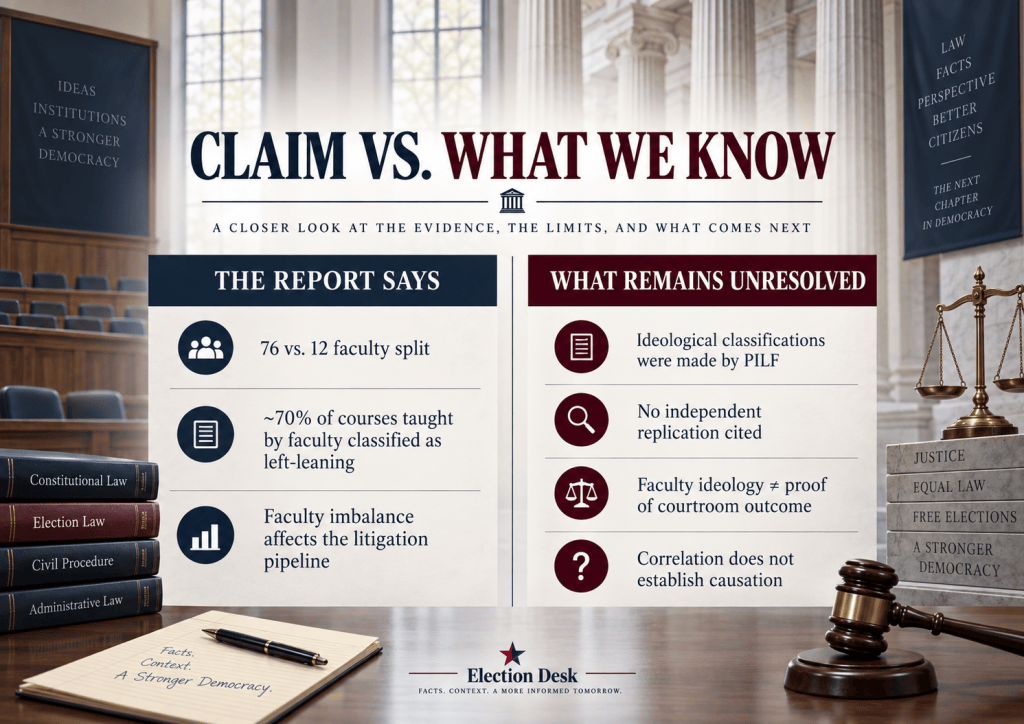
This is a first-of-its-kind count, by PILF’s own account — nobody had previously tried to quantify the ideological makeup of election-law faculty nationally. That means there’s no independent replication yet, and the classifications of “left-leaning” and “conservative” are PILF’s own, not a neutral third party’s. Fox News Digital reported the findings first and says it reached out to Harvard, UC Berkeley, and the University of Michigan law schools — three of the programs PILF names — for comment; the article does not indicate whether any of the three responded.
“The classifications of ‘left-leaning’ and ‘conservative’ are PILF’s own, not a neutral third party’s.”
Adams points to one concrete policy lever: state legislatures funding election-law chairs at public universities in states, like Texas, where he says almost no law school currently teaches the subject at all.
The Short Version
| What happened | PILF report counts ideological lean of election-law faculty at all 198 ABA-accredited law schools |
| Headline number | ~76 left-leaning to 12 right-leaning/conservative professors teaching election law; ~70% of classes taught by left-leaning faculty |
| PILF’s claim | Imbalance shapes who becomes an election litigator, and produces lopsided legal representation in court |
| What’s disputed / unverified | PILF’s own ideological classifications; no independent count exists to check the numbers against |
| Named schools | Harvard, UC Berkeley, University of Michigan cited as examples; Fox News Digital says it contacted all three, response status unreported |
| Proposed fix | State-funded election-law chairs at public law schools, especially in states without existing programs |
Sources
This piece draws on Fox News Digital’s September 17, 2026 report on the Public Interest Legal Foundation’s law-school faculty study, including on-record comments from PILF President J. Christian Adams. The underlying PILF report itself was not independently reviewed for this piece; where PILF’s methodology or classifications are described, that description reflects PILF’s own characterization as reported by Fox News Digital, not independent verification by Election Desk.
 Election Desk
Leave a comment