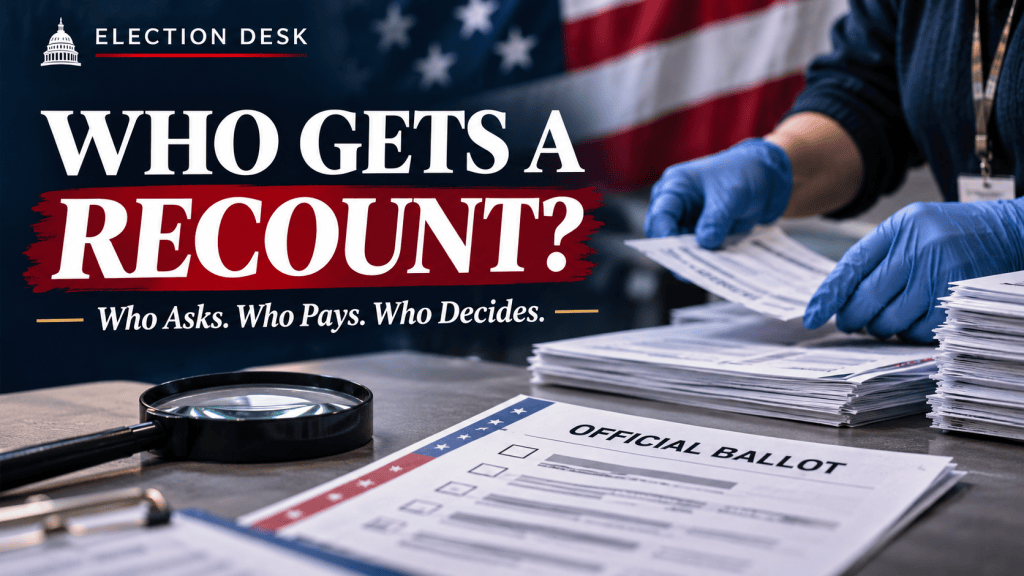
Five states are recounting or have recounted legislative races decided by 311 votes or fewer. Whether a recount happens at all depends on the state, and so does the bill.
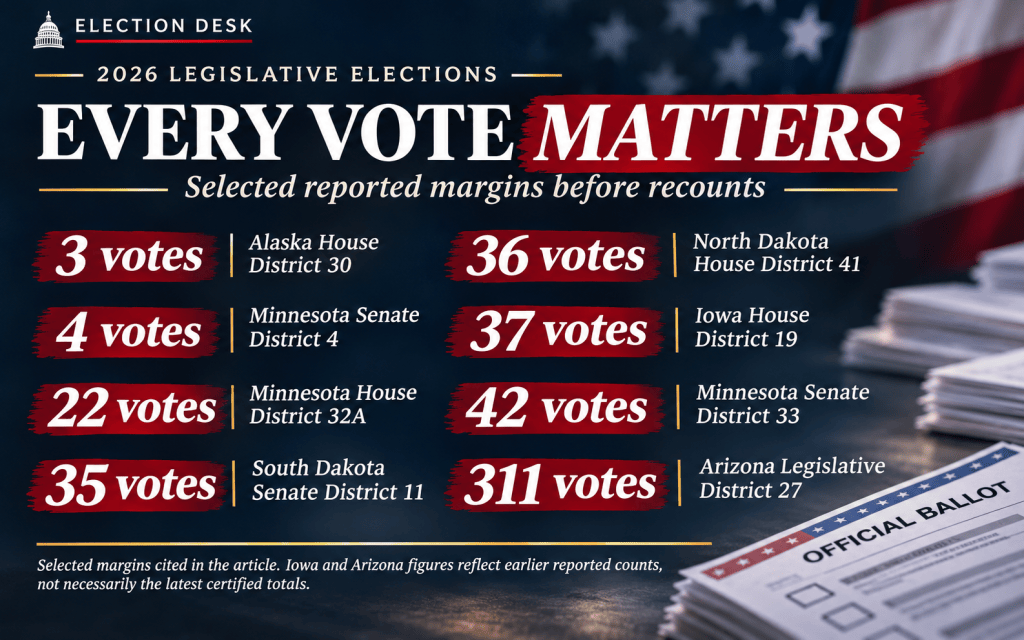
A 22-vote gap in Blaine, Minnesota. A 37-vote gap in Council Bluffs, Iowa. A 35-vote gap in Sioux Falls. Three votes in the Mat-Su Valley of Alaska, after ranked-choice tabulation. A 311-vote gap between two Republican incumbents in Maricopa County, Arizona. The November 3 general election left each of these state legislative races close enough to trigger a recount or to let the trailing candidate ask for one.
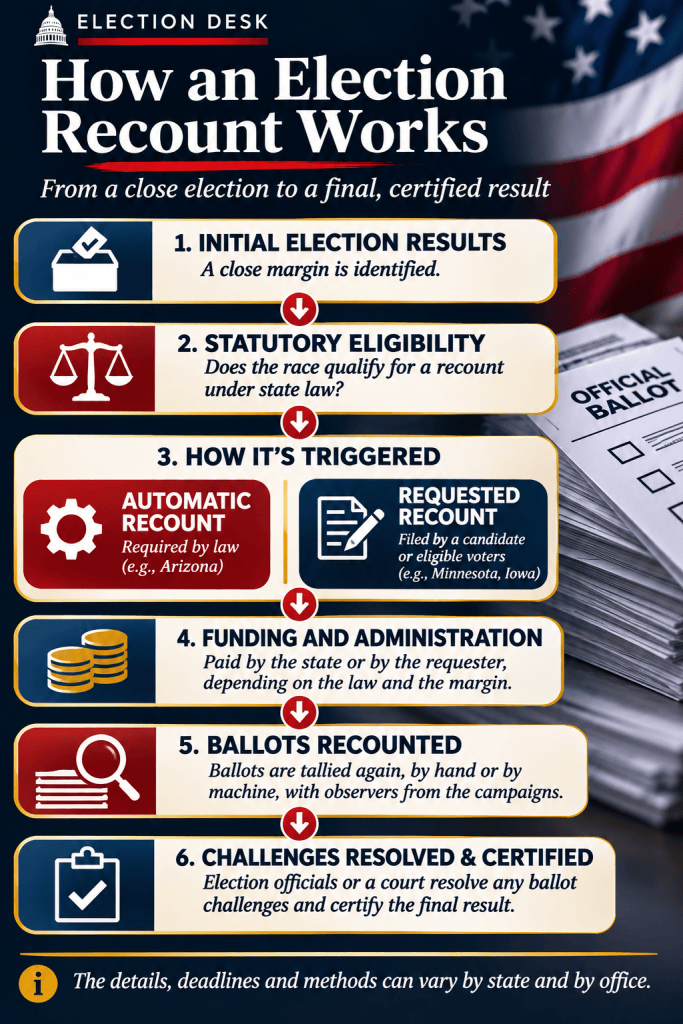
The rules differ in ways that matter. In Arizona, a close enough margin brings a recount without anyone asking, though a judge has to order it. In the Minnesota, Iowa and South Dakota races covered here, the trailing candidate had to request it. Alaska works somewhere in between: the state pays when the margin is tight, but a candidate or 10 voters must still file the request. Some states charge the requester when the margin is wider than the statute allows for a free recount, and some do not allow a recount outside a narrow band at all.
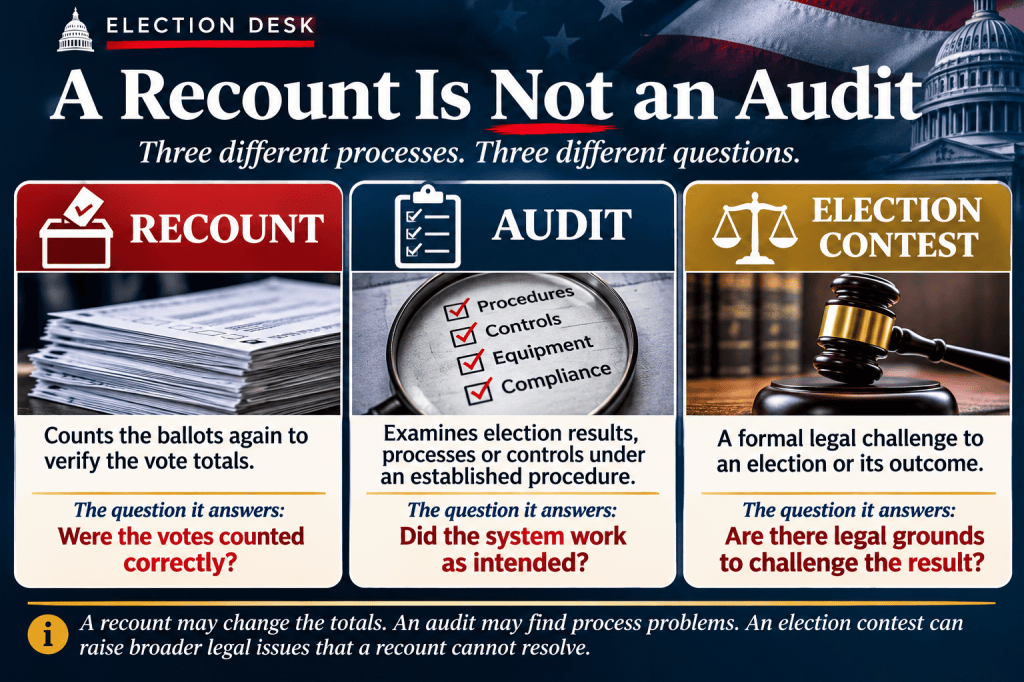
This piece walks through who can ask, who pays, and who runs the count, using this month’s races as the examples. Some of those recounts were still pending when this was written. Where the outcome could not be confirmed against an official source, the text says so. A recount checks whether ballots were counted correctly. It is separate from a post-election audit and from an election contest, a court case that can raise questions a recount cannot.
Who can ask, and what sets one off
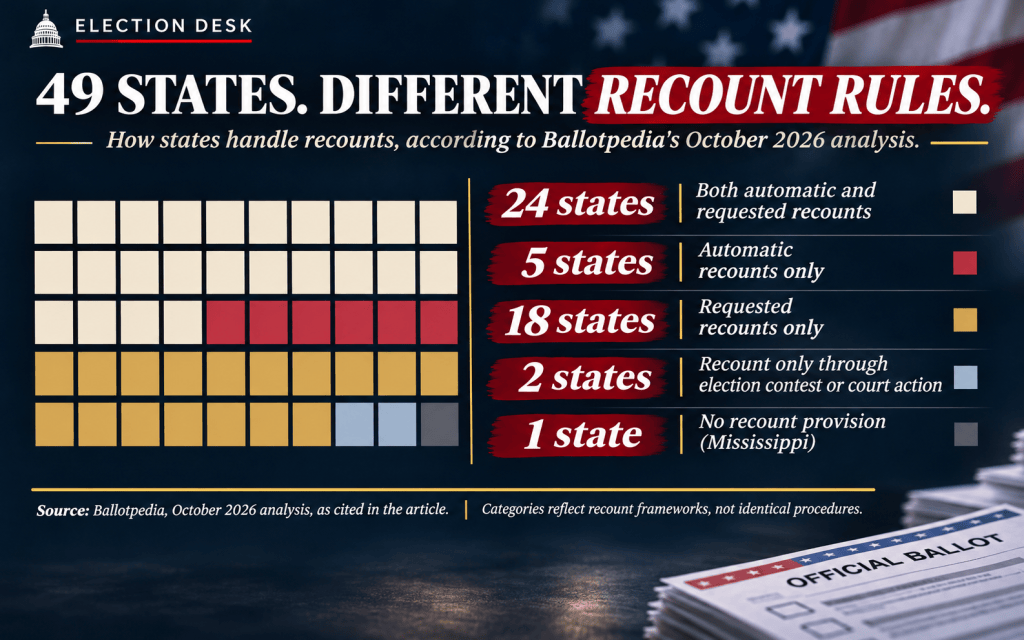
States sort into three groups. Some recount automatically when the margin falls under a set line. Some let the trailing candidate ask. A few do both. Ballotpedia’s October 2026 analysis counts 49 states with some recount provision (Mississippi has none): 24 with both automatic and requested recounts, five automatic only, 18 requested only, and two, Illinois and Tennessee, where a recount comes only through an election contest or court action. The most common automatic line, according to the National Conference of State Legislatures, is a margin of 0.5 percent.
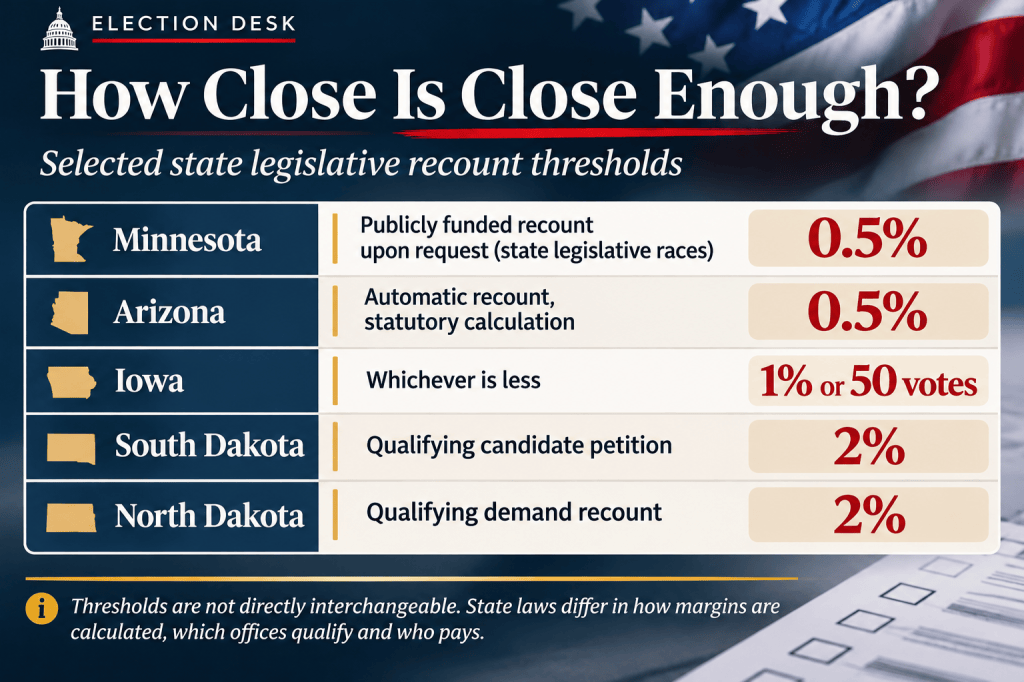
Minnesota funds recounts from public money when the margin is close enough, and the margin decides who pays. Under Minn. Stat. § 204C.35, a publicly funded recount is available when the gap is under 0.25 percent in federal, statewide constitutional and judicial races, or under 0.5 percent in state legislative races. The apparent loser still has to file the request after the State Canvassing Board certifies. Matchett in House District 32A and Smith in Senate District 33 both did, and so did U.S. Rep. Brad Finstad in the 1st Congressional District, who trailed by about 324 votes. A candidate outside those margins can ask too, at their own expense.
Arizona is automatic and judicial. A 2022 law, SB 1008, set the trigger at 0.5 percent of votes cast. No one files anything. The Secretary of State certifies the facts to the Maricopa County Superior Court, which orders the recount once the county and state canvasses are done (A.R.S. §§ 16-661 to 16-663). The statute does not say who pays. Ballotpedia says Arizona does not allow a recount outside that band.
Iowa has no automatic recount. A candidate can request one when the margin is less than the lesser of 1 percent or 50 votes (Iowa Code § 50.48). The request goes to the county commissioner by 5 p.m. the day after the county canvass, and the county recounts by machine. Benjamin Larson’s written request reached Secretary of State Paul Pate on November 10.
South Dakota also leaves it to the candidate. A losing candidate can petition for a recount when the margin is within 2 percent of the total votes cast for all candidates in the race (SDCL 12-21-10 and 12-21-11), and only a tie triggers one automatically.
Alaska counts a tie as the only automatic trigger. Otherwise a candidate, or 10 qualified voters, can ask. The request has to come within five days of certification in most races, according to Ballotpedia, and three days for governor and lieutenant governor.
Who pays, and who counts
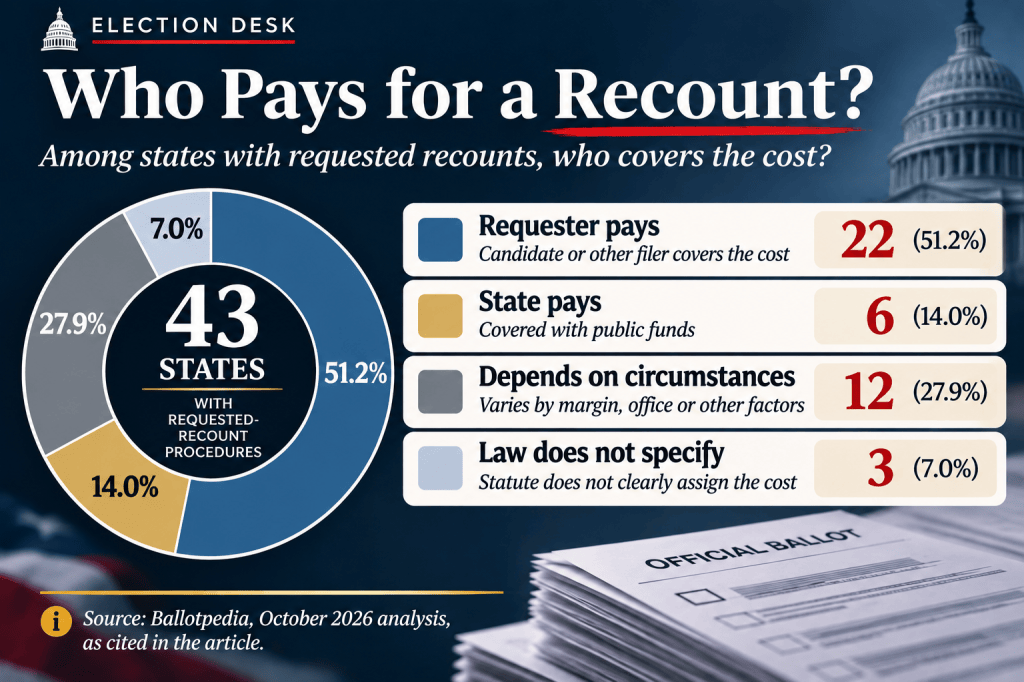
Cost splits along the same line as eligibility. Among states with requested recounts, Ballotpedia’s October 2026 analysis has the requester paying in 22, the state paying in six, the answer depending on circumstances in 12, and state law silent in three. In most states with a close-margin trigger, that same margin decides whether the public pays.
Minnesota’s recounts inside the 0.5 percent legislative line are publicly funded, and the Secretary of State’s office said so for both Senate District 33 and House District 32A. The method is a hand count of the ballots. Candidates can send observers, and campaigns routinely bring lawyers to argue over individual ballots. A candidate who falls outside the margin and asks anyway pays for it, though the jurisdiction pays instead if the winner changes or the hand count differs from the original by more than two votes and 0.25 percent.
Alaska’s Division of Elections runs its own recounts, usually at its office in Juneau, and the Division director has the final say at the table under the state’s recount handbook. The state covers the cost when the margin is under 0.5 percent, as Lt. Gov. Nancy Dahlstrom’s office said when it announced the 2024 recount of Ballot Measure 2. A wider margin, up to 4 percent according to the Anchorage Daily News, can still be recounted at the requester’s cost.
In Iowa the work is local. Pottawattamie County Auditor Mary Ann Hanusa ran the November 16 recount of House District 19 with sealed election-night bags and sealed absentee ballots on display, and with up to five observers per candidate. Ballotpedia lists Iowa as a state-paid recount, though the statute does not say who pays. South Dakota’s Minnehaha County Auditor handled the Sioux Falls recount on November 19.
In North Dakota, the District 41 House race fell within the 2 percent margin that allows a demand recount, and the candidate’s campaign pays for that kind of recount, according to the North Dakota Monitor. Ballotpedia puts the automatic line at 1, 0.5 or 0.25 percent depending on the election.
This month’s close races
Minnesota Senate District 33 (Stillwater area). Republican Sen. Karin Housley led Democrat Nat Smith 23,977 to 23,935, a 42-vote gap that is 0.08 percent of the votes cast. Smith asked for the publicly funded recount after Washington County certified on November 9, and the hand count began at 9 a.m. on November 17. Fox 9 and the Minnesota House’s daily news service both reported Housley still ahead by 42 after the count. Sources give the certification date as either November 18 or 19.
Minnesota House District 32A (Blaine). Republican Rep. Nolan West led Democrat Amanda Matchett 11,833 to 11,811, a 22-vote gap, or 0.09 percent. Anoka County certified on November 10 and Matchett requested the recount. The recount was set for November 23 and the county certified the result on November 24. Recount figures posted by the Secretary of State are unofficial until the canvassing boards certify them.
Iowa House District 19 (Council Bluffs). Republican Rep. Brent Siegrist, whose name WOWT spells Segrist, finished 37 votes ahead of Democrat Benjamin Larson on election night. Pottawattamie County recounted more than 10,000 ballots on November 16. Siegrist came out ahead 5,157 to 5,118, a 39-vote margin against 37 on election night, and the state certified the result on November 24. Republicans hold their House majority whichever way it goes.
South Dakota Senate District 11 (Sioux Falls). Republican Chris Karr beat Democrat Aaron Matson by 35 votes. Matson was the only one of five eligible losing legislative candidates to ask for a recount. It ran on November 19 and left the result unchanged.
Arizona Legislative District 27 (northwest Maricopa County). Arizona elects two House members here. Democrat Deborah Howard took the first seat with 40,161 votes. Republicans Lisa Fink and Tony Rivero, both incumbents, fought over the second. On November 11 the county reported Fink at 33,724 and Rivero at 33,413, a 311-vote gap. KTAR later reported 33,731 to 33,418, a 313-vote gap. Either is well inside the 0.5 percent line, so the recount is automatic. Rivero had already conceded on November 6. The recount still needs a court order after the November 23 state canvass, and no recount result had been reported as of November 28.
Alaska House Districts 29 and 30 (Mat-Su Valley). After the Division of Elections completed ranked-choice tabulation on November 18, Republican Doug Massie led incumbent Republican Rep. Kevin McCabe by three votes in District 30. McCabe led in first-choice votes, but supporters of Democrat Sandra Loomis ranked Massie second at a higher rate once she was eliminated. In District 29, the Alaska Beacon reported an incumbent leading by four. McCabe requested a recount on November 24. Reports differ on the exact line for a state-paid recount.
North Dakota. The State Canvassing Board certified on November 18, and one legislative race, District 41, fell within the 2 percent margin for a demand recount, which the candidate pays for. Republican Jennifer Benson trailed Democrat Stacy Heidenreich by 36 votes and had until November 21 to ask. Reports available as of November 28 did not say whether she did.
What happens next
Minnesota has two larger contests in the queue. In Senate District 4, Peterson led Kupec by four votes. The recount began November 23, and the Secretary of State’s portal lists 33 challenged ballots from Becker and Clay counties. In the 1st Congressional District, Johnson led Finstad by about 324 votes, Finstad requested a recount on November 19, and the count runs November 30 through December 3, with certification set for December 8. Recount figures for Senate District 4 are unofficial until the canvassing boards finish, and the congressional count has not begun.
In Alaska, the Division of Elections certified on November 23. The deadline to request a recount in House District 30 or 29 is November 28. The Division then has to finish the count within the window the statute sets. Whoever loses can still go to court after a recount, as candidates have in earlier cycles.
Arizona’s recount in Legislative District 27 follows the court order. In Iowa, the result was certified on November 24, and Secretary of State Paul Pate has said Larson can seek legal action if he disagrees with the recount. North Dakota’s District 41 recount is candidate-funded.

Sources: the Minnesota Secretary of State’s legislative recount updates; the Minnesota House session daily; Fox 9; WOWT on the Iowa House District 19 recount; Dakota News Now; AZFamily and KTAR on Arizona Legislative District 27; the Alaska Beacon and Anchorage Daily News on the Mat-Su races; the Alaska Lieutenant Governor’s 2024 recount release; Ballotpedia’s Alaska recount page; and Verified Voting. The state-by-state counts come from Ballotpedia and the National Conference of State Legislatures. Minnesota and Iowa statute text comes from the Minnesota Revisor of Statutes and the Iowa Legislature.
Minnesota and Iowa thresholds come from statute text; Alaska, South Dakota and Arizona rest on Ballotpedia and news reports because the statute pages would not load. Outcomes for Minnesota House District 32A, Senate District 4, the 1st Congressional District, Arizona Legislative District 27 and the Alaska races could not be confirmed as of November 28, and neither could the Arizona court order or whether a recount demand was filed in North Dakota’s District 41, and the Minnesota Senate District 33 certification date (November 18 or 19) and the Alaska margin line are reported inconsistently.
Keep Election Desk Explainings Free
Election Desk exists to explain how elections actually work — from voting rules and ballot procedures to certification, recounts, and court challenges — without spin or partisan framing.
If this explainer helped you understand the process or cleared up confusion, reader support makes it possible to keep producing clear, accessible election reporting.


Leave a Reply