
An Election Desk explainer
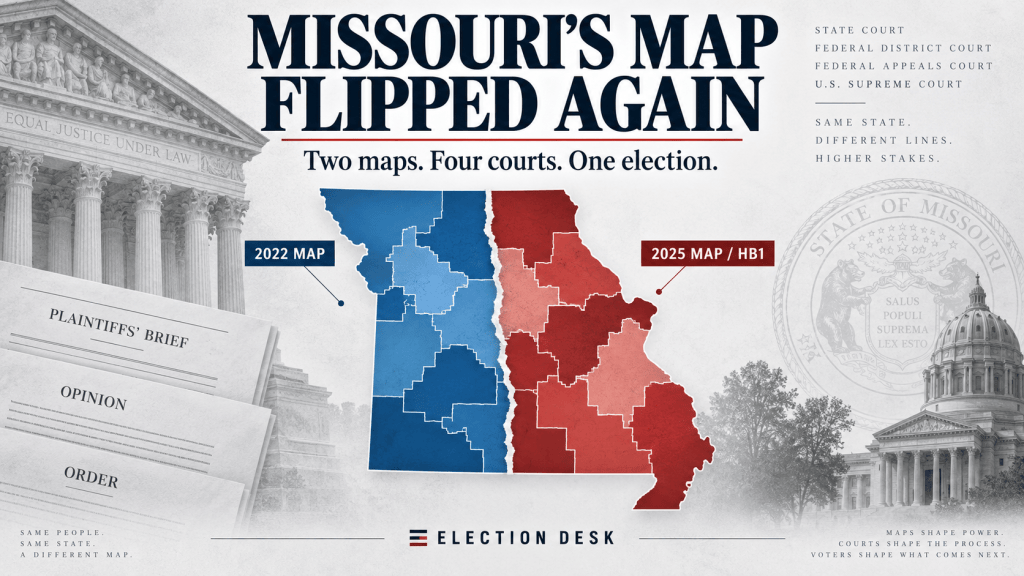
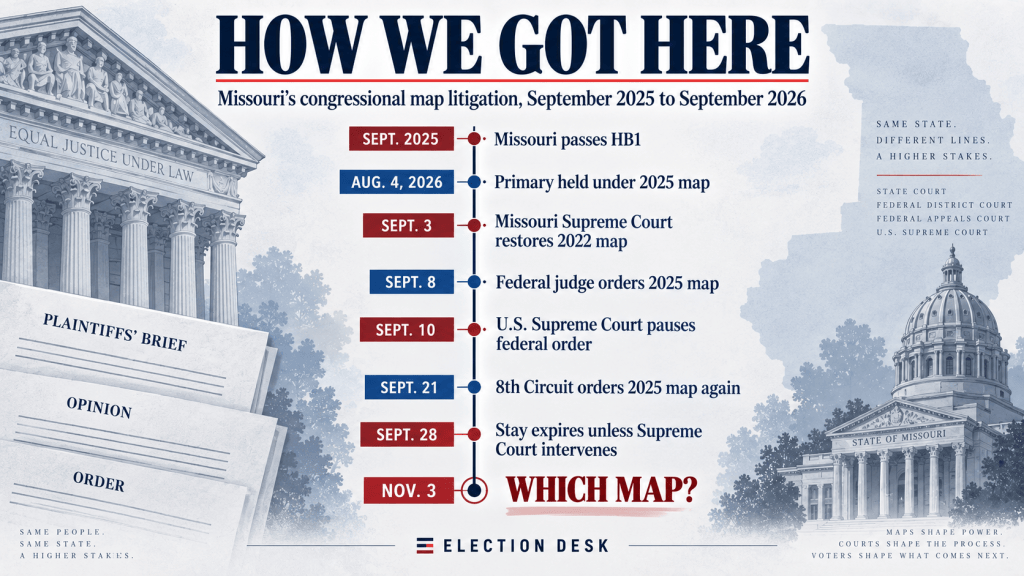
A federal appeals court on Monday ordered Missouri to use a Republican-drawn congressional map for the November election — then immediately paused its own order for a week, leaving the state’s older map in place for now. It’s the latest turn in a yearlong fight that has already run through a state trial court, the Missouri Supreme Court, a federal district judge, and the U.S. Supreme Court twice. The 8th U.S. Circuit Court of Appeals, based in St. Louis, ruled that Missouri’s plan to use its older, 2022 map for the general election violates the Constitution, and directed a lower court to order use of the map lawmakers drew last year — effective Sept. 28, unless the U.S. Supreme Court intervenes first. Opponents said within hours that they plan to ask the justices to do exactly that. Two things are true at once here: which map Missouri voters will actually use in November is still not fully settled, and the fight itself is a genuine, high-stakes legal dispute rather than a simple partisan talking point. This piece walks through what the map does, how the litigation got this tangled, and what happens next.
What it is
The map itself
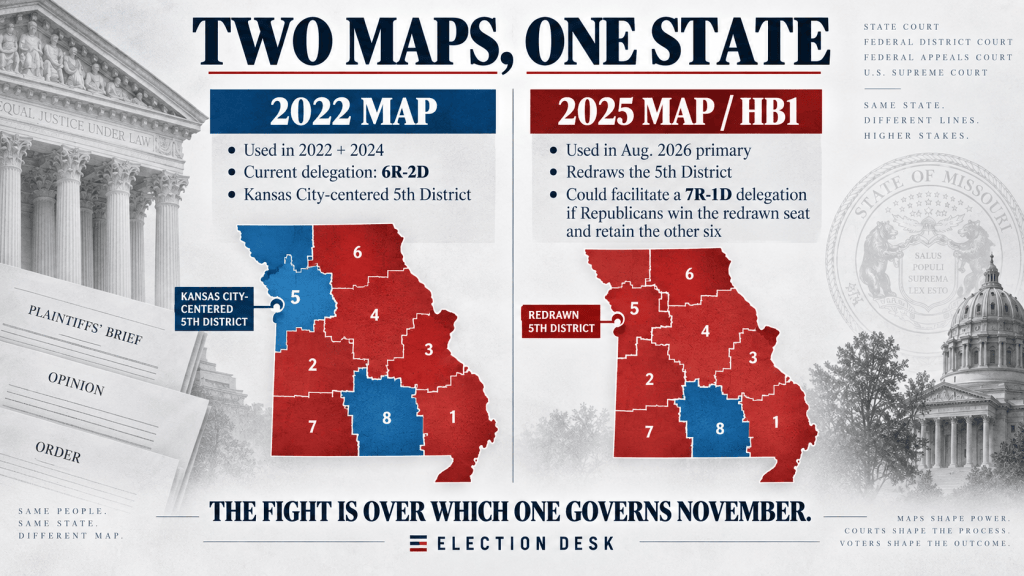
In September 2025, Missouri’s Republican-controlled legislature passed, and Gov. Mike Kehoe signed, a new congressional map — commonly called “the 2025 map” or “HB1” — in a special session convened partway through the decade, rather than after the standard post-census redistricting cycle. The map redraws the Kansas City-area 5th District, long held by Democratic Rep. Emanuel Cleaver, splitting the city’s Jackson County core across three districts and shifting the seat toward Republicans. Backers say the map reduces the number of counties split between districts. Opponents call it a mid-decade gerrymander pushed at the urging of the Trump administration, which was also pressing Texas and other Republican-led states to redraw lines ahead of the 2026 midterms.
Under Missouri’s current map — the one drawn after the 2020 census and used in 2022 and 2024 — the state’s U.S. House delegation is six Republicans and two Democrats. The 2025 map redraws Cleaver’s seat to lean Republican; if Republicans won that redrawn seat while holding their other six, the delegation would become 7–1, though the actual outcome still depends on how voters cast ballots, not on the map alone.
The referendum
“The 2025 map therefore ‘is not the law and has never been the law.’”
Missouri’s constitution allows voters to force a statewide referendum on a new law by petition. A group called People Not Politicians, led by Richard von Glahn, submitted more than 300,000 signatures seeking a public vote on whether the 2025 map should stand. The Missouri Supreme Court later wrote there was no dispute the petition had the number of signatures required by the Missouri Constitution. State law gave Secretary of State Denny Hoskins, a Republican, until 5 p.m. on Aug. 4, 2026 — the day of Missouri’s primary — to certify or reject the petition. He issued a certificate of insufficiency at about 4 p.m. that day, arguing the state constitution doesn’t allow a referendum on congressional redistricting specifically. Because Hoskins had not certified the referendum, the August primary was conducted under the 2025 map.
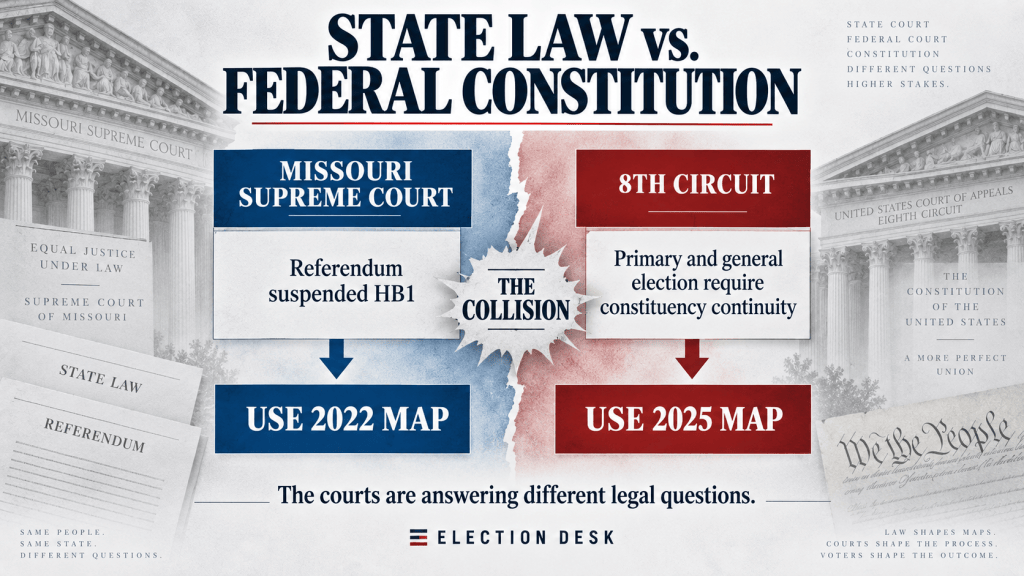
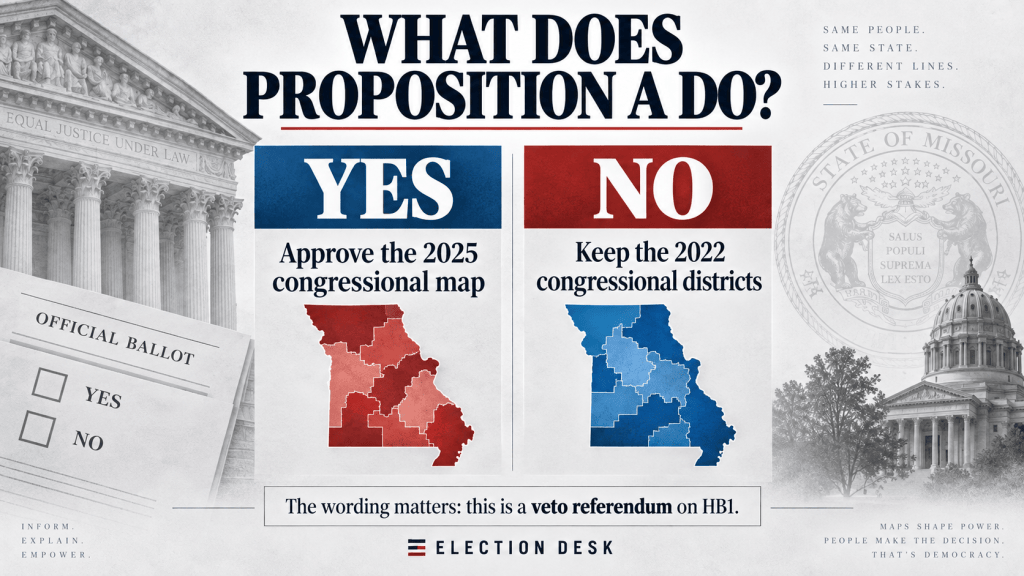
Von Glahn sued. On Sept. 3, 2026, the Missouri Supreme Court ruled unanimously that the referendum petition had met every legal requirement, and that the 2025 map therefore “is not the law and has never been the law” — meaning, in the court’s view, that Missouri should use its 2022 map for the November general election while voters decide the map’s fate at the ballot box, as Proposition A. (A “yes” vote on Proposition A would approve the 2025 map; a “no” vote would leave the 2022 districts in place — Missouri’s veto-referendum ballots are worded this way.) The court’s order wasn’t merely advisory: it explicitly enjoined Hoskins from using the 2025 map unless and until voters approve it. The court found no carve-out for redistricting in the state’s referendum power:
“The Missouri Constitution authorizes a referendum as to any act of the general assembly.” — Missouri Supreme Court, Sept. 3, 2026
The federal collision
“Missouri briefly had a federal order and a state order pointing in opposite directions at the same time.”
A separate group of plaintiffs — U.S. Rep. Bob Onder, state Sen. Rick Brattin (the Republican nominee for the 5th District under the 2025 map), and two voters — sued in federal court, arguing that switching maps between the primary and the general election is unconstitutional because voters who were shifted into new districts under the 2025 map would be asked to vote in November for candidates chosen in a primary they had no part in nominating. Their complaint raised multiple constitutional theories, including the Equal Protection Clause and the Elections Clause.
That argument found a receptive federal judge. U.S. District Chief Judge Stephen Clark — a Trump appointee in the Eastern District of Missouri — issued a temporary restraining order on Sept. 8, 2026, barring Hoskins from using any map except the 2025 one. The order came down within minutes of Justice Brett Kavanaugh separately rejecting the state’s own emergency request to pause the Missouri Supreme Court’s ruling — meaning Missouri briefly had a federal order and a state order pointing in opposite directions at the same time.
Where it stands
A week of whiplash
What followed was a genuinely chaotic stretch for the officials who actually have to print ballots:
- Sept. 8: Clark orders the 2025 map used; Hoskins tells local election authorities to comply.
- Sept. 9: The 8th Circuit declines to pause Clark’s order, but People Not Politicians immediately takes the fight to the U.S. Supreme Court.
- Sept. 10: The U.S. Supreme Court stays Clark’s order, effectively reviving the Missouri Supreme Court’s 2022-map ruling. Hoskins reverses course again, directing officials back to the 2022 map. The Missouri Supreme Court, which had already begun contempt proceedings against Hoskins over his Sept. 8 email, finds him in contempt but imposes no punishment after he corrects course.
Boone County Clerk Brianna Lennon summed up the position local officials were put in: courts were simultaneously ordering her to use two different maps.
Monday’s ruling
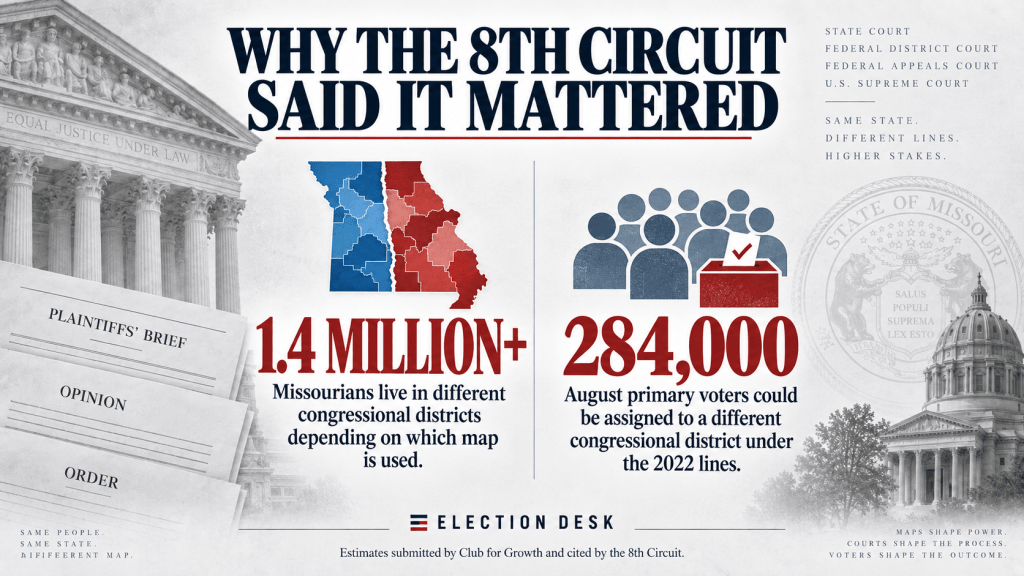
The underlying federal case — Onder and Brattin’s constitutional challenge — kept moving even after the Supreme Court’s stay. The 8th Circuit heard oral arguments on the merits on Sept. 17, with the panel’s presiding judge, James Loken, pressing both sides on whether there was still time to change the map at all before the election. On Sept. 21, a three-judge panel ruled 2-1, in an unsigned majority opinion, that Missouri’s plan to use the 2022 map for the general election — after conducting its primary under the 2025 map — violates Article I, Section 2 of the Constitution, which the panel read to require “continuity in the constituency throughout all stages of a single election.” The panel cited estimates — submitted to the court by the conservative Club for Growth — that more than 1.4 million Missourians live in different districts depending on which map applies, including roughly 284,000 people who voted in the August primary who would be assigned a different district for November under the 2022 lines. Notably, the panel did not decide the broader Equal Protection or Elections Clause arguments the parties had also raised; it relied narrowly on the primary-to-general continuity theory. One judge on the panel dissented — agreeing with the majority’s constitutional reasoning, but arguing the court should not have reached the merits this close to the election at all.
“More than 1.4 million Missourians live in different districts depending on which map applies.”
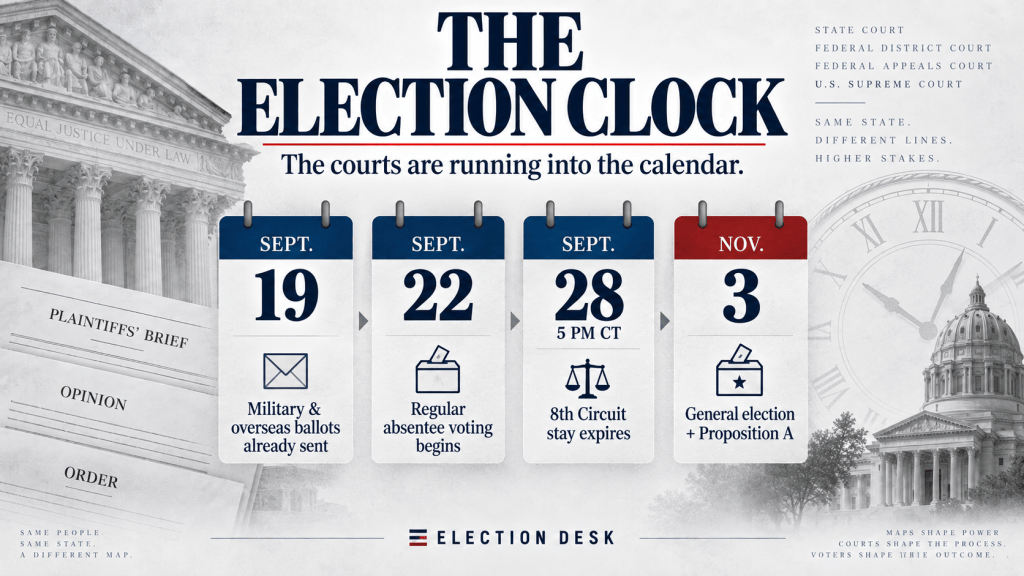
The ruling doesn’t change what map is used right away, though. The panel directed the district court to enter a permanent injunction requiring the 2025 map, but stayed that injunction until Sept. 28 at 5 p.m. Central time specifically to give the Supreme Court room to act. Unless the justices intervene before then, Missouri will have to switch to the 2025 map for the general election; until then, the 2022 map remains in effect on the ground. People Not Politicians said Monday it will ask the Supreme Court to step in again.
Some legal observers had been skeptical before Monday’s ruling that the 8th Circuit could ultimately change the map actually used in November, given both the Supreme Court’s stay and the Missouri Supreme Court’s separate finding — under state, not federal, law — that the 2025 map never took legal effect. Former Missouri Supreme Court Judge Michael Wolff called that state-law finding an “insuperable obstacle” for Republicans, since the Missouri Supreme Court, not a federal appeals court, has the final word on what Missouri law says. The 8th Circuit panel disagreed with that framing, ruling that a state court’s determination of state law doesn’t override a separate federal constitutional requirement. Missouri’s Republican leadership had argued for that outcome all along: Gov. Kehoe said before the ruling that he remained “confident in the legal process.”
“The panel did not decide the broader Equal Protection or Elections Clause arguments.”
Why the calendar matters
“Military and overseas ballots had already gone out before Monday’s ruling.”
Missouri’s court fight has been colliding with hard, fixed election-administration deadlines. Military and overseas ballots — printed under the 2022 map — had already gone out by Sept. 19, before Monday’s ruling. Regular absentee voting begins today, Sept. 22, also under the 2022 map, since the 8th Circuit’s order isn’t scheduled to take effect until Sept. 28. Local election clerks, represented separately in the 8th Circuit case, had urged the court to weigh the practical cost of another switch; the clerks argued that further changes would create confusion “after ostensibly-final resolution consistent with Missouri law.” If the Supreme Court doesn’t act by Sept. 28, Missouri will need to switch systems again — including its centralized voter registration database, which assigns each voter’s district code and, according to Republican filings, is not simple to update on short notice this close to the election.
“Which map Missouri voters will actually use in November is still not fully settled.”
The Short Version
| 2022 map | 2025 map (HB1) | |
|---|---|---|
| Drawn | After 2020 census | Mid-decade special session, 2025 |
| Used in | 2022 and 2024 elections | Aug. 2026 primary |
| Current delegation | 6 Republicans, 2 Democrats | — |
| Potential partisan effect | — | Could produce a 7R–1D delegation if Republicans win the redrawn 5th District and hold their other six seats |
| District most affected | 5th (Cleaver), Kansas City-anchored | 5th split across three districts |
| Backed by court order from | Missouri Supreme Court (Sept. 3); reinstated by U.S. Supreme Court stay (Sept. 10) | U.S. District Judge Clark (Sept. 8, later stayed); 8th Circuit merits ruling (Sept. 21, itself stayed until Sept. 28) |
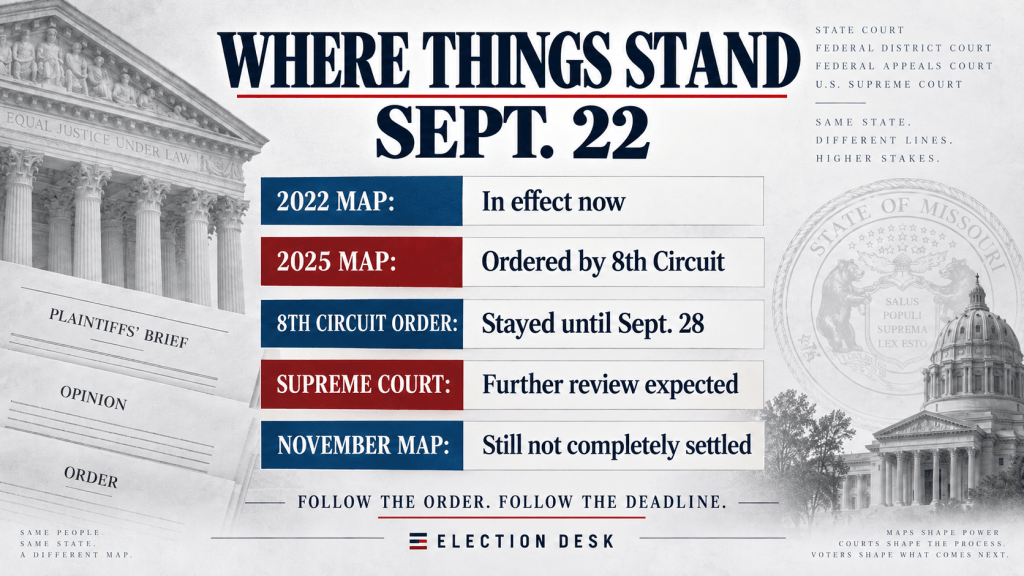
| Status as of Sept. 22, 2026 | Currently in effect on the ground | Ordered by 8th Circuit, effective Sept. 28 unless the Supreme Court intervenes first |
| On the Nov. 3 ballot as | — | Proposition A (up-or-down referendum on the 2025 map) |
Sourcing note
This piece draws on rulings and filings from the Missouri Supreme Court (including its official case summary in von Glahn v. Hoskins, No. SC101805), the U.S. District Court for the Eastern District of Missouri, the 8th U.S. Circuit Court of Appeals, and SCOTUSblog’s docket tracking, alongside reporting from the Associated Press, Bloomberg Law/Bloomberg Government, NBC News, Courthouse News Service, the Missouri Independent, Democracy Docket, St. Louis Public Radio, KCUR, and Missouri regional outlets (KCTV5, KFVS12/KY3, the Southeast Missourian). Figures on delegation composition and district partisan lean are drawn from official House biographical and district data. The 1.4-million and 284,000-voter figures cited in the “Monday’s ruling” section come from the 8th Circuit’s own opinion, which in turn drew on estimates submitted by the Club for Growth, a conservative advocacy group that supports the 2025 map; they are presented here as the court’s stated basis for its ruling, not as independently audited counts. A widely shared social-media summary of Monday’s ruling circulating on X cited the same general delegation-shift figure (6–2 to a potential 7–1) used here, which checks out against official sources.
This is a fast-moving case, and this piece reflects the state of the litigation as of the morning of Sept. 22, 2026. People Not Politicians has said it will ask the Supreme Court to intervene before the 8th Circuit’s Sept. 28 deadline; further changes to which map Missouri uses are possible right up to that date. Election Desk will update this piece as the litigation develops.
For more on how U.S. redistricting and election-law disputes work, see Election Desk’s overview of federal and state election law.
 Election Desk
Leave a comment