
Tennessee Republicans choose their nominee for governor on Thursday, August 6, in a primary that has tightened in its final stretch. Three GOP officeholders are treated as the field’s major contenders — U.S. Sen. Marsha Blackburn, U.S. Rep. John Rose, and state Rep. Monty Fritts — though a fourth Republican, Cito Pellegra, is also on the ballot with no tracked polling or fundraising to date. The winner will face the Democratic primary winner and any independent candidates in the November 3 general election to succeed term-limited Gov. Bill Lee.
Where the polling stands
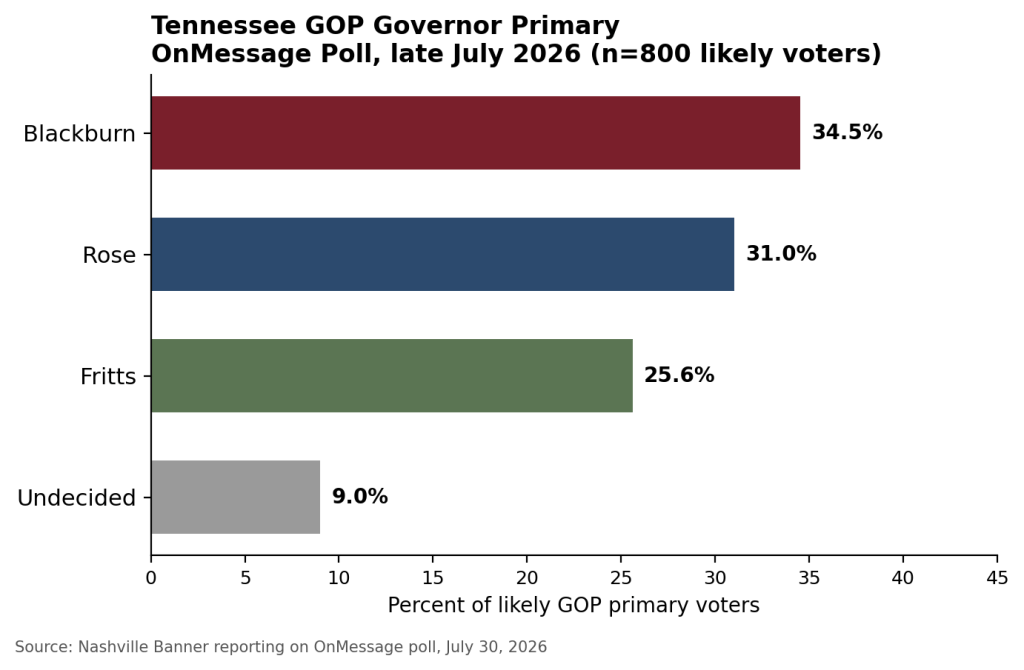
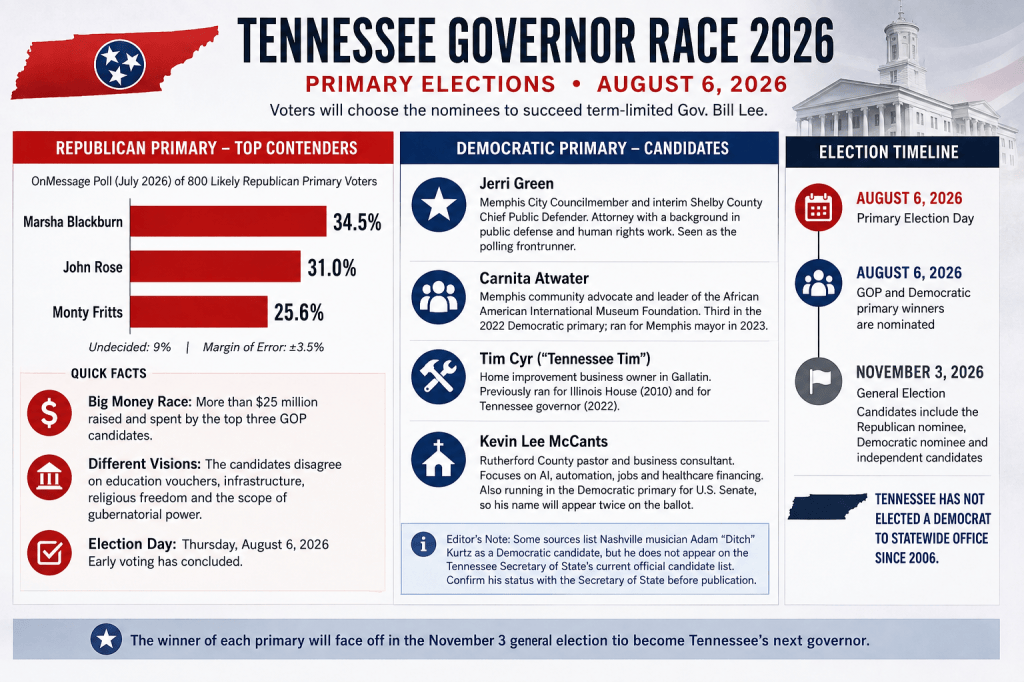
Blackburn has led the race since entering it last year, but her margin has narrowed. A late-July poll of 800 likely Republican primary voters conducted by OnMessage — described by the Nashville Banner as the closest survey published so far in the race — put Blackburn at 34.5%, Rose at 31%, and Fritts at 25.6%, with 9% undecided. Blackburn’s campaign has disputed the poll’s finding of a single-digit gap, while Rose’s campaign manager, Chris Devaney, has pointed to it as evidence of late momentum. Both campaigns agree on one thing: with the vote days away, there is limited time left for either trailing candidate to close the gap.
(Note: An earlier version of the numbers circulated publicly showed Blackburn, Rose, and Fritts at 39%, 35%, and 29% — figures that sum to more than 100% and don’t match any poll Election Desk could independently verify. The figures above reflect the OnMessage poll as reported by the Nashville Banner.)
With the vote days away, there is limited time left for either trailing candidate to close the gap.
Money in the race
Campaign finance filings show sharply different strategies among the three candidates. Blackburn has out-raised her rivals overall and built the largest war chest — roughly $6 million in cash on hand after her latest filing — drawing contributions from more than 19,000 donors, about two-thirds of them from outside Tennessee. Her campaign has also drawn scrutiny over a $4.8 million transfer from her U.S. Senate campaign account to a Club for Growth-linked political action committee, which in turn moved a similar sum into a new state PAC supporting her candidacy; a nonpartisan campaign-finance tracking group has described the maneuver as a legal workaround, since Tennessee law bars her from spending federal Senate funds directly on the state race. A separate complaint alleging Blackburn improperly used Senate funds to lay groundwork for her gubernatorial bid before formally announcing remains under review by the state campaign finance board.
More than $25 million has flowed through the race, making money nearly as much a story as the candidates themselves.
Rose, meanwhile, has financed his campaign largely through personal loans — nearly $9 million as of the most recent reporting period — reflecting a fortune built from selling an IT training company decades ago. Total fundraising figures vary somewhat by source and date: the Tennessee Firefly’s race tracker, last updated August 1, put Rose’s total raised at $14.97 million and Blackburn’s at $10.74 million — a combined figure north of $25 million that has drawn criticism from some voters and commentators who argue the race is being shaped disproportionately by personal wealth and outside money rather than grassroots support. (Earlier reporting from mid-July put Rose’s total closer to $10.8 million, reflecting the gap between reporting periods.) Fritts, by contrast, has run a far smaller operation, raising roughly $255,000 from just over 100 donors and spending about $26,000 on advertising in the most recent period, compared with Blackburn’s $651,000 and Rose’s $39,000.
The candidates’ pitches
Blackburn, a nearly three-decade officeholder who has served in the U.S. Senate since 2019, has campaigned on continuing what she describes as Tennessee’s conservative economic momentum, including reduced housing-permitting barriers. Rose, a former information-technology entrepreneur who was elected to Congress in 2018 and was among 147 House Republicans who voted against certifying the 2020 presidential election, has emphasized his business background and has proposed infrastructure investments such as widening interstate highways statewide. Fritts, a state representative from Kingston who describes himself as a constitutionalist and Christian (some coverage has characterized him as a Christian nationalist, a label he has not used of himself), has run on a platform of limited government and has opposed continued expansion of the state’s Education Freedom Scholarships program, calling it “fiscally irresponsible” — a position that sets him apart from both Blackburn and Rose, who support expansion. His campaign slogan, “Don’t D.C. my Tennessee,” has been a recurring theme at candidate forums.
Fritts has also drawn scrutiny for a policy proposal reported by WSMV: he said he would work to ban mosques and what he called “pagan religions” — including Islam, Buddhism, and Hinduism — if elected governor. Legal analysts cited in that reporting noted the proposal would conflict with First Amendment religious-freedom protections; a spokesperson for Blackburn said she “supports the religious freedom our country was founded upon” while also describing Tennessee as “a Christian state.”
An investigation by Nashville’s WSMV found that several campaign promises made by all three candidates — on immigration enforcement, education policy, foreign land ownership restrictions, and religious-freedom measures — would exceed the legal authority of the governor’s office, requiring federal action, state legislative approval, or independent board action to implement.
An investigation found several campaign promises from all three leading candidates would require powers the governor simply does not have.
The Democratic field
The Tennessee Secretary of State’s official candidate list shows four Democrats competing in the August 6 gubernatorial primary: Carnita Atwater, Tim Cyr, Jerri Green, and Kevin Lee McCants. Green has generally been viewed as the frontrunner, though all four remain on the ballot.
Jerri Green has represented District 2 on the Memphis City Council since January 2024 and was appointed interim Shelby County Chief Public Defender by Shelby County Mayor Lee Harris in January 2026. An attorney with a background in public defense and international human rights work, she holds a bachelor’s degree from the University of Tennessee, Knoxville, and a J.D. from Georgetown University Law Center, and previously served as a senior policy advisor and deputy chief of staff to Harris. She ran unsuccessfully for a Tennessee House seat in 2020. Multiple outlets, including Tennessee Lookout and Memphis’s Action News 5, have reported polling showing Green leading the Democratic field.
Carnita Atwater is a Memphis community advocate who leads the African American International Museum Foundation. She finished third in the 2022 Democratic gubernatorial primary and ran for Memphis mayor in 2023. She holds bachelor’s and master’s degrees from Austin Peay State University and a Ph.D. in public health administration from Tennessee State University.
Tim Cyr, who campaigns as “Tennessee Tim,” owns a home-repair business in Gallatin. He previously ran for the Illinois House of Representatives in 2010 and for Tennessee governor in the 2022 Democratic primary.
Kevin Lee McCants is a Rutherford County pastor — senior pastor of an online ministry he co-leads with his wife — with a background spanning manufacturing, logistics, and corporate training, and holds a master’s degree in industrial/organizational psychology. His campaign centers on how artificial intelligence and automation will affect jobs and healthcare financing. McCants is simultaneously running in the Democratic primary for U.S. Senate, meaning his name will appear twice on the same statewide ballot.
(Editor’s Note: Ballotpedia and Wikipedia’s election tracker list Nashville musician Adam “Ditch” Kurtz as a Democratic candidate. However, he does not appear on the Tennessee Secretary of State’s current official candidate list reviewed for this article.)
Tennessee has not elected a Democrat to statewide office since 2006, when Phil Bredesen won reelection as governor.
Tennessee has not elected a Democrat to statewide office since 2006.
What’s next
Early voting has concluded, and Election Day is Thursday, August 6. The Republican primary winner and the Democratic primary winner advance to the November 3 general election, alongside a large field of independent candidates.
Election Desk will follow the August 6 results and update coverage of the general election field as it takes shape.
 Election Desk
Leave a comment