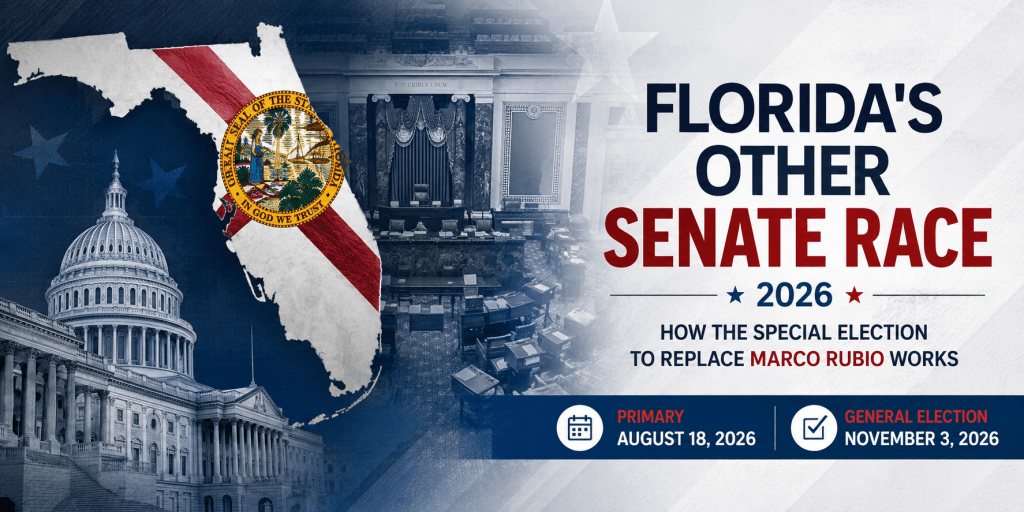
Florida voters won’t just be choosing a governor and a full slate of U.S. House members this fall. They’ll also decide who finishes out the final two years of Marco Rubio’s U.S. Senate term — a contest that is procedurally distinct from any other race on the 2026 ballot, and the first Senate special election Florida has held since 1936. With the primary now less than two weeks away, on August 18, both parties’ fields are set and campaigns have moved from qualifying paperwork to the closing stretch.
Here’s how the seat became vacant, how Florida law fills it, and who’s actually running.
How the seat opened up
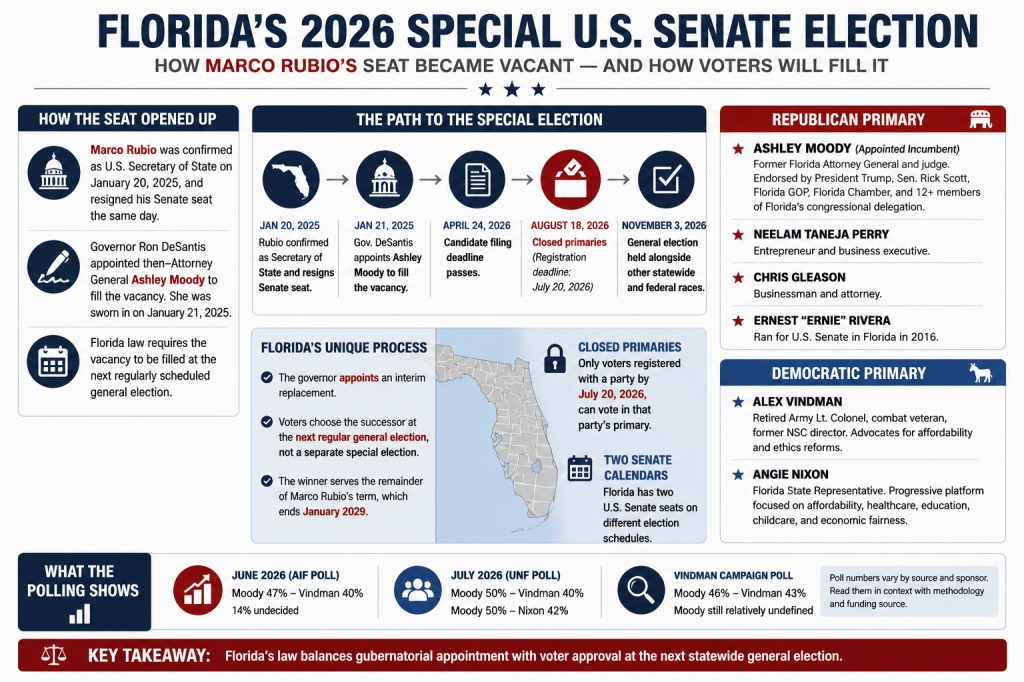
Rubio, a three-term Republican senator, was nominated by President Donald Trump to serve as U.S. Secretary of State in his second administration. The Senate confirmed him on January 20, 2025, and he resigned his Senate seat the same day.
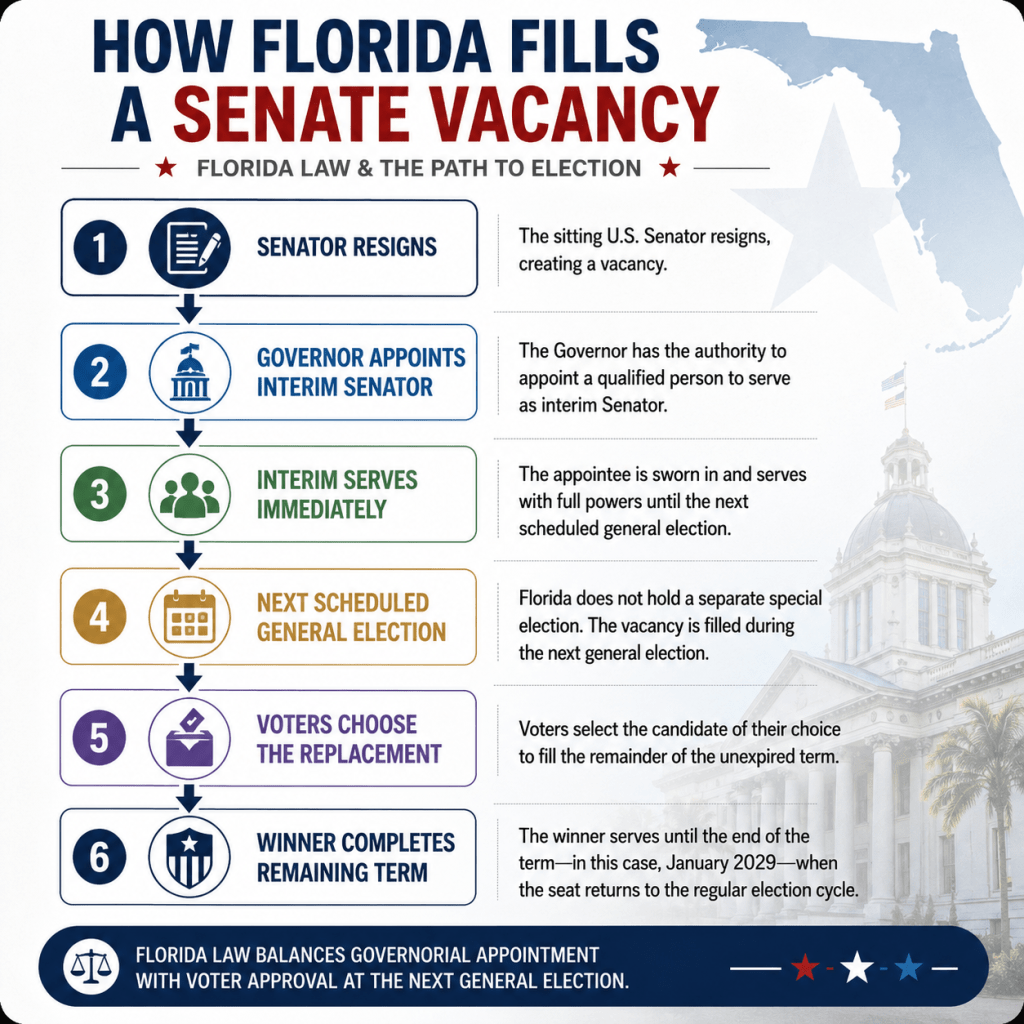
Florida’s vacancy-filling statute
“Florida doesn’t hold a standalone Senate special election—it folds the contest into the next regularly scheduled general election.”
Under Florida law, when a U.S. Senate seat becomes vacant, the governor has the authority to appoint a temporary replacement to serve until the vacancy is filled by election. That appointee holds the seat until the next scheduled general election — Florida does not call a standalone special election on its own calendar, as some states do. Instead, the special election is folded into the state’s regular November general election cycle.
Governor Ron DeSantis appointed then–Attorney General Ashley Moody to the seat, and she was sworn in on January 21, 2025. She is now running in the special election to hold the seat through the remainder of Rubio’s term, which runs to January 2029 — at which point the seat reverts to Florida’s normal six-year Senate election cycle.
This structure means Florida has two U.S. Senate seats functioning on different clocks: its regularly scheduled Class III seat (not up in 2026) and this special election for the remainder of the Class I term Rubio vacated.
“Florida’s two Senate seats now operate on different election calendars because one is finishing Marco Rubio’s unexpired term.”
Where things stand
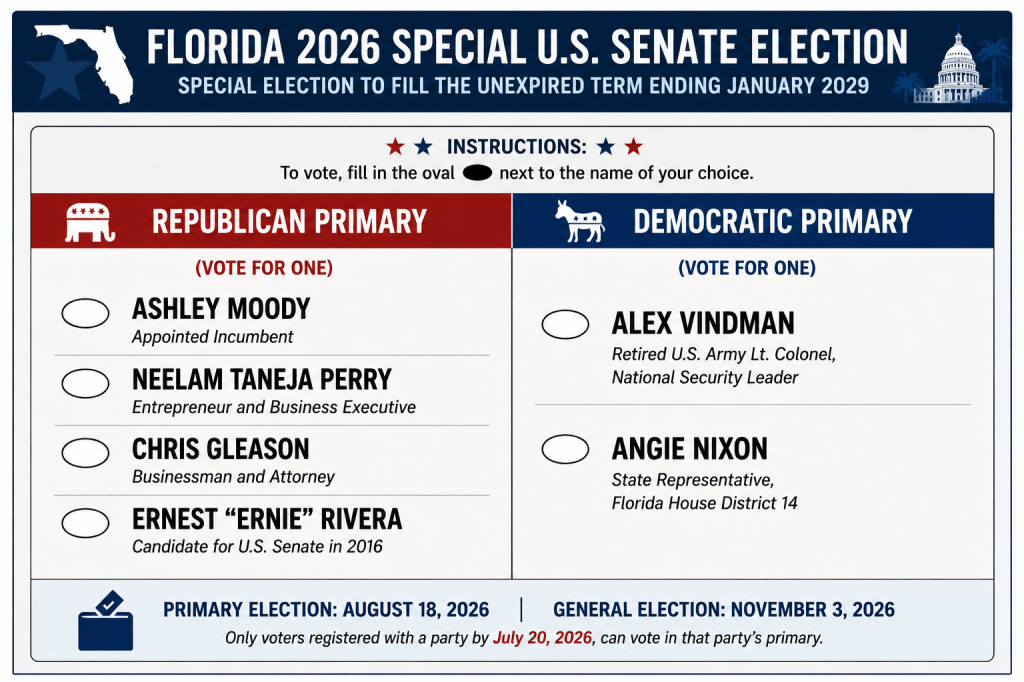
The candidate filing deadline passed on April 24, 2026. Both parties will hold closed primaries on August 18, 2026 — meaning only voters registered with a party by the July 20 registration deadline can vote in that party’s contest. The general election follows on November 3, 2026, concurrent with the regular midterm general.
“The special election follows the normal primary and general election calendar even though the seat itself became vacant mid-term.”
Who’s on the ballot
Republican primary
Ashley Moody is running as the appointed incumbent, and is the far better-funded and more prominently endorsed candidate in the GOP field. She served two terms as Florida’s elected attorney general — including a 2018 win over Democrat Sean Shaw and a 2022 reelection — before working in civil litigation and as a federal prosecutor earlier in her career; she was also a Hillsborough County circuit judge starting in 2006. This will be the first time she has faced voters since her Senate appointment. She has secured endorsements from President Trump, Senator Rick Scott, the Republican Party of Florida, the Florida Chamber of Commerce, and more than a dozen members of Florida’s congressional delegation. Coverage of her campaign has noted a lower-key, less combative public style than some other prominent Florida Republicans — an approach some in the party see as a deliberate contrast, and others have privately questioned as the race nears.
She faces three lesser-known Republican challengers on the primary ballot: Neelam Taneja Perry, Chris Gleason, and Ernest “Ernie” Rivera (who also ran for U.S. Senate in Florida in 2016). None has reported fundraising or endorsements approaching Moody’s; as of early August, Taneja Perry had not filed a campaign finance report with the Federal Election Commission.
Democratic primary
Two candidates remain after a field that also once included former Brevard County school board member Jennifer Jenkins and former Google philanthropy executive Hector Mujica, both of whom withdrew before qualifying and endorsed Alex Vindman.
Alex Vindman, a retired U.S. Army lieutenant colonel and combat veteran wounded in Iraq, is making his first bid for public office. He later served as a National Security Council director for European affairs and became a national figure after testifying in President Trump’s first impeachment inquiry over a 2019 call with Ukraine’s president; he was subsequently fired from his NSC role. His twin brother, Eugene Vindman, represents Virginia’s 7th District in the U.S. House. Vindman has built a significant fundraising advantage in the primary and has framed his campaign — a “Florida First Agenda” — around affordability (gas, groceries, housing, insurance) and congressional ethics, including a proposal to ban members of Congress from trading individual stocks. On foreign policy he has staked out positions to the right of some in his own party, including openness to case-by-case military intervention and skepticism of eliminating the Senate filibuster, framing himself as an independent-minded pragmatist rather than a movement progressive.
Angie Nixon, a state representative from Jacksonville first elected in 2020, is running as the field’s more progressive candidate, backed by endorsements from U.S. Rep. Maxwell Frost and state Rep. Anna Eskamani. Her platform centers on affordability, and includes universal health care (an incremental approach toward Medicare for All), universal childcare, free higher education and student loan forgiveness, rent stabilization, and higher taxes on wealthy earners and corporations — funding priorities she frames as a response to what she calls corporate greed. Nixon also works as director of the Florida Public Service Union’s higher-education campaign and previously served as Florida state field director for the Service Employees International Union. She drew statewide attention in April 2026 when she used a megaphone to disrupt a congressional redistricting vote on the Florida House floor, an action for which the chamber formally reprimanded her the following month.
The two Democrats have also surfaced a divide over foreign policy, particularly regarding Israel, with Nixon’s more progressive coalition pressing Vindman on the issue at recent campaign events — a fault line that has drawn some national attention given the broader debate inside the Democratic Party.
What the polling shows
Public polling through mid-2026 has consistently shown Moody ahead of both potential Democratic opponents, though the size of her lead varies considerably by poll and sponsor — a spread worth noting rather than averaging into a single number.
- A June 2026 poll from the Associated Industries of Florida (conducted by McLaughlin & Associates, a Republican polling firm, and released alongside an AIF endorsement of Moody) showed her leading Vindman 47%–40%, with 14% undecided.
- A late-July 2026 poll from the University of North Florida’s Public Opinion Research Lab, an academic survey not aligned with either campaign, showed Moody leading Nixon 50%–42% and leading Vindman 50%–40% in hypothetical general-election matchups.
- An internal poll released by Vindman’s own campaign, conducted by Global Strategy Group, showed a much tighter race: Moody at 46% to Vindman’s 43%, within the poll’s margin of error, and found Moody still relatively undefined to voters — with under half reporting an opinion of her job performance.
Fundraising has followed a similar pattern within the Democratic primary: as of late June 2026 disclosures, Vindman had reported raising roughly $16.7 million to Nixon’s approximately $625,000, though outraising a primary opponent is not itself a measure of general-election standing. Independent aggregators and race-rating services have generally rated the seat as favoring Republicans, consistent with Florida’s rightward shift in recent statewide races, while treating it as somewhat more competitive than the state’s other federal contests. As with any single-race polling, campaign-sponsored surveys — from AIF or from a candidate’s own campaign — should be read alongside their funding source, since sponsors have an incentive to release favorable numbers.
Why the mechanism matters
Special U.S. Senate elections are relatively rare, and states handle vacancies differently. Some governors appoint a replacement who serves out the full remainder of the term with no election at all; others require a standalone special election on an expedited timetable, separate from the regular calendar. Florida’s approach — gubernatorial appointment paired with an election folded into the next regularly scheduled general — sits in between. It means Florida voters get a say in who holds the seat, but not until the next general election arrives, whenever that happens to fall relative to the vacancy.
“Florida’s system balances gubernatorial appointment with voter approval at the next statewide general election.”
That framework is also why this race receives comparatively little separate procedural infrastructure: no unique special-election primary calendar, no standalone filing system distinct from other 2026 federal contests. It rides on the rails of the ordinary election cycle, which is part of why it can be easy to overlook alongside the governor’s race and the 28 U.S. House contests on the same ballot.
FAQ
Why is Florida holding a special Senate election in 2026?
Because Marco Rubio resigned after becoming U.S. Secretary of State, creating a vacancy that Florida law requires to be filled at the next regularly scheduled general election.
Why was Ashley Moody appointed instead of immediately elected?
Florida law allows the governor to appoint an interim senator until voters choose a successor at the next general election.
When is Florida’s Senate special election primary?
August 18, 2026.
When is the general election?
November 3, 2026.
Is this a full six-year Senate term?
No. The winner completes the remainder of Marco Rubio’s term, which expires in January 2029.
Sources: Florida Division of Elections; Ballotpedia; Wikipedia; Florida Politics; Florida Phoenix; WLRN; Miami Times; FOX 13 Tampa Bay; Orlando Weekly; Jacksonville Today; CBS News Miami.


Leave a comment