Following up on “Who Is Running for Governor of California in 2026?”, published in January when the field was still crowded and unsettled.
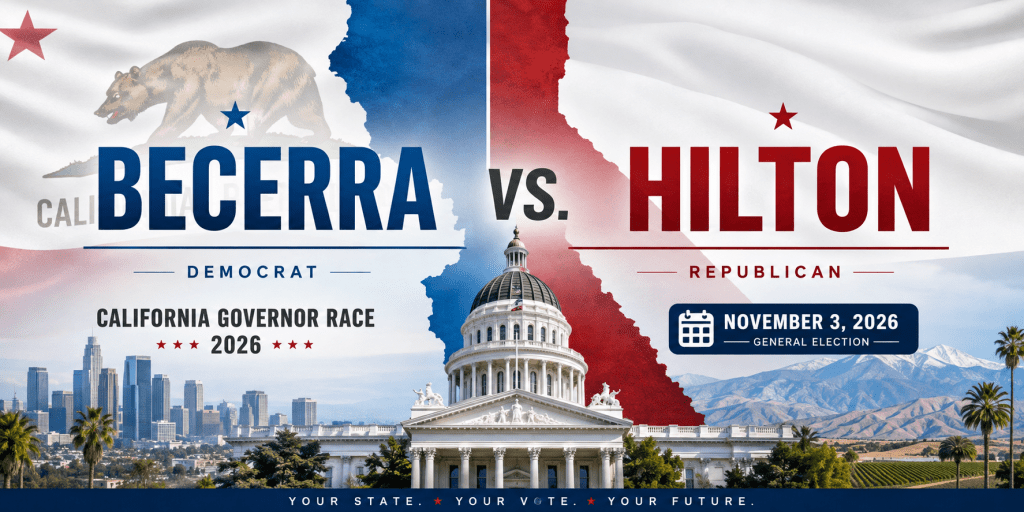
California’s crowded, unpredictable primary is over, and the state’s top-two system has produced its matchup: Democrat Xavier Becerra against Republican Steve Hilton in the November 3 general election to succeed term-limited Gov. Gavin Newsom.
The result answered the central question hanging over the race in January — whether a fractured Democratic field would let two Republicans advance. It didn’t happen, but it was close. Here’s where the race stands heading into the fall.
How We Got Here: The June 2 Primary
“California’s top-two primary answered the biggest question of the race: would Democrats split the vote enough to lock themselves out of November?”
California’s nonpartisan “top-two” primary places all candidates, regardless of party, on a single ballot. The two highest vote-getters advance to November no matter their party affiliation. With more than 60 candidates on the ballot and Democratic support split across a large field, some strategists warned California Democrats risked being “locked out” of the general election entirely.
That risk eased in April, when Democratic Rep. Eric Swalwell — then one of the top-polling candidates — dropped out after facing allegations of sexual misconduct, which he denied. His exit consolidated Democratic support and helped Becerra, who had been polling in the single digits earlier in the year, surge into contention.

When the votes were counted, Becerra finished first with about 28% of the vote, followed closely by Hilton at 25%, Democrat Tom Steyer at 23%, and Republican Chad Bianco — the Riverside County sheriff who drew controversy after seizing ballots in March as part of a disputed election investigation — at 10%. Turnout was low, with roughly 23% of registered voters casting ballots.
Because county officials have up to 30 days to finish counting mail and provisional ballots, the race between Becerra and Hilton for the second spot wasn’t called until about a week after Election Day. Steyer, who spent more than $200 million of his own money on the campaign, ultimately fell about two points short.
What the Polls Show Now
With the field narrowed to two candidates, general-election polling shows Becerra with a substantial lead. A Public Policy Institute of California (PPIC) survey conducted June 29–July 6 found Becerra ahead of Hilton 61% to 36% among likely voters. The polling average tracked by RealClearPolling shows a similar gap, with Becerra leading by roughly 23 points as of early August.

That margin is consistent with California’s recent political history — Republicans have not won a statewide race in the state since 2006, and Newsom defeated his last two GOP opponents by 18 to 23 points. Prediction markets reflect the same expectation: contracts tracked by RealClearPolling and other exchanges have priced Becerra’s chances at roughly 95%, with Hilton around 4–5%, as of early August.
“Republicans haven’t won a statewide California race since 2006, and current polling reflects that long-term political reality.”
Two factors are worth watching as potential wild cards. First, the PPIC poll found that 85% of likely voters said candidates’ positions on the environment matter to them, with a sharp partisan split — 60% of Democrats called it “very important” versus 29% of Republicans — a dynamic that could shape how each candidate campaigns on energy and climate policy. Second, Hilton has leaned into his endorsement from President Trump, whom California voters disapprove of by wide margins statewide but who remains popular within the state’s shrunken Republican base; that dynamic could help him consolidate conservative support even as it limits his appeal beyond it.
Where the Candidates Stand

Xavier Becerra (Democrat)
Becerra, 67, is a Sacramento native and the son of immigrant parents. He served 24 years in Congress, then about four years as California’s attorney general (2017–2021) — during which independent tallies put his lawsuits against the first Trump administration at more than 100, while Becerra’s own count is 120 — and then as U.S. Secretary of Health and Human Services under President Biden.
His campaign has centered on:
- Affordability and the economy: Becerra has called the state’s cost-of-living crisis a “break-glass moment” and made economic opportunity his central message, framing the race around restoring what he calls the “California Dream.”
- Health care: Becerra says he would sign a first-day executive order aimed at preserving “coverage continuity” for Californians affected by federal cuts to Medicaid/Medi-Cal, and has defended maintaining Medi-Cal access for undocumented immigrants who work and pay taxes in the state.
- Housing: He has set a goal of doubling housing production compared with the Newsom era, targeting 1.5 to 2 million new homes over a first term, while saying homelessness should be addressed through a combination of expanded housing supply and greater accountability for those who decline available shelter.
- Utilities and insurance costs: He has proposed declaring a state of emergency to freeze utility rates as a near-term measure to blunt cost increases.
- Experience and contrast with Trump: Becerra has leaned on his management background — citing his time overseeing a federal department with a larger budget than California’s state government — and has cast himself as the candidate best positioned to counter Trump administration policy from the governor’s office.
Steve Hilton (Republican)
Hilton, a British American former Fox News host, previously worked as a strategist for U.K. Prime Minister David Cameron before entering California politics. He has been endorsed by President Trump.
His campaign has centered on:
- Taxes: Hilton’s signature proposal would eliminate state income tax on the first $100,000 of earnings and replace the state’s tiered system with a flat tax above that threshold; he has said his campaign would study raising that cap after further economic analysis.
- Cost of living: Hilton has branded his campaign around making the state “Califordable,” framing high housing, energy, and living costs as the defining issue of the race.
- Energy and environment: He has called for expanded oil drilling and the rollback of environmental regulations, including the state’s greenhouse gas reduction mandates and the gas tax.
- Government size and regulation: He has proposed reducing the state government workforce and cutting regulatory red tape, particularly around housing construction.
- Public safety and immigration: Hilton has campaigned on stronger enforcement of criminal law and immigration policy, positioning himself against what he characterizes as permissive Democratic policies.
- Fiscal measures: He opposes a November ballot initiative that would impose a 5% wealth tax on the state’s billionaires.
- “Ending one-party rule”: Hilton’s closing argument is procedural as much as ideological — he argues 16 years of unified Democratic control in Sacramento (aside from Arnold Schwarzenegger’s tenure) warrants a change regardless of the specific policy debate, and has said a governor with a “good working relationship” with the Trump White House would benefit the state.
“Hilton’s campaign argues the election is less about ideology than ending one-party rule in Sacramento.”
What to Watch Through November
“Low primary turnout answered who advanced—but November turnout will determine who governs.”
- Certification and turnout: Primary turnout was historically low at roughly 23%. Whether general-election turnout patterns favor Becerra’s coalition or produce a tighter-than-expected race will be a key storyline pollsters are watching.
- How solid is Hilton’s base? Hilton and Bianco combined for about 35% of the primary vote, suggesting a real conservative bloc even though it fell well short of the top two spots for both Republicans. Emerson College’s final pre-primary poll (May 27–28) found 88% of Hilton’s primary supporters said they would “definitely” stick with him — the highest certainty score of any candidate in the field, and higher than Becerra’s 76%. That measures commitment within the primary electorate, not the general-election matchup, but it points to a hard floor of support even as his ceiling looks capped in current head-to-head polling.
- Down-ballot measures: The wealth-tax initiative Hilton opposes, along with other ballot measures, could shape turnout and messaging on both sides.
- Utility and insurance costs: Both candidates have signaled these will be flashpoints, including a state of emergency declaration some local officials have already called for around unrelated issues like the Tijuana River sewage crisis.
- National dynamics: Hilton’s Trump endorsement and Becerra’s framing of the race as a check on federal policy mean the contest may increasingly track national political currents as November approaches.
Election Desk will continue to track certified results, polling, and candidate position changes as the general election campaign develops.

For official filings, results, and voter information, consult the California Secretary of State.


Leave a comment