
An Election Desk explainer
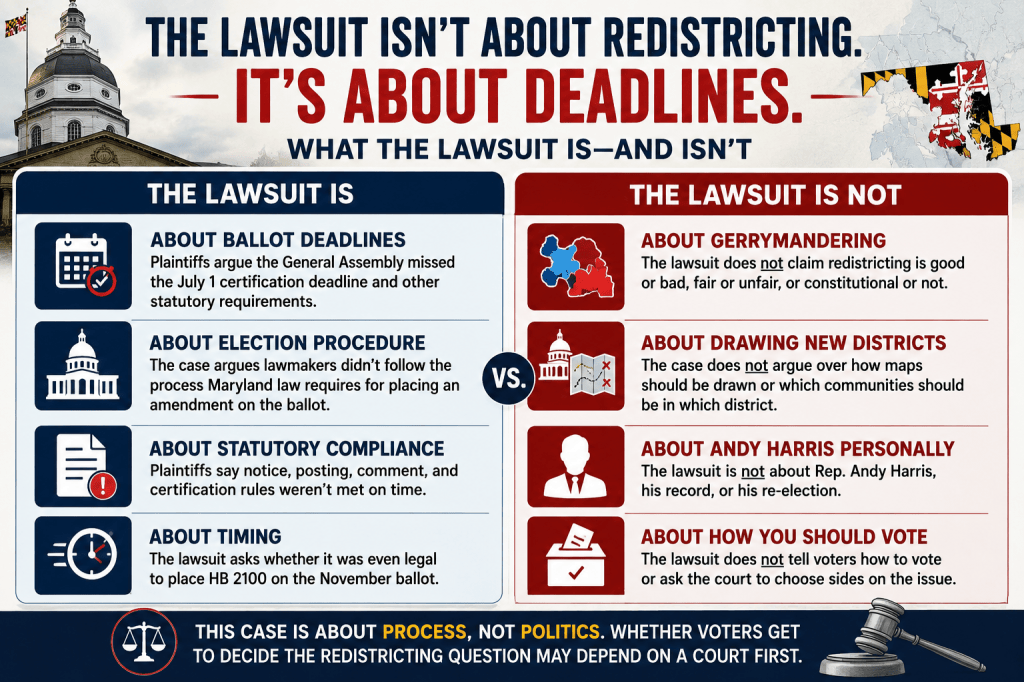
A lawsuit filed this week in Anne Arundel County Circuit Court is trying to keep a Maryland constitutional amendment off the November ballot before voters ever get to weigh in on it. The amendment itself is about congressional redistricting — whether the state’s compactness and boundary rules should apply only to state legislative districts, freeing lawmakers to redraw the congressional map. But the lawsuit isn’t arguing about redistricting at all. It’s arguing about timing: whether the General Assembly missed its own legal deadline to put the question on the ballot in the first place. That’s a narrower, more technical dispute than it might look like from the outside, and it’s worth separating from the larger political fight over the map itself. This piece walks through both.
“The lawsuit doesn’t challenge what the amendment does — it challenges whether lawmakers were still allowed to put it on the ballot by the time they voted on it.”
Track One: The Lawsuit
What it is
The case is Howell v. Maryland State Board of Elections, filed August 6 in Anne Arundel County Circuit Court. The plaintiffs are the Oversight Project, a Washington-based conservative watchdog group, along with all seven members of the Maryland Freedom Caucus — Chair Matt Morgan, Vice Chair Kathy Szeliga, Ryan Nawrocki, Lauren Arikan, Mark Fisher, Brian Chisholm, and Robin Grammer — plus Senate Minority Leader Steve Hershey and Senate Minority Whip Justin Ready. The defendants are the Maryland State Board of Elections, Secretary of State Susan Lee, Attorney General Anthony Brown, and Governor Wes Moore.
What’s being challenged
The target is HB 2100, a constitutional amendment the General Assembly passed during an Aug. 3–5 special session and Moore signed August 6. If ratified by voters, it would narrow the state constitution’s compactness, contiguity, and county-line requirements so they apply only to state legislative districts, not congressional ones. Congressional maps would still have to meet federal population-equality standards, but would no longer be bound by the tighter state standard — a standard that dates to a March 2022 ruling, with Szeliga as lead plaintiff, in which an Anne Arundel County judge (Lynne Battaglia) struck down Maryland’s prior congressional map as an unconstitutional partisan gerrymander. If voters approve HB 2100, that 2022 constraint on congressional maps goes away, and the legislature — which holds supermajorities in both chambers — could draw a new congressional map before the 2028 elections.
“The 2022 ruling that currently limits Maryland’s congressional map-drawing is exactly what HB 2100 would undo, if voters approve it.”
The legal argument
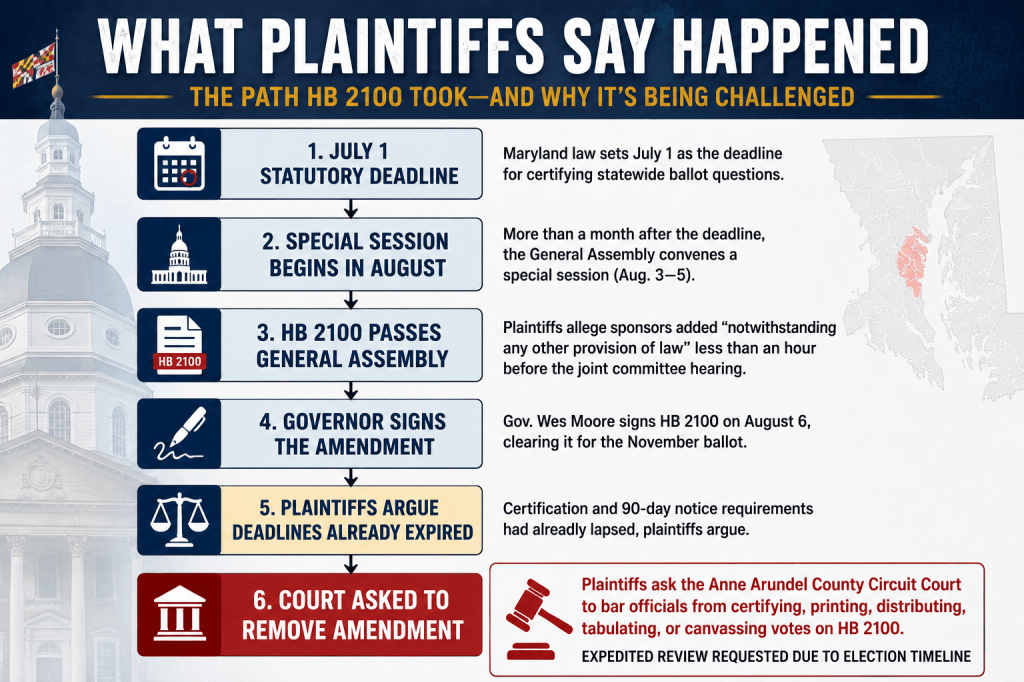
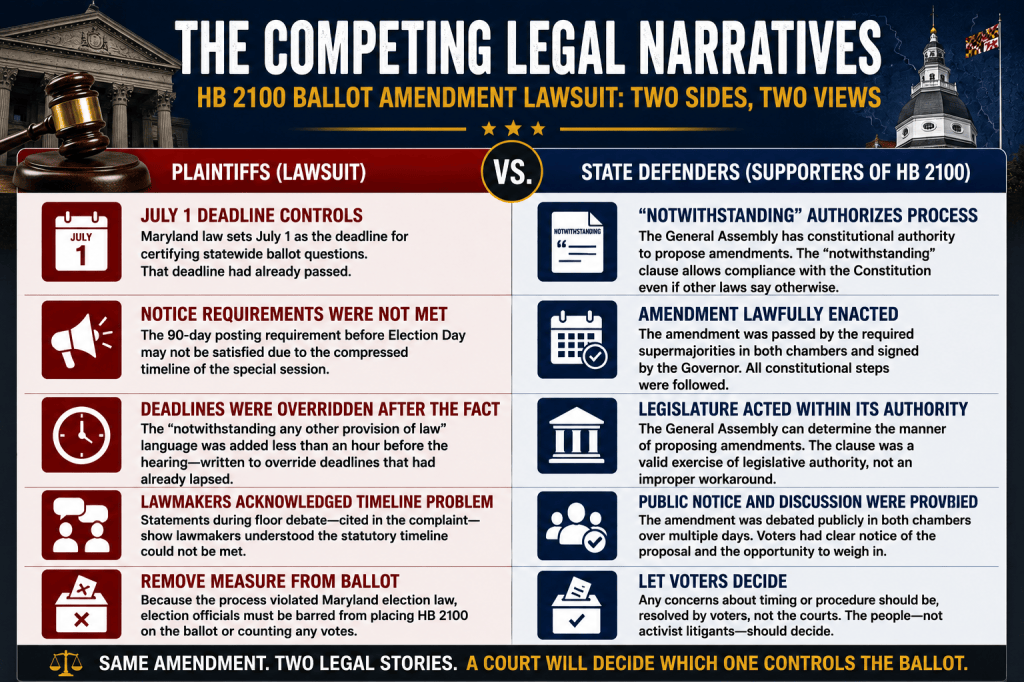
The complaint doesn’t dispute any of that policy substance. It argues the process used to get HB 2100 onto the ballot violated Maryland election law. Specifically:
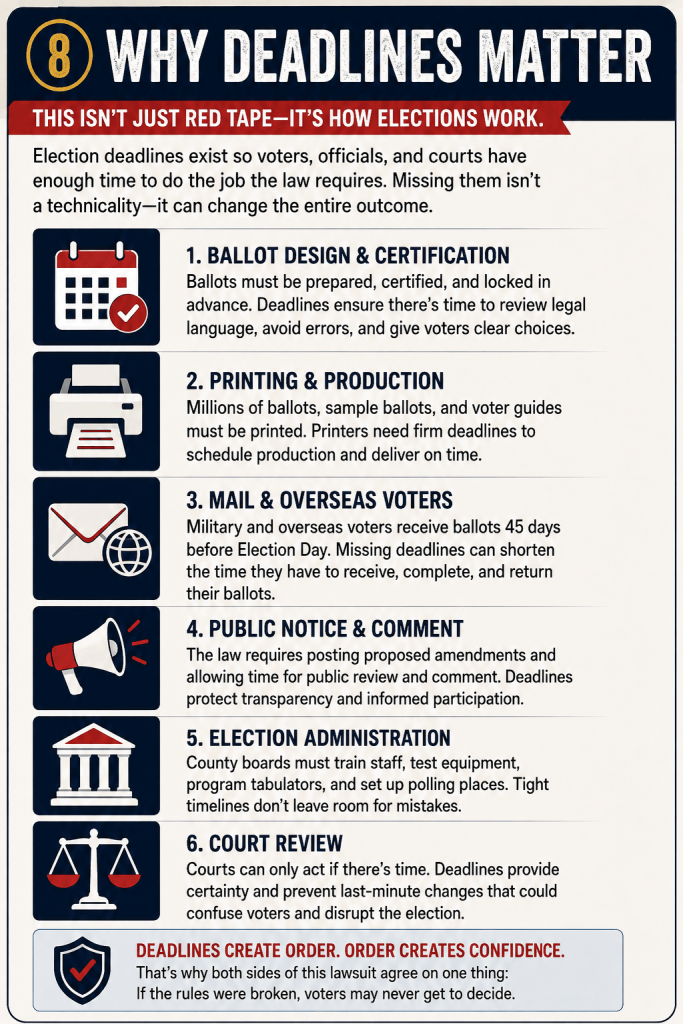
- Maryland has a July 1 statutory deadline for certifying statewide ballot questions. According to the complaint, that deadline had already passed by the time the special session convened in early August — more than a month later.
- Election officials are separately required to post the full text of a proposed constitutional amendment at least 90 days before Election Day, a window the compressed timeline may not satisfy.
- The complaint alleges sponsors inserted the phrase “notwithstanding any other provision of law” into HB 2100 less than an hour before the joint committee hearing began — language the plaintiffs argue was written specifically to override the certification, notice, and comment deadlines after they’d already lapsed.
- The plaintiffs point to how the bill was discussed during debate: described as “technical” in the House, according to the complaint, while Senate floor debate — including remarks by Democratic state Sen. Cheryl Kagan cited in the filing — reflected an understanding that the statutory timeline could no longer be met.
The suit asks the court to declare HB 2100 was unlawfully placed on the ballot and to bar state officials from certifying, printing, distributing, tabulating, or canvassing votes on it, with expedited review given the approaching election.
Where it stands
The case was filed the night of August 6 and has not yet been heard. Moore’s office, the Attorney General’s office, and the State Board of Elections had not responded to requests for comment as of that night, per Fox News Digital, which first reported the filing. No hearing date had been set as of this writing.
Track Two: The Redistricting Fight Behind It
Why this specific amendment, why now
HB 2100 didn’t emerge in isolation. Democratic legislative leaders have pointed to two things as backdrop: a wave of mid-decade congressional redistricting already underway in Republican-led states, and the U.S. Supreme Court’s April 29 ruling in Louisiana v. Callais, which narrowed — but did not eliminate — the circumstances under which Section 2 of the federal Voting Rights Act can justify race-conscious district lines. In his own statement signing the bill, Moore pointed to Republican-led states and said Maryland would not be “caught flat-footed.” Senate President Bill Ferguson and House Speaker Joseline Peña-Melnyk have described HB 2100 as restoring the legal standard that existed before the 2022 ruling, not as a new partisan maneuver. Republican legislators, including Hershey, have called it a power grab timed to eliminate the state’s only Republican-held congressional seat.
“Both sides agree on what HB 2100 would do. They disagree entirely on why it’s happening now.”
The seat at stake
That seat is Maryland’s 1st Congressional District, the only one of the state’s eight held by a Republican. Rep. Andy Harris has represented it for eight terms; Cook Political Report rates it R+8, the only GOP-leaning district in the state. It’s also geographically the largest, covering the Eastern Shore’s nine counties plus part of Harford and Baltimore counties. A Moore-appointed redistricting panel had floated redrawing the seat before this year’s special session; two earlier attempts stalled in Senate committee before leadership revived the effort this spring.
During floor debate, a Republican delegate’s proposal to put a nonbinding secession question to the Shore’s nine counties failed, as did a Republican-sponsored amendment requiring any new map to account for the Chesapeake Bay as a shared regional resource. The opposition wasn’t confined to Republicans: Del. Sheree Sample-Hughes, a Democrat representing part of the Shore, said on the floor that she wasn’t defending Harris personally, but that her rural constituents “still want to have a voice” in a district that could be redrawn to include more suburban precincts. HB 2100 passed the House 96–38 and the Senate 32–13, both largely along party lines.
Why this matters regardless of how the lawsuit turns out
The lawsuit and the underlying redistricting fight are legally separate, but practically linked. If the lawsuit succeeds, HB 2100 could be struck from the ballot before voters ever weigh in on the redistricting question itself — meaning the case could resolve the political fight without ever reaching it. If the lawsuit fails, the redistricting question goes to voters November 3 as planned, and the deadline dispute becomes moot.
“Whether voters ever see the amendment could depend on a court deciding a procedural question before Election Day.”
The Short Version
| The Lawsuit | The Redistricting Fight | |
|---|---|---|
| Type of dispute | Civil suit over ballot-certification procedure | Political and legal dispute over how Maryland draws congressional maps |
| What’s being decided | Whether HB 2100 was lawfully placed on the ballot | Whether voters approve loosening the state’s congressional map-drawing rules |
| Who decides next | Anne Arundel County Circuit Court (expedited review requested) | Maryland voters, if the amendment survives to Election Day |
| Key date | No hearing date set as of this writing | November 3, 2026 |
| If it succeeds/passes | Amendment removed from the ballot entirely | Legislature gains authority to redraw the congressional map before 2028 |
Sources: complaint filed Aug. 6, 2026, Anne Arundel County Circuit Court (Howell v. Maryland State Board of Elections); Oversight Project press release; Fox News Digital; Fox45/WBFF Baltimore; Maryland Matters; WBOC; WMDT/47abc; Fox 5 DC; WYPR; Office of Governor Wes Moore; The American Redistricting Project (Szeliga v. Lamone case history); Cook Political Report district ratings.


Leave a comment