The full U.S. Court of Appeals for the Ninth Circuit, sitting en banc, ruled Friday that a lower court was wrong to block two provisions of a 2022 Arizona election law — though for two different reasons on the two provisions, and over a notable internal disagreement about the court’s own reasoning. The 11-judge court also overruled a specific list of prior Ninth Circuit precedents on when advocacy organizations have legal standing to sue, a procedural shift that could affect litigation well beyond this case.
The case, Arizona Alliance for Retired Americans v. Mayes, No. 22-16490, has moved through the district court, a divided three-judge panel, and now an en banc rehearing over roughly four years. Friday’s majority opinion was authored by Judge Anthony Johnstone and joined by five other judges; five judges — a bare minority of the 11 — agreed with the outcome but wrote separately to say the majority’s reasoning was flawed.
Editorial note: This article is based on the full text of the en banc opinion, retrieved directly from the Ninth Circuit’s public opinions server (cdn.ca9.uscourts.gov), along with the court’s own case-status page and contemporaneous reporting on the earlier stages of the litigation. All holdings described below are drawn from the opinion itself.
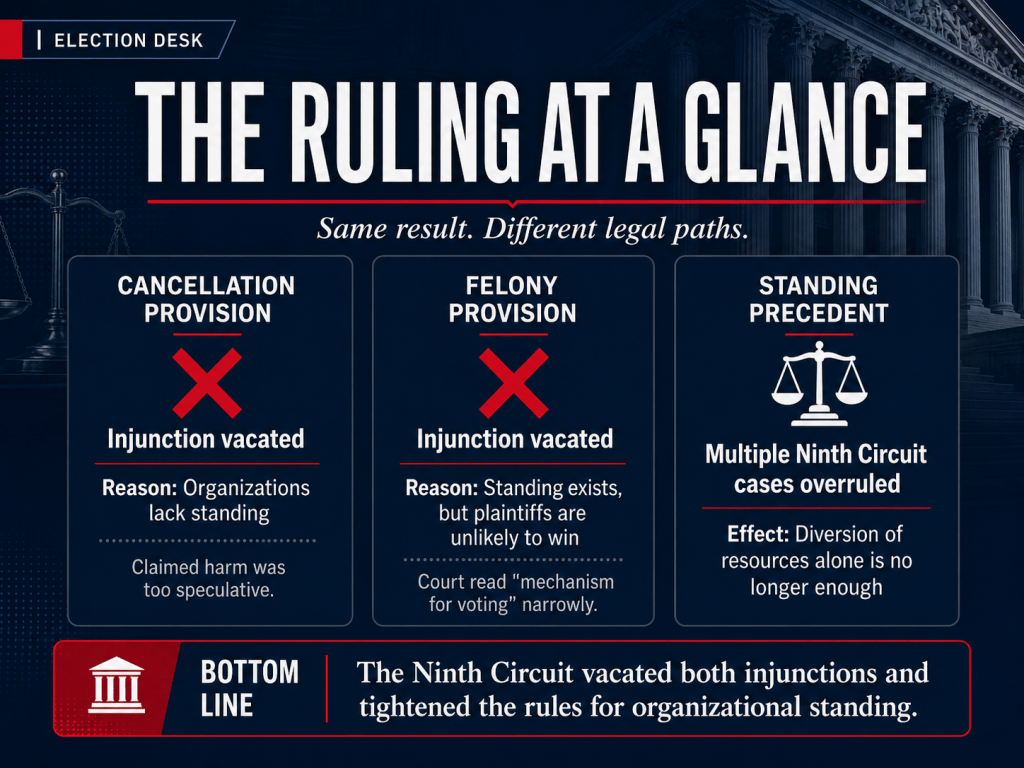
Timeline
- June 2022: Arizona Gov. Doug Ducey signs Senate Bill 1260, which added three provisions to state election law: a “cancellation provision” allowing county recorders to cancel a voter’s registration once another county confirms the person has re-registered there; a “felony provision” criminalizing knowingly providing “a mechanism for voting” to someone registered in another state; and a “removal provision” affecting the state’s permanent early-voting list.
- August 15, 2022: The Arizona Alliance for Retired Americans, Voto Latino, and Priorities USA sue, arguing the cancellation and felony provisions are unconstitutional and conflict with the National Voter Registration Act (NVRA).
- September 26, 2022: U.S. District Judge G. Murray Snow preliminarily blocks enforcement of the cancellation and felony provisions; the removal provision is allowed to take effect.
- September 20, 2024: A divided three-judge Ninth Circuit panel (Judges Nguyen, Collins, and Lee) reverses the injunction as to the cancellation provision, holding the plaintiff organizations lacked Article III standing because they showed only a “frustrated mission” and diverted resources, not direct harm to existing core activities. The panel unanimously rejects a separate vagueness challenge to the felony provision. Judge Nguyen dissents in part. Ariz. All. for Retired Ams. v. Mayes, 117 F.4th 1165 (9th Cir. 2024).
- March 2025: The full Ninth Circuit grants rehearing en banc and vacates the panel opinion.
- June 25, 2025: The en banc court — Chief Judge Murguia and Judges Callahan, Ikuta, Bennett, R. Nelson, Bress, VanDyke, Sung, H.A. Thomas, Desai, and Johnstone — hears argument in Seattle. (Confirmed via the Ninth Circuit’s own en banc case-status page.) Judge Ikuta later dies before the opinion issues; per Ninth Circuit General Order 5.1(b)(1), Judge Mendoza reviews the briefing and the argument recording and replaces her on the panel. (Confirmed via the opinion’s own cover pages.)
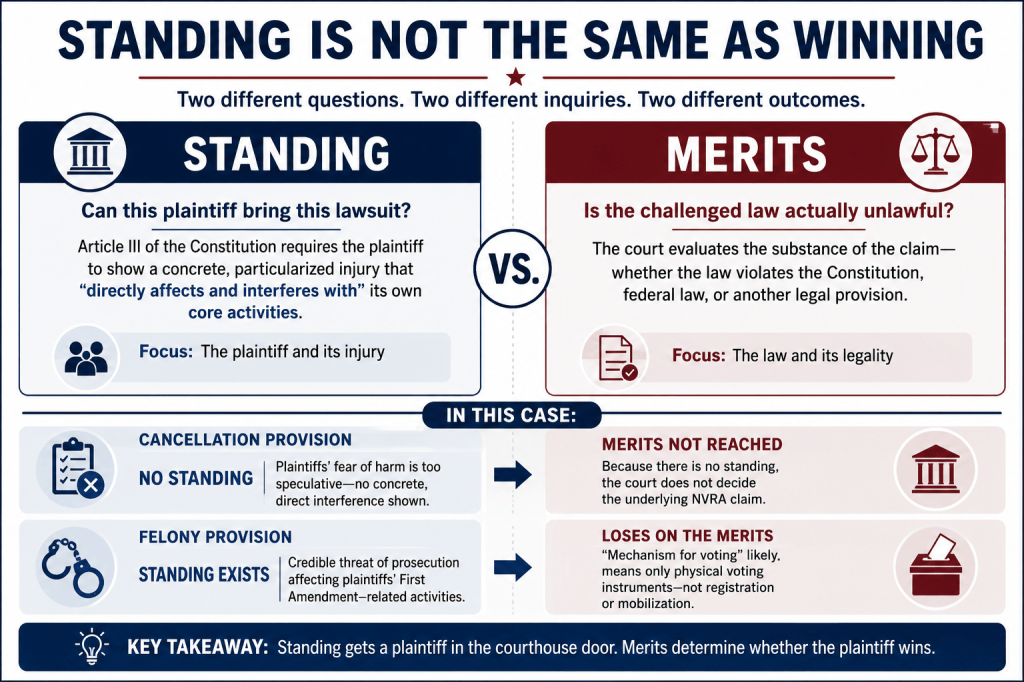
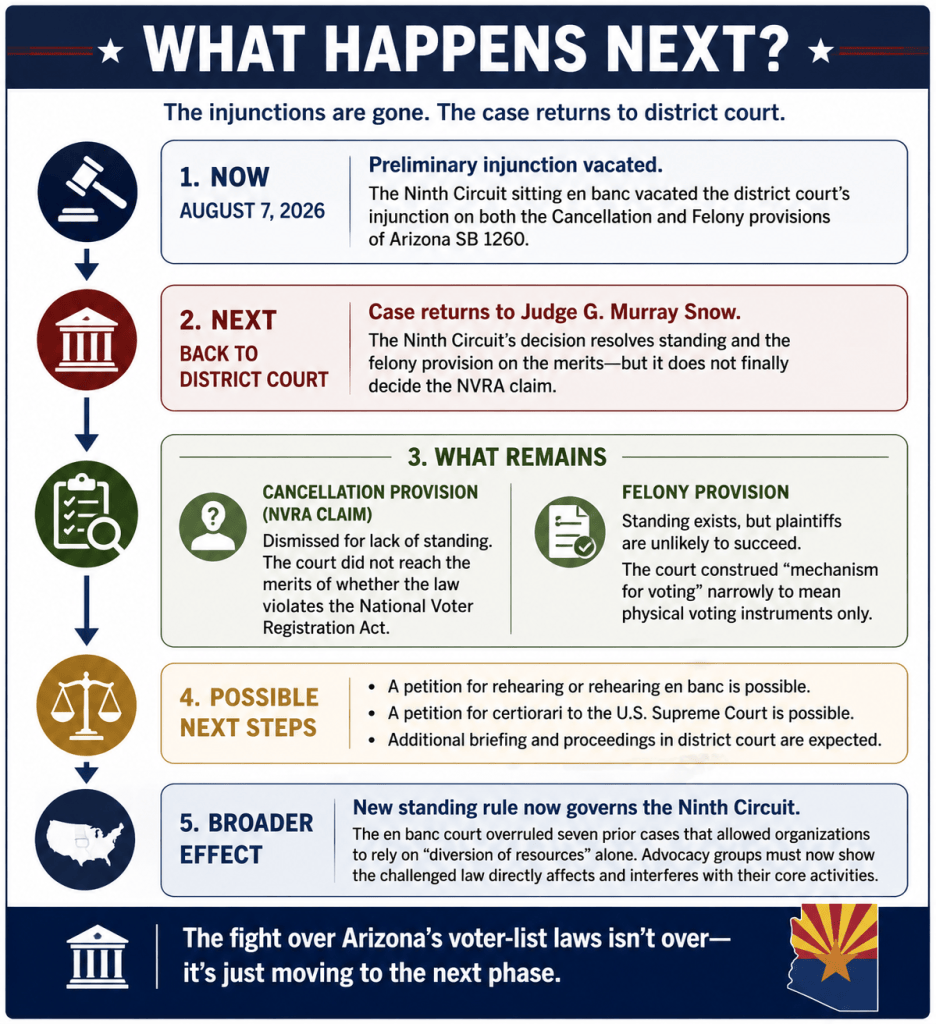
- August 7, 2026: The en banc court files its opinion, vacating the preliminary injunction on both provisions and remanding to the district court — but on two different grounds. It holds the Organizations lack standing to challenge the Cancellation Provision. It holds they do have standing to challenge the Felony Provision, but are unlikely to succeed on the merits, because the statutory phrase “mechanism for voting” likely refers only to a physical ballot and affidavit envelope, not to voter registration or mobilization work. The opinion is authored by Judge Johnstone and joined by five other judges; a five-judge bloc led by Judge Bress (joined by Callahan, Bennett, R. Nelson, and VanDyke) concurs only in the judgment, arguing the majority’s own reasoning improperly folds a merits analysis into the standing question. Judge VanDyke separately proposes loosening the circuit’s Miller v. Gammie standard for when three-judge panels may depart from circuit precedent. The result is unanimous, 11-0, though the majority and the concurrence disagree sharply on the reasoning; there is no dissent, in contrast to the 2024 three-judge panel, where Judge Nguyen dissented in part.
“The result is unanimous, 11-0, though the majority and the concurrence disagree sharply on the reasoning.”
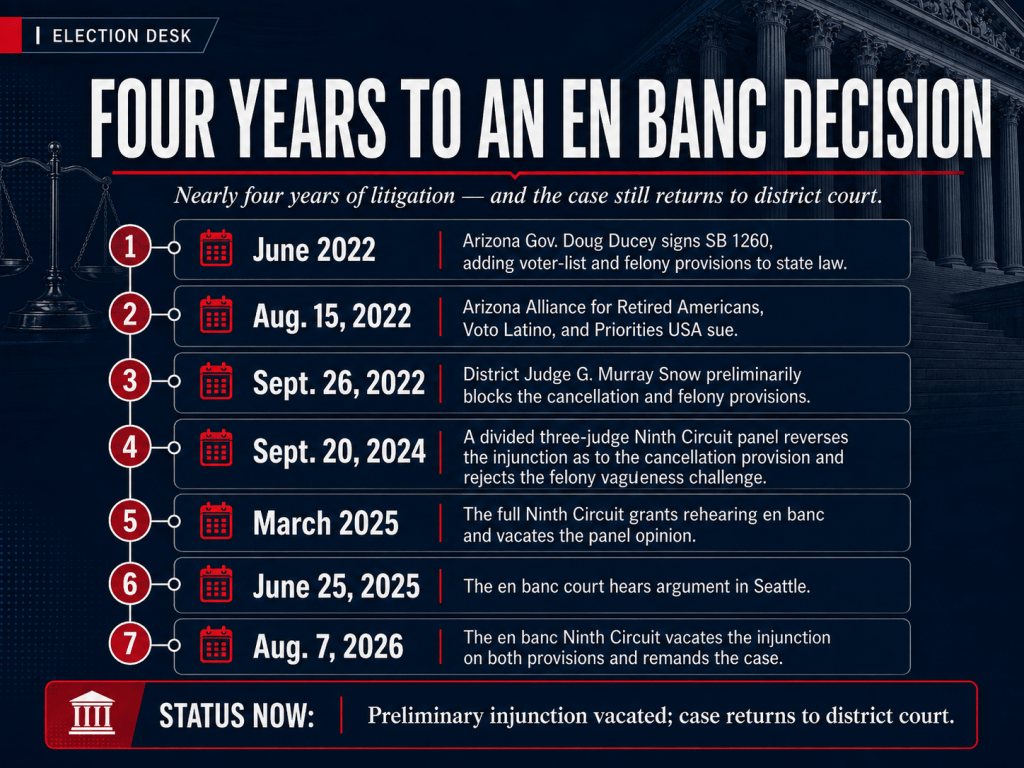
What the ruling actually does
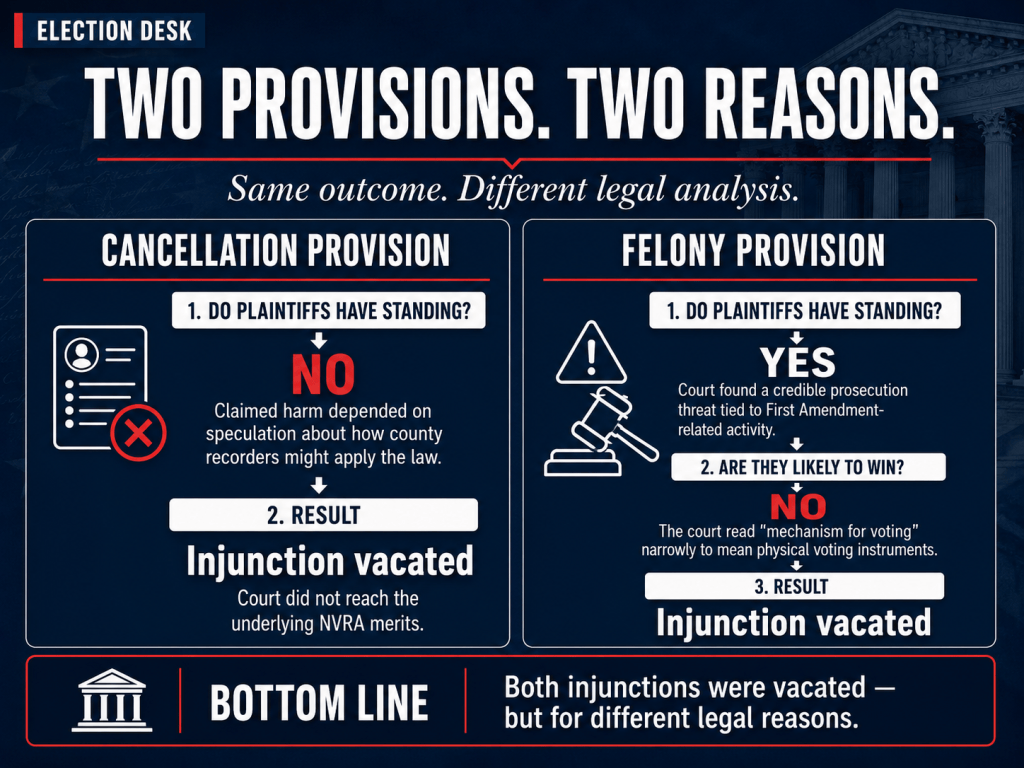
On the Cancellation Provision (no standing).
Under FDA v. Alliance for Hippocratic Medicine (2024), an organization must show a challenged law “directly affects and interferes with” its own core activities — not just that the law frustrates its mission or forces it to spend money in response. The majority held the Organizations’ fear — that county recorders might cancel a voter’s new registration instead of an outdated one — was too speculative to support standing, because Arizona’s Election Procedures Manual already directs recorders to cancel only the old registration when a voter re-registers elsewhere, and the Organizations pointed to no instance of the state doing otherwise. Because the claimed harm rested on this unsupported prediction rather than a “direct” interference with the groups’ registration and education work, the majority found no injury-in-fact.
On the Felony Provision (standing, but loses on the merits).
The court held the Organizations do have standing to challenge the felony provision, because their voter-registration and education work is “arguably” close enough to the statute’s undefined phrase “mechanism for voting” to create a credible threat of prosecution — and because the claims implicate First Amendment activity, the standing bar is lower. The court also rejected Attorney General Mayes’s argument that her office’s promise not to prosecute defeats standing, noting the disavowal doesn’t bind her successors or Arizona’s independent county attorneys. But on the merits, the court read “mechanism for voting” narrowly: read alongside the rest of the statute (which otherwise criminalizes acts like tampering with ballots or voting more than once) and the sole example given in the text — an early ballot — the phrase likely refers only to physical instruments of voting, not registration or mobilization. So the Organizations are unlikely to prevail on their vagueness and overbreadth claims, and the injunction on this provision was also vacated.
“The Organizations do have standing to challenge the felony provision — but they still lose because the court reads ‘mechanism for voting’ narrowly.”
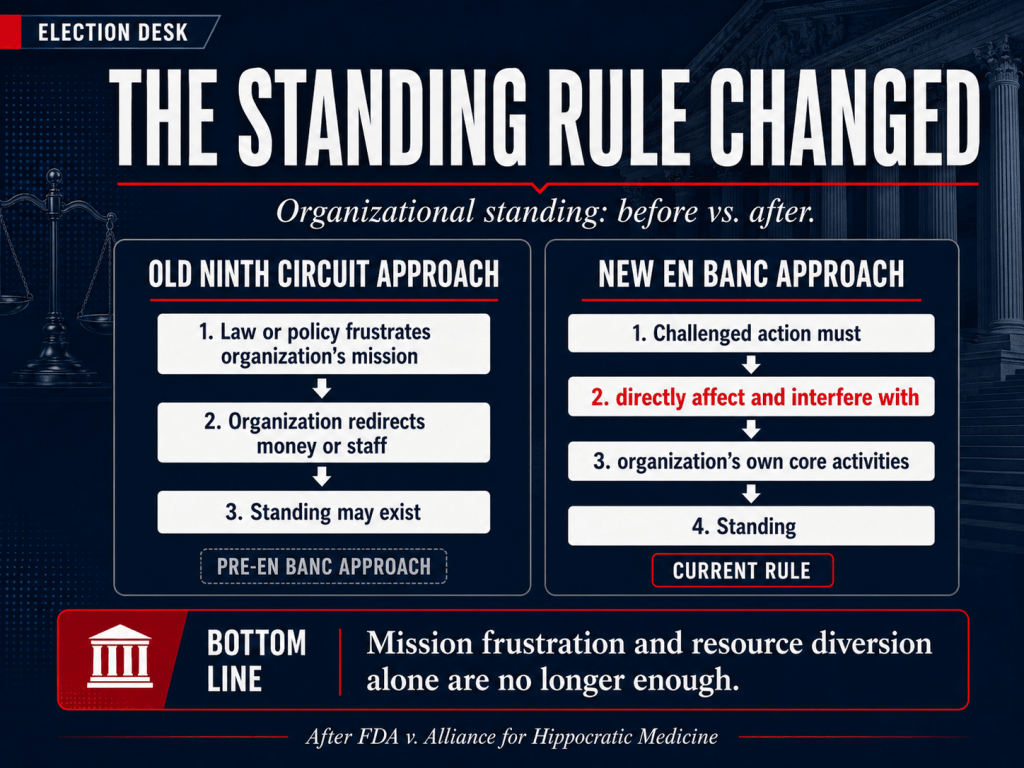
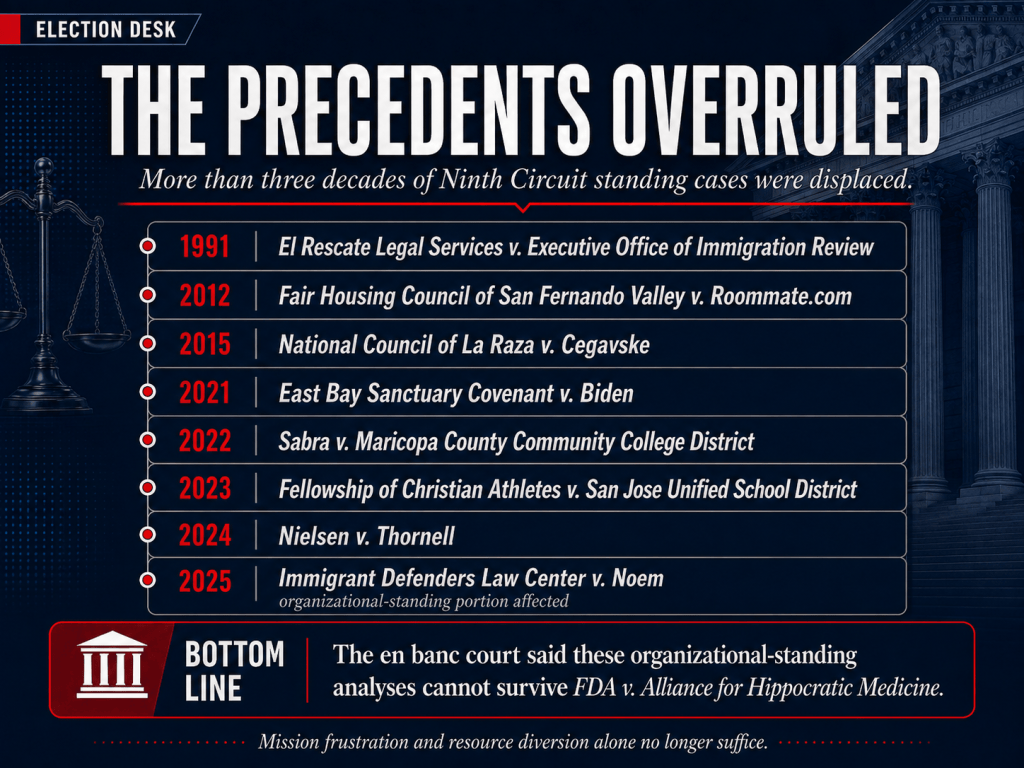
The standing precedents that were overruled.
The court held that a body of prior Ninth Circuit case law — which had allowed organizations to establish standing merely by showing a law frustrated their mission and caused them to divert resources — did not survive Hippocratic Medicine, because those cases never asked whether the challenged law “directly affected and interfered with” the organization’s core activities. It overruled the organizational-standing analyses in East Bay Sanctuary Covenant v. Biden (2021), Nielsen v. Thornell (2024), Fellowship of Christian Athletes v. San Jose Unified School District (2023, en banc), Sabra v. Maricopa County Community College District (2022), National Council of La Raza v. Cegavske (2015), Fair Housing Council of San Fernando Valley v. Roommate.com (2012), and El Rescate Legal Services v. Executive Office of Immigration Review (1991) — and, to the extent it relied on East Bay Sanctuary, the organizational-standing portion of a 2025 order in Immigrant Defenders Law Center v. Noem.
A sharp internal split over reasoning, not outcome.
The 11-judge court is unanimous on the bottom line — vacating the injunction on both provisions — and unanimous that the old organizational-standing precedents don’t survive Hippocratic Medicine.
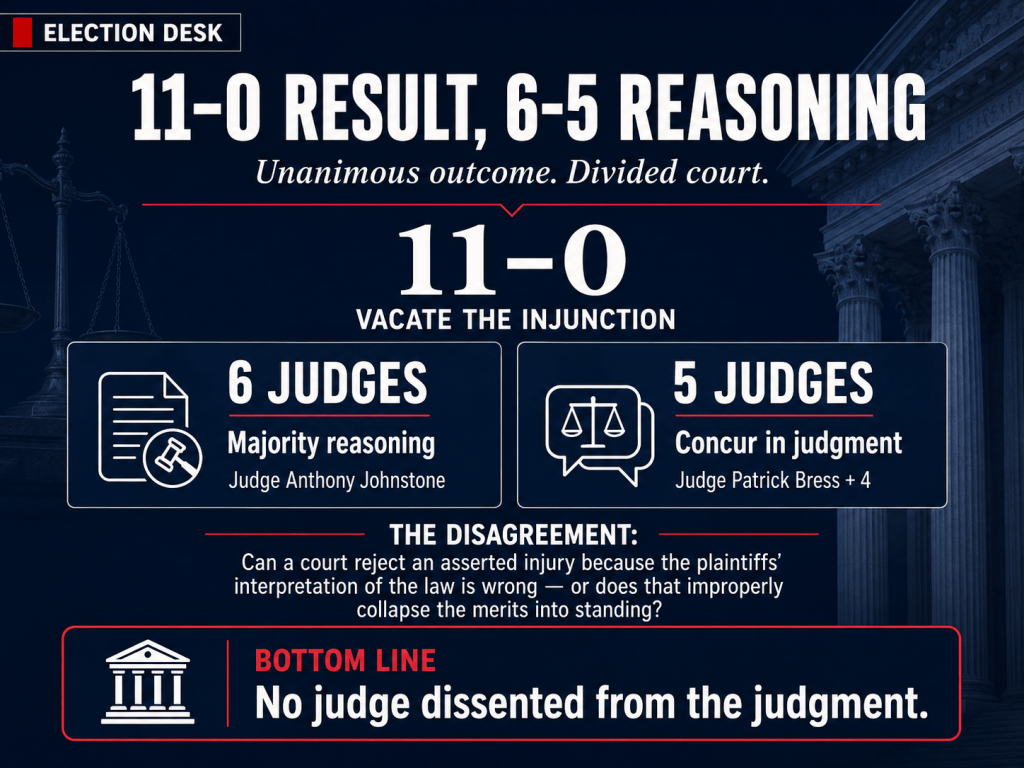
But five of the eleven judges (Bress, joined by Callahan, Bennett, R. Nelson, and VanDyke) concurred only in the judgment as to the Cancellation Provision, arguing the majority opinion’s own reasoning is flawed: rather than explaining why the Organizations’ claimed injury fails to “directly” affect their core activities the way Hippocratic Medicine requires, the majority instead concluded the Organizations’ theory of how the law would operate was factually wrong on the merits — and used that merits determination to deny standing, which the concurrence calls an improper conflation of standing and the merits that will confuse lower courts.
“Five judges agreed with the outcome but said the majority reached it using the wrong analytical route.”
Judge VanDyke’s separate writing goes further, proposing the circuit loosen its Miller v. Gammie standard so that three-judge panels can depart from old circuit precedent whenever it’s merely inconsistent with, rather than “clearly irreconcilable” with, intervening Supreme Court precedent — a broader structural point about how much weight circuit precedent should carry against the Supreme Court, unconnected to the voting-law dispute itself.
The removal provision was not part of this appeal; it took effect in 2022 and has not been under injunction.
Why it matters beyond Arizona
“The Ninth Circuit didn’t merely resolve an Arizona injunction. It rewrote part of the circuit’s law governing who gets into federal court.”
The Ninth Circuit is the largest federal appeals circuit and covers nine western states. By overruling a specific list of prior circuit precedents on organizational standing, the court has raised the bar for advocacy groups seeking to challenge state election-administration rules on a “diversion of resources” theory anywhere in the circuit, not just in Arizona.
But the 5-judge concurrence’s critique — that the majority’s own application of the new standard smuggles a merits analysis into the standing inquiry — means the doctrine isn’t fully settled even within this opinion; expect litigants on both sides to invoke the concurrence’s reasoning in future standing disputes, since it’s arguably a stricter reading of Hippocratic Medicine than the majority itself applied.
“The court has raised the bar for advocacy groups seeking to challenge state election-administration rules on a ‘diversion of resources’ theory anywhere in the circuit, not just in Arizona.”
Judge VanDyke’s proposal to loosen Miller v. Gammie did not command a majority and is not binding, but signals at least some appetite on the court to make it easier for three-judge panels to depart from older circuit precedent when the Supreme Court has moved the ground beneath it.
What’s ahead
- The case returns to the district court for further proceedings; today’s ruling vacates the preliminary injunction but doesn’t finally resolve the Cancellation Provision’s compliance with the National Voter Registration Act, since that claim was dismissed on standing grounds rather than decided on the merits.
- Watch for a possible petition for certiorari or rehearing, particularly given the concurrence’s pointed critique of the majority’s reasoning — a rare instance of five judges who agreed with the outcome but not the analysis, on a question of some importance to standing doctrine circuit-wide.
- This case is separate from the pending Supreme Court case over Arizona’s documentary proof-of-citizenship and noncitizen voter-removal laws, though both involve Arizona voter-list administration and overlapping state officials.
- Election Desk will watch for reactions from the plaintiff organizations (Arizona Alliance for Retired Americans, Voto Latino, Priorities USA) and from Attorney General Mayes’s office, neither of which had issued a public statement at the time of writing.
For Election Desk’s broader coverage of Arizona election law and litigation, see our redistricting and election-law litigation tracker.


Leave a comment