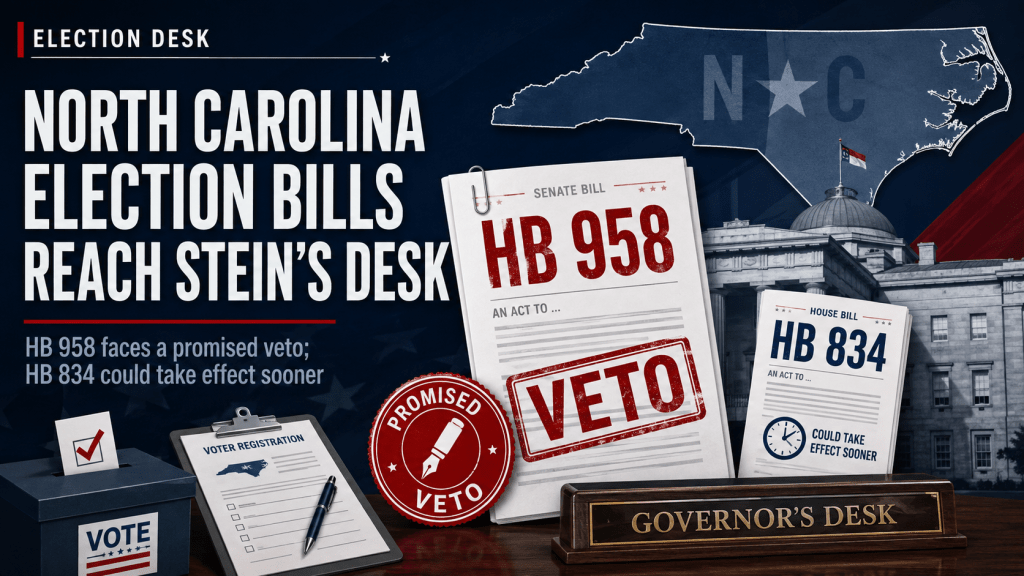
Two North Carolina election bills cleared the General Assembly on August 4 and were formally presented to Gov. Josh Stein on August 7. The larger of the two, House Bill 958, shortens the early-voting period for primaries and runoffs, creates a new state auditor role in post-election reviews, and changes several voter-registration and ballot-challenge procedures. Stein said on social media, before the bill was even presented to him, that he intends to veto it. As of a check against both the North Carolina General Assembly’s official bill-tracking system and the governor’s own press-release feed on August 9, no formal veto or signature had been recorded for either bill. The North Carolina Constitution gives him a window of days after presentation to act. The second, smaller bill, House Bill 834, has drawn no public veto threat and could become law by Stein’s signature or by his inaction.
Most of HB 958’s provisions do not take effect until January 1, 2027 — after the 2026 general election — a detail that has been largely absent from coverage focused on the veto fight.
Most of HB 958’s provisions do not take effect until January 1, 2027 — after the 2026 general election.

How the bills got here

HB 958, titled “Election Law Changes,” was filed in April 2025 and spent roughly 14 months moving through House committees before reaching the floor. The House passed it 66-47 on June 30, 2026; the Senate passed an amended version 28-13 on July 28; and the House voted 62-47 on August 4 to concur with the Senate’s changes, sending the bill to the governor. HB 834, “SBOE Administrative Changes,” followed a similar path and drew more bipartisan support, passing the Senate 42-0 and clearing the House’s final concurrence vote 74-35.
Some of the absentee- and provisional-ballot provisions that were originally part of HB 958 were removed by Senate amendment and resurfaced instead in HB 834, according to Carolina Journal — which is one reason the two bills’ subject matter overlaps.
Both bills were ratified by the General Assembly on August 6 and presented to Stein on August 7. Under the North Carolina Constitution, a bill becomes law if the governor neither signs nor returns it with objections within a set number of days (Sundays excepted) after presentment; if he vetoes it, the legislature can attempt to override with three-fifths majorities in both chambers. House Speaker Destin Hall has said Republicans are unlikely to attempt an override before the November election, according to multiple outlets covering the vote.

What HB 958 changes
Early voting. The bill shortens the early-voting window for primaries, second primaries, and runoff elections by moving the start date from the third Thursday before the election to the second Thursday — a reduction of about a week, which lawmakers and news coverage have described as cutting the period from 17 to 10 days. Early voting for general elections is not affected. The bill separately caps early voting for most special and municipal elections at 10 days.

Post-election audits. The bill creates a new statutory audit program run by the State Auditor’s office — currently held by Republican Dave Boliek — that randomly selects counties for post-election reviews of election systems and controls after each general election, with a requirement that every county be audited at least once every six years. The audits can examine voter-roll accuracy, equipment-testing procedures, chain-of-custody records, and absentee and provisional ballot handling, but the bill specifies that audit findings cannot be used to challenge an election’s outcome.
Voter registration and citizenship. The bill adds a new statutory requirement that county boards process a voter-registration application only if the applicant has affirmatively indicated U.S. citizenship; applications with no answer trigger a follow-up notice giving the applicant 30 days to respond under penalty of perjury before the application is denied. It also directs the State Board to develop a removal process for voters flagged as potentially non-citizens by a federal database, provided the voter hasn’t been separately challenged or removed. The bill’s text refers only to “a federal database” without naming it, but the State Board of Elections’ own website confirms it already runs the statewide voter list through the federal SAVE (Systematic Alien Verification for Entitlements) database under a Memorandum of Agreement with U.S. Citizenship and Immigration Services, approved in April 2026 — a program that predates and operates independently of this bill. That makes SAVE the near-certain reference, even though the bill language itself is generic.
The bill’s text refers only to ‘a federal database’ without naming it.

List maintenance for deceased voters. The bill formalizes a weekly process for the Department of Health and Human Services to share death records with the State Board, which must in turn notify county boards weekly so they can remove deceased voters from the rolls.
Ballot challenges. Comparing the current, codified text of G.S. 163-89 against the ratified bill’s redline clarifies what changes and what doesn’t. Under current law, mail-in absentee ballots may be challenged up to the fifth business day after an election — a deadline HB 958 leaves unchanged. What the bill does add is a new, separate, and shorter deadline specifically for ballots cast during early voting: they may now be challenged only up to the third business day after an election, whereas under current law they were treated the same as mail absentee ballots and subject to that fifth-day deadline. In other words, HB 958 shortens the post-election challenge window for early-voting ballots specifically, rather than lengthening it. This differs from at least one advocacy-oriented outlet’s description of the change as “extending” the deadline “from the close of voting on Election Day” — a framing that appears to describe a different, existing statute (G.S. 163-87, which governs real-time challenges to a voter at the polls) rather than the post-election ballot-challenge procedure in G.S. 163-89 that HB 958 actually amends. Readers who want to verify this directly can compare the current G.S. 163-89 (PDF) against Section 3.2 of the ratified HB 958 text.

HB 958 shortens the post-election challenge window for early-voting ballots specifically, rather than lengthening it.
Campaign finance. The bill raises several reporting thresholds: the amount below which an individual contributor’s name and address need not be disclosed (from $50 to $100), the amount below which a small-dollar candidate committee is exempt from filing full financial reports (from $1,000 to $5,000), the amount above which independent expenditures must be reported (from $100 to $1,000), and the amount that triggers a 48-hour large-contribution disclosure (from $1,000 to $2,000).
Other provisions. HB 958 also requires local governments to use the most recent federal decennial census data when drawing district boundaries, extends the party-affiliation requirement for primary candidates from 90 to 365 days (with a waiver process), and adds new grounds and procedures for counties to suspend or remove precinct officials.
Nearly every substantive provision in HB 958 carries an effective date of January 1, 2027, meaning most would not apply to North Carolina’s 2026 primary, runoff, or general elections even if the bill becomes law without further changes. (One administrative step is scheduled earlier: the State Board must recalculate the campaign-finance reporting thresholds for inflation no earlier than October 1, 2026 — but the underlying threshold changes themselves still take effect January 1, 2027, for the 2027-28 election cycle.) A separate wire report reached the same conclusion about the 2027 effective date independently of Election Desk’s reading of the ratified text.
What HB 834 changes
HB 834 is narrower and takes effect largely upon becoming law, not in 2027.
HB 834 is narrower and takes effect largely upon becoming law, not in 2027, which means its changes — if enacted — could apply sooner than HB 958’s.
- Cure and provisional-ballot deadlines. The bill extends several deadlines for voters to fix registration errors, cure missing signatures on absentee or provisional ballots, or provide missing identification — from the third business day after an election to the fifth business day.
- Deceased-voter ballots. It bars counting a ballot when a challenge is sustained on grounds that the voter died before 11:59 p.m. the night before the election.
- Judicial review venue. It allows people challenging State Board of Elections decisions to file in the Superior Court of the county where they live, rather than requiring all such cases to go to Wake County.
- Equipment security. It requires county boards to lock down early-voting equipment and separate paper and electronic vote records in secure storage once early voting ends, and makes it a violation to reveal ballot-count results before polls close.
- Photo ID moratorium carryover. It applies an existing temporary extension of certain Class C driver’s license expiration dates to the photo-ID requirement for voting, through the end of 2027.
The political dispute
Stein, a Democrat, wrote on social media that he would veto HB 958 because it “makes it harder for you to vote, introduces unnecessary chaos into our elections, and invites sore losers to try to overturn an election they lost.” He has specifically criticized the early-voting reduction and the ballot-challenge changes. Democratic Rep. Phil Rubin separately drew a comparison to the prolonged 2024 state Supreme Court race, in which a losing candidate sought to have thousands of ballots thrown out after the election; Election Desk did not find that Stein made the same comparison in his own public statements.
Republican legislators and bill supporters have described it as a package of election-integrity and administrative-improvement measures. Andy Jackson, director of the John Locke Foundation’s Civitas Center for Public Integrity, pointed to the citizenship-verification and foreign-money provisions as improvements, according to Carolina Journal. During floor debate, Senate Democrats offered and lost several amendments, including proposals to keep the 17-day primary early-voting period, require independent confirmation before removing voters flagged as deceased, and require nonpartisan staff to conduct the new state-auditor reviews.
Coverage of the bill has varied in emphasis: some outlets have focused on the early-voting and ballot-challenge provisions as the central story, while at least one opinion-oriented piece has argued that Stein’s public statement oversimplified a bill that also includes bipartisan-passed administrative provisions. Readers should note that characterizations of “why” the bill matters differ by source; Election Desk has drawn the provision summaries above directly from the ratified bill text.
What’s ahead

Stein’s decision on HB 958 — sign, veto, or allow to become law without signature — was still pending as of publication. If he vetoes it, an override requires three-fifths support in both chambers: 72 of 120 House members and 30 of 50 senators. Based on the final concurrence and passage votes recorded, HB 958’s 62-47 House margin and 28-13 Senate margin both fall short of that threshold as cast, meaning an override would need additional votes from members who were absent or who voted no. HB 834’s 74-35 House margin clears the House threshold; Carolina Public Press has reported Republicans likely have the votes to override a veto of HB 834 if one were issued, though Stein has given no indication he plans to veto it. House Speaker Destin Hall has said he doubts lawmakers will return for an override vote before November regardless.
Because most of HB 958’s provisions would not take effect until 2027, its immediate stakes are less about North Carolina’s 2026 elections than about the rules in place for the 2028 cycle and beyond — a distinction likely to shape how the fight over the bill continues in the coming weeks.
Its immediate stakes are less about North Carolina’s 2026 elections than about the rules in place for the 2028 cycle and beyond.
For continuing coverage of North Carolina’s 2026 election cycle, see Election Desk’s State Elections and Election Law and Process sections.

Sources
This article draws on the ratified text of HB 958 and HB 834, General Assembly roll-call records, the nonpartisan Legislative Analysis Division’s bill summary, and the current text of G.S. 163-89 for comparison against the bill’s changes. Gov. Josh Stein’s statements of intent to veto HB 958 are from his posts on X/Twitter (@NC_Governor), Aug. 3–5, 2026; the State Board of Elections’ SAVE database program is documented on ncsbe.gov. Additional reporting from NC Newsline, WUNC, CBS17, NBC News, and Carolina Public Press was cross-referenced throughout. Veto status confirmed as pending via the governor’s press-release feed, checked Aug. 9, 2026.


Leave a comment