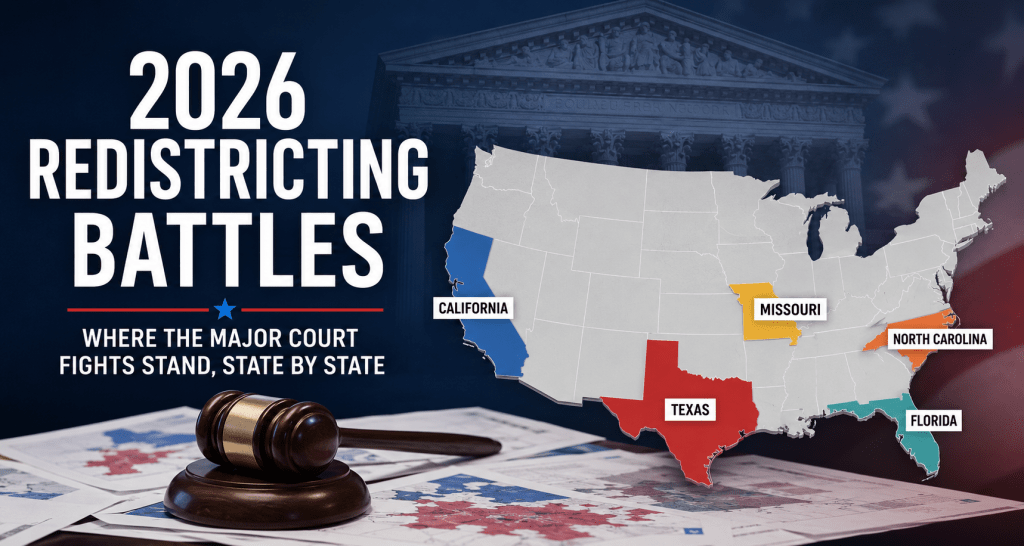
Mid-decade redistricting has touched more states in the past year than at any point since the 1960s, and the legal fights it triggered are still working their way through courts even as the 2026 midterm election cycle is well underway — in Missouri’s case, days away from colliding directly with a certification deadline. Here’s a state-by-state look at where the major congressional map disputes stand as of this week, plus the Supreme Court ruling that’s shaping how courts evaluate new majority-minority districts nationally.

Mid-decade redistricting has touched more states in the past year than at any point since the 1960s.
How this started
In the summer of 2025, President Trump encouraged Republican-controlled state legislatures to redraw congressional maps outside the normal once-a-decade schedule, aiming to add Republican-leaning seats ahead of the 2026 midterms. Texas moved first; several other Republican-led states followed. Democratic-led states, led by California, pursued counter-redistricting to offset the expected Republican gains. The result is active litigation in at least six states.

Texas — resolved, map upheld
Texas’s new map, which reconfigures nearly all 38 districts and is projected to add up to five Republican-leaning seats, was struck down by a federal three-judge panel in November 2025 on racial-gerrymandering grounds. The Supreme Court stayed that ruling in December, allowing the map to be used for the 2026 primaries, and on April 27, 2026, the Court made that stay permanent — upholding the map for the rest of the decade. Justices Kagan, Sotomayor, and Jackson dissented both times.
California — resolved, map in effect
California voters approved Proposition 50 in November 2025, adopting a new map projected to shift up to five seats toward Democrats in response to Texas’s redraw. Republican challengers sued, alleging racial gerrymandering, but the Supreme Court declined to take up an emergency appeal, clearing the map for use in 2026 without comment.
Preliminary rulings have kept the maps in place, but the cases themselves are far from over.
North Carolina — map in effect, trial pending
A federal panel unanimously allowed North Carolina’s new map — expected to cost Democratic Rep. Don Davis his seat and produce an 11–3 Republican delegation — to proceed for 2026, ruling in November 2025 that the partisan-gerrymandering claims raised political questions outside the court’s reach. A full trial on the surviving constitutional and Voting Rights Act claims is still pending, and any ruling is expected to be appealed directly to the Supreme Court.
Missouri — map in effect, but a referendum deadline is bearing down
Missouri’s map, which targets Democratic Rep. Emanuel Cleaver’s Kansas City-based seat, has survived a state Supreme Court challenge to Gov. Mike Kehoe’s authority to call the special session that passed it. But a separate fight remains unresolved: opponents gathered more than 305,000 signatures — nearly three times the required threshold — for a referendum that would let voters repeal the map in November. Secretary of State Denny Hoskins has a constitutional deadline of August 4 to certify those signatures, which is the same day as Missouri’s primary election. Under the state constitution, a referendum petition is supposed to suspend the law it targets once it qualifies — meaning it’s legally possible the map could be ruled invalid on the same day voters are using it to cast primary ballots. Hoskins has said the map remains “the law of the land” in the meantime and has questioned whether a congressional map can even be subject to referendum at all, a position referendum organizers dispute.
It’s legally possible the map could be ruled invalid on the same day voters are using it to cast primary ballots.
Florida — map in effect, challenge continuing
Florida’s new map, expected to give Republicans up to 24 of 28 seats, was allowed to proceed after a Leon County judge declined in May to block it, and the Florida Supreme Court rejected an emergency appeal in June without ruling on the underlying merits. The judge overseeing the case suggested the core dispute — over the state’s voter-approved ban on partisan gerrymandering — is “more geared toward the 2028 or 2030 election cycles than the 2026 election cycle.” The underlying challenge continues in the trial court.
The Supreme Court’s other big move: Louisiana v. Callais
The decision doesn’t directly govern the mid-decade map fights, but it signals a tightening standard for majority-minority districts nationwide.
Separately from the mid-decade redistricting fights, the Supreme Court ruled in April 2026 in Louisiana v. Callais, striking down a Louisiana congressional map that had created a second majority-Black district — one that had itself been adopted under a prior court order to remedy a Voting Rights Act violation. The 6–3 ruling sided with a group of voters who challenged the map as an unconstitutional racial gerrymander. The decision doesn’t directly govern the mid-decade map fights above, but it signals a tightening standard for when states can draw majority-minority districts as a Voting Rights Act remedy — a standard likely to be cited in ongoing cases in North Carolina, Florida, and elsewhere where similar districts are at issue.
What to watch next
The next phase won’t be about whether these maps can be used—it will be whether they survive trials on the merits before the next election cycle.
Missouri’s August 4 collision between certification and its primary is the most immediate flashpoint. Beyond that, trial-court rulings on the merits — as opposed to the preliminary rulings that have kept maps in place so far — are still pending in North Carolina and Florida, and any of those could still be appealed to the Supreme Court before the maps are used again in 2028.

Sources
This story draws on reporting and case tracking from the Brennan Center for Justice’s Redistricting Litigation Roundup; Democracy Docket; the Texas Tribune and Votebeat Texas; the Houston Public Media; NBC 5 Dallas-Fort Worth and KSAT; CBS News; the Associated Press via Axios; NC Newsline, Carolina Public Press, WRAL, and WCNC; Ballotpedia’s Missouri Congressional Map Referendum tracker; St. Louis Public Radio; ABC17 News; Votebeat national; Axios Florida; WUSF; NBC News; and SCOTUSblog’s coverage of Louisiana v. Callais.
Election Desk will continue tracking these cases as Missouri’s certification deadline and other rulings approach.
 Election Desk
Leave a comment