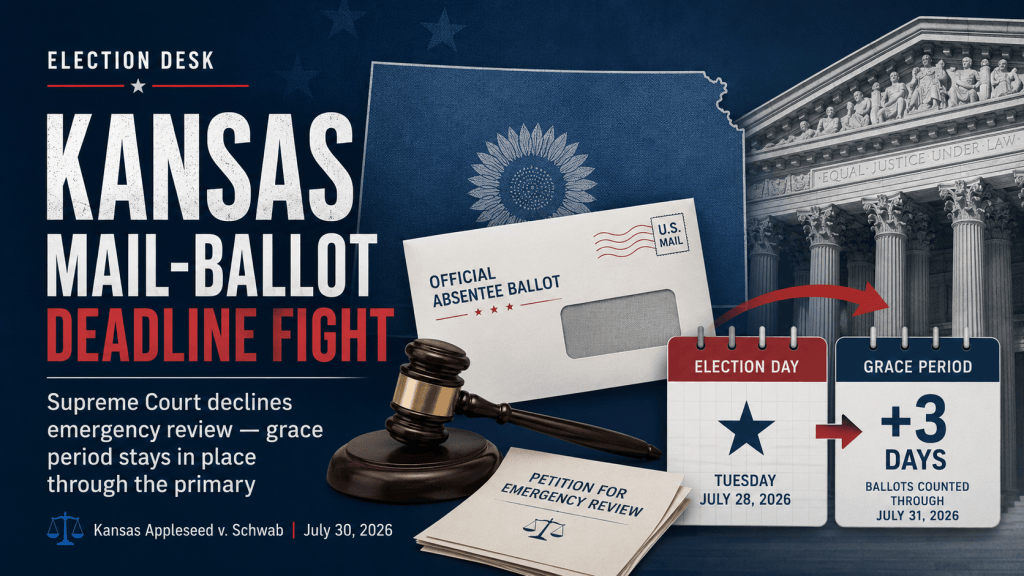
Divided court lets lower-court rulings stand as litigation over Senate Bill 4 continues past Kansas’s August 4 primary
TOPEKA — A divided Kansas Supreme Court declined on July 30 to take up an emergency appeal from Secretary of State Scott Schwab, leaving in place a district court injunction that restored the state’s three-day grace period for mail ballots ahead of the August 4 primary. The order kept the case in the Kansas Court of Appeals rather than elevating it to the state’s highest court, and it did not resolve the underlying constitutional question of whether Senate Bill 4 — the 2025 law that eliminated the grace period — can stand.

What the court decided
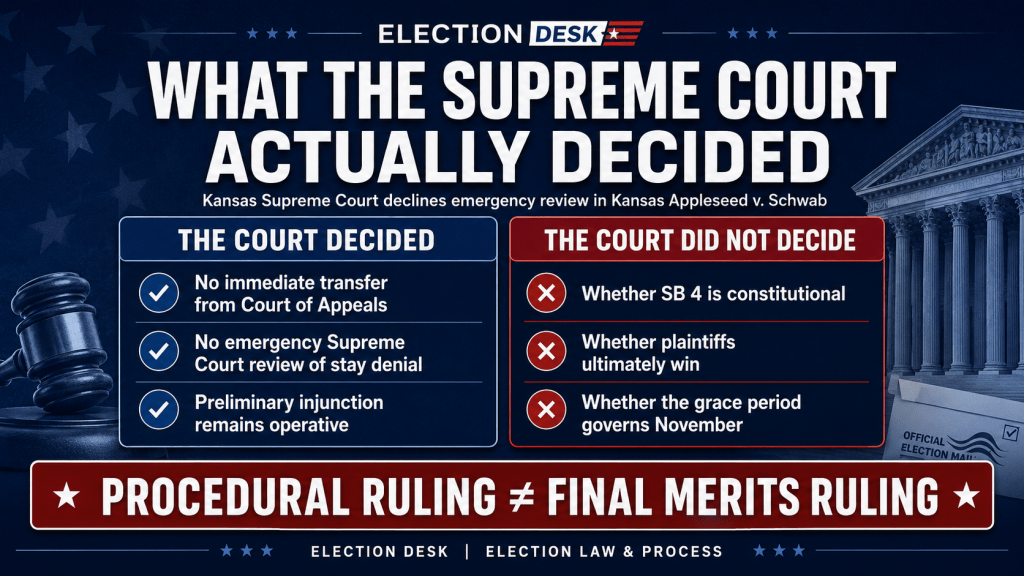
The Supreme Court’s July 30 order decided who hears the case next — not whether Senate Bill 4 is constitutional.
The order, Kansas Appleseed Center for Law and Justice, Inc. v. Schwab, No. 130,839, resolved two separate requests from Schwab: a motion to transfer the case from the Court of Appeals to the Supreme Court, and an emergency petition asking the Supreme Court to review the Court of Appeals’ July 27 refusal to stay the district court’s injunction. A majority denied both, in an opinion authored by Chief Justice Eric Rosen. The majority found Schwab had not shown “sufficient data concerning the state of the docket of the Court of Appeals and of the Supreme Court to demonstrate that the expeditious administration of justice requires the transfer,” adding that the Court of Appeals “appears ready, willing, and able to administer justice at this stage in the case.” The majority stated it was acting “expressly without comment on the merits of the appeal,” describing the case as interlocutory — arising from a preliminary injunction, not a final ruling on SB 4’s constitutionality — and noted that any future appeal from a final ruling that a statute is unconstitutional would come directly to the Supreme Court “by legislative design.”
A significant part of the majority’s reasoning addressed the Purcell principle — the doctrine, from the U.S. Supreme Court’s Purcell v. Gonzalez (2006), that courts should generally avoid changing election rules close to an election. Schwab argued the Court of Appeals should have applied Purcell to fault the district court’s injunction; the majority disagreed that Purcell “clearly” controlled the analysis, pointing to what it called inconsistent recent U.S. Supreme Court rulings on the doctrine, and noted that Schwab’s separate argument — that federal election-day statutes preempt state grace-period laws — had been rejected by the U.S. Supreme Court on June 29, 2026, in Watson v. Republican National Committee, a case involving Mississippi’s own mail-ballot grace period.
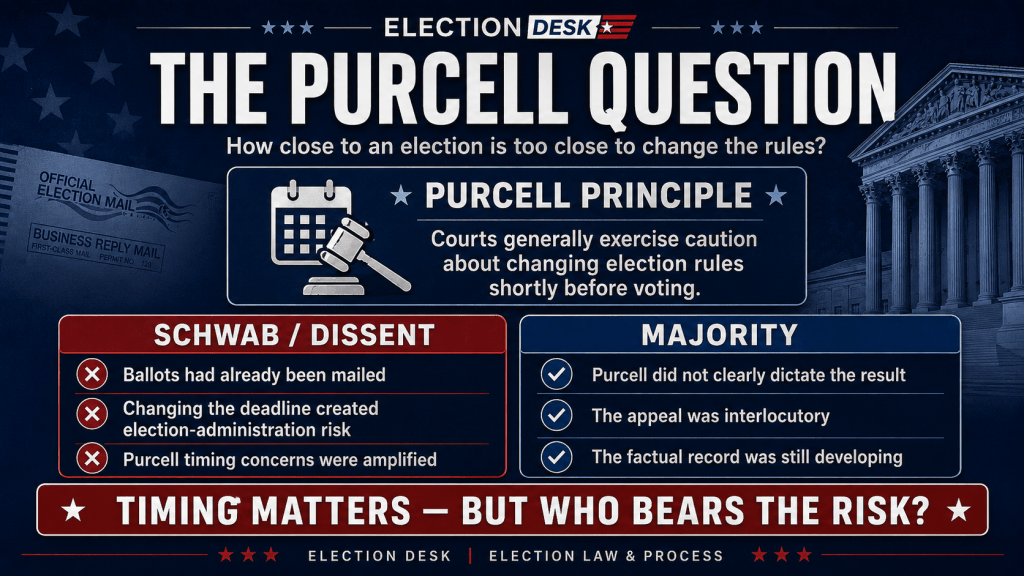
The dispute is not simply over when ballots arrive. It is also over how close to an election courts should be willing to change the rules.
Justices Caleb Stegall and K.J. Wall dissented from both rulings. Stegall was appointed by Republican Gov. Sam Brownback; Wall was appointed by Democratic Gov. Laura Kelly. The dissent argued the case presented “a pure question of law on undisputed facts” of “maximal importance” given the approaching primary and general elections and should have been transferred under the statutory ground allowing transfer of cases with “major public significance.” On the stay request specifically, the dissent argued Purcell‘s underlying timing concerns were “amplified” because the district court acted after ballots had already been mailed, and — despite writing that its dissent was “not the proper place for a full discussion of the merits” — went on to lay out an extended critique of the district court’s equal protection, due process and right-to-vote analysis, including a separation-of-powers objection to a district court “reviving” a statute that had been repealed. The dissent also argued that if the injunction is later lifted after the primary, “every single Kansas voter who cast a lawful ballot” under SB 4’s deadline “will have been disenfranchised due to the counting of tardy ballots” — framing potential disenfranchisement as something that could cut against the injunction as well as for it.
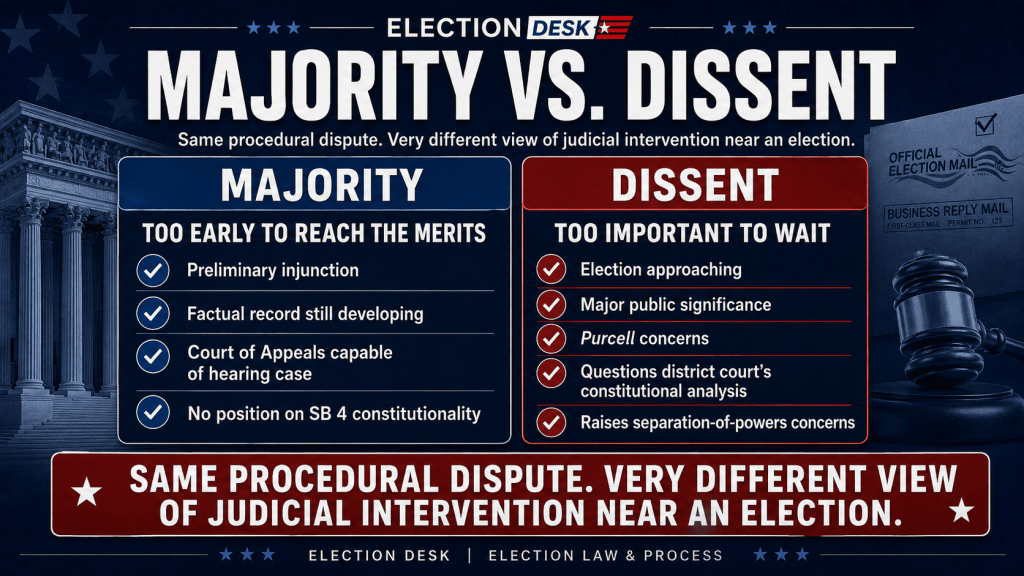
The majority pushed back directly on the dissent’s approach, writing that the case “is on interlocutory appeal from a preliminary injunction. The facts are not undisputed; they are undeveloped,” and stating that “Kansans deserve better from their highest court” than a nonprecedential dissent that engages the merits while disclaiming that it is doing so.
The facts are not undisputed; they are undeveloped.
How the case reached the court
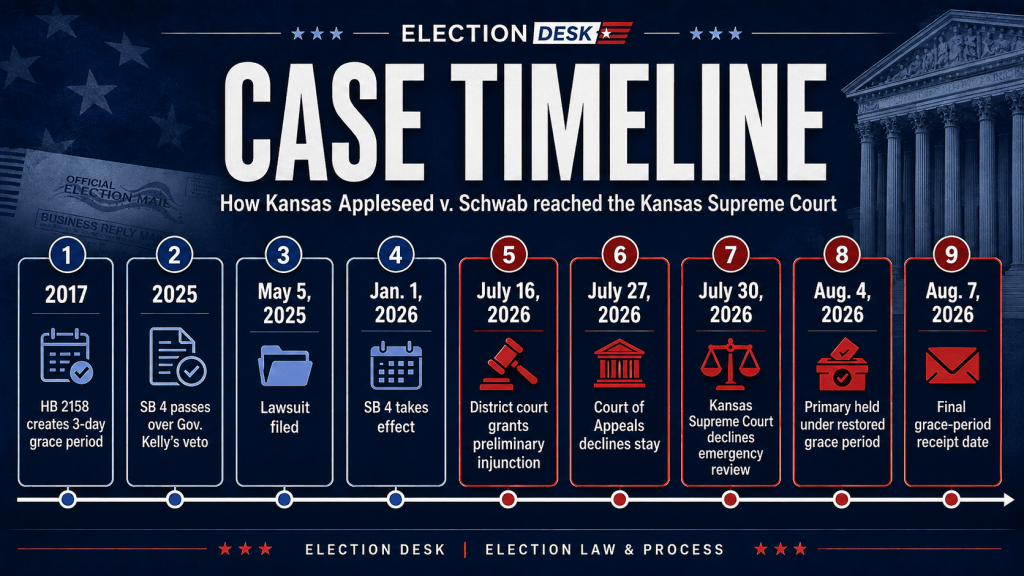
Kansas used a three-day grace period from 2017 through 2025. SB 4 eliminated it beginning January 1, 2026.
Senate Bill 4, passed by the 2025 Legislature over Kelly’s veto, ended a grace period that had allowed mail ballots postmarked by Election Day to be counted if they arrived at county election offices up to three days later. The 2017 law it replaced, House Bill 2158, passed 123-1 in the House and 40-0 in the Senate and took effect July 1, 2017, after Republican Gov. Sam Brownback signed it. SB 4 took effect January 1, 2026, requiring advance ballots to arrive by 7 p.m. on Election Day.
Kansas Appleseed, Loud Light, the Disability Rights Center of Kansas and three individual voters sued Schwab and Douglas County Clerk Jamie Shew on May 5, 2025, arguing the change violated the Kansas Constitution’s equal protection, due process and right-to-vote guarantees. Plaintiffs moved for a temporary injunction on December 9, 2025; after a January 27, 2026 hearing, Douglas County District Judge Carl Folsom III granted it on July 16, finding plaintiffs “substantially likely” to prevail at trial. His 54-page order concluded SB 4 would arbitrarily disenfranchise voters — citing evidence specific to rural voters, voters with disabilities, elderly voters and out-of-state college students — because of mail delays outside their control, and cited data showing the Kansas-Missouri postal district ranked among the three or four worst-performing districts nationally.
Schwab, who is also a Republican candidate for governor, pursued a rapid sequence of appeals: an emergency motion to stay the injunction at the Court of Appeals, an emergency motion to transfer the case directly to the Supreme Court, and, after the Court of Appeals denied the stay on July 27, an emergency petition asking the Supreme Court to review that denial. The July 30 order resolved the last of those requests without addressing whether SB 4 itself is constitutional.
Where the case stands
The July 30 order was explicitly procedural — it decided which court hears the appeal and on what timeline, not whether the grace period survives. The underlying merits case remains before the Court of Appeals, with Folsom’s injunction in effect while that plays out. The Kansas primary took place August 4 under the restored grace period, meaning ballots postmarked by that date and received through August 7 were eligible to be counted under the same standard Kansas used from 2017 until this year.
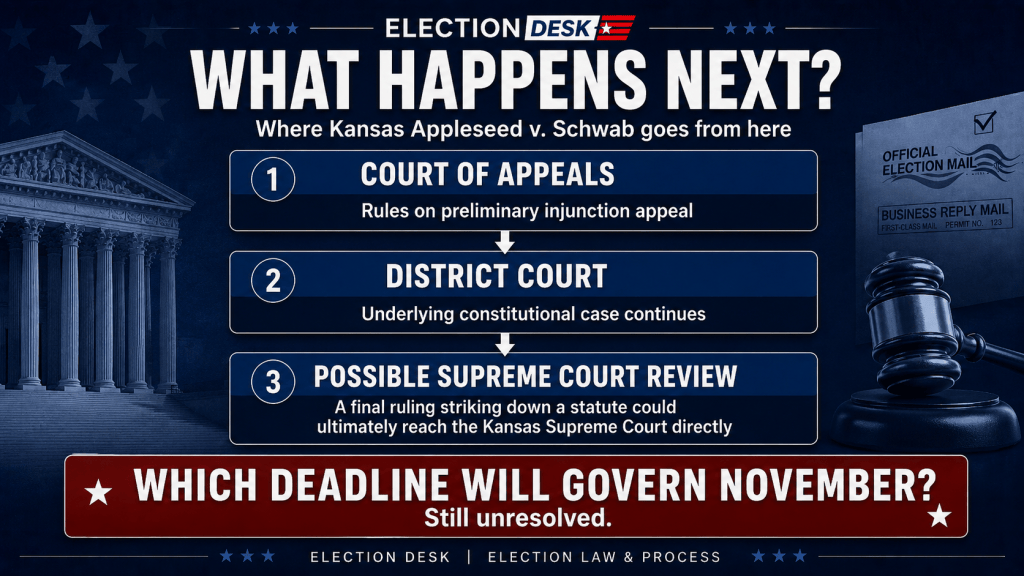
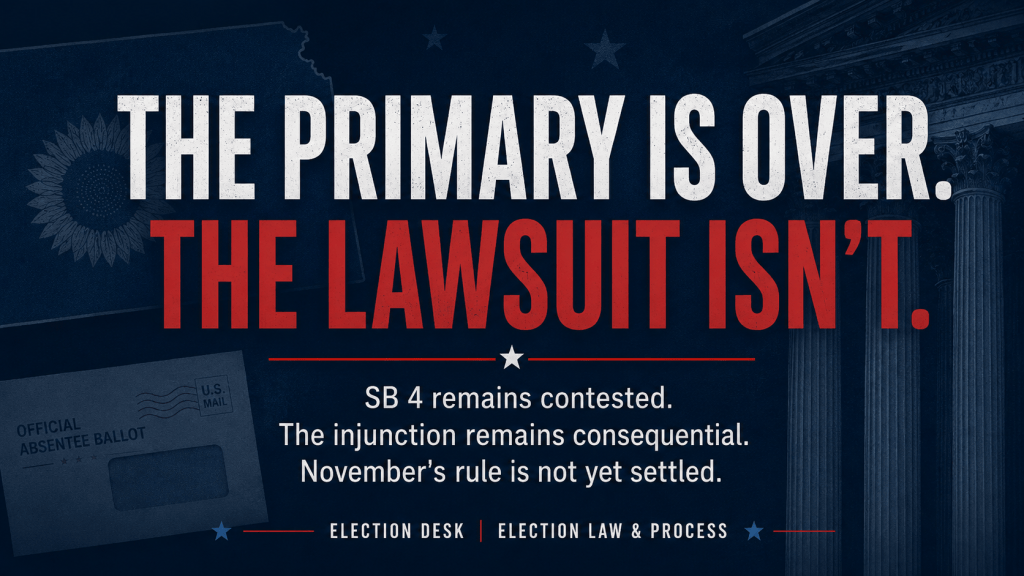
The primary was conducted under the restored grace period. Whether the same rule governs November remains unresolved.
What’s ahead
The Court of Appeals has not yet ruled on the merits of Schwab’s underlying appeal of Folsom’s injunction, and no trial date in the district court had been publicly scheduled as of this writing. Because the Supreme Court’s order took no position on SB 4’s constitutionality, the law’s ultimate fate — and whether the grace period will still be in place for Kansas’s November general election — remains unresolved. Election Desk will continue tracking the Court of Appeals docket and district court proceedings in Kansas Appleseed v. Schwab as the case develops.
Sourcing note: This account is based on two primary documents obtained directly via Democracy Docket’s case-document hosting: the Kansas Supreme Court’s July 30, 2026 order in Kansas Appleseed Center for Law and Justice, Inc. v. Schwab, No. 130,839 (majority opinion by Chief Justice Eric Rosen, dissent by Justices Stegall and Wall), and Douglas County District Judge Carl Folsom III’s July 16, 2026 order granting a temporary injunction, Case No. DG-2025-CV-000206, Division 7. Legislative history — the 2017 enactment of HB 2158 and the 2025 passage and veto override of SB 4 — is drawn from Folsom’s order together with contemporaneous reporting by Kansas Reflector, KMUW, KCUR, HPPR, KSNT and KSN, cross-referenced against Ballotpedia and LegiScan’s roll-call record for SB 4. All direct quotations are taken from the two court orders themselves rather than secondary summaries. One figure remains necessarily approximate: the composition of the Supreme Court’s majority beyond the two named dissenters is not specified in the order or in available secondary sources, so this account refers only to “a majority” rather than a vote count.


Leave a comment