

Scroll through political X or news coverage of any 2026 primary and you’ll see it: a screenshot of a Kalshi or Polymarket price, presented as the odds. “58% chance to win.” “Darline Graham: 42%.” These numbers show up within minutes of returns, often faster than any actual vote count, and they’re increasingly treated as a live scoreboard for American politics.
That’s a big shift from a decade ago, when betting on elections lived mostly in the shadows or in small academic experiments. It raises a fair question for anyone reading the news: are these numbers actually good predictions, or just a new kind of noise dressed up as data?
The honest answer is: it’s genuinely contested, and both the legal status and the accuracy of these markets are still being fought out — in courtrooms, in Washington, and in academic journals.
These numbers show up within minutes of returns, often faster than any actual vote count, and they’re increasingly treated as a live scoreboard for American politics.
How this actually works
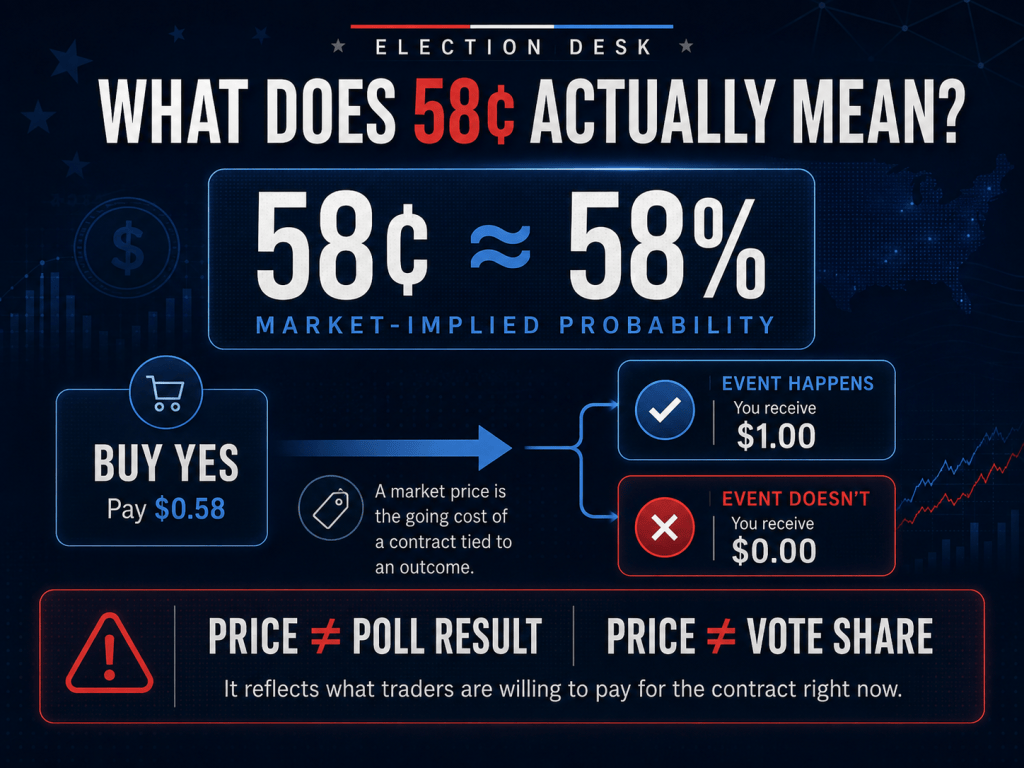
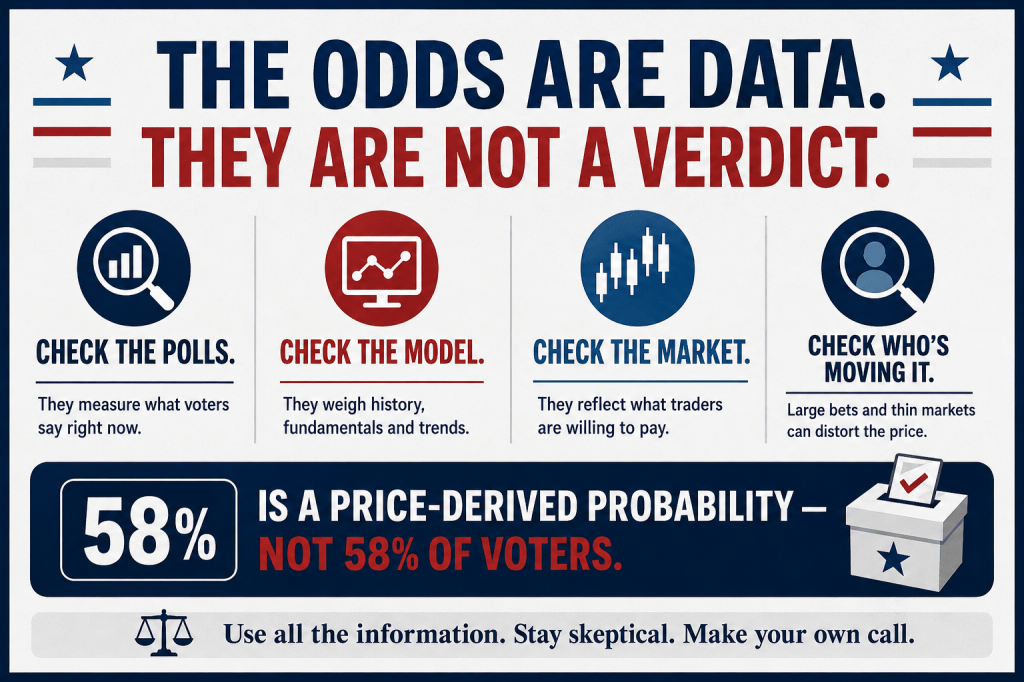
A prediction market lets people trade contracts tied to a real event instead of a stock or a barrel of oil. Buy a “yes” on “Candidate X wins,” and if you’re right, the contract pays out. If a contract is trading at 58 cents, the market is essentially saying there’s a 58% chance the thing happens — and that number moves in real time as people bet.
Two platforms dominate this space in U.S. politics: Kalshi, which is registered with and regulated by the federal Commodity Futures Trading Commission (CFTC), and Polymarket, which built its user base overseas on blockchain technology before recently registering a domestic arm, Polymarket US, as well.
Is this even legal? Nobody’s fully settled it.
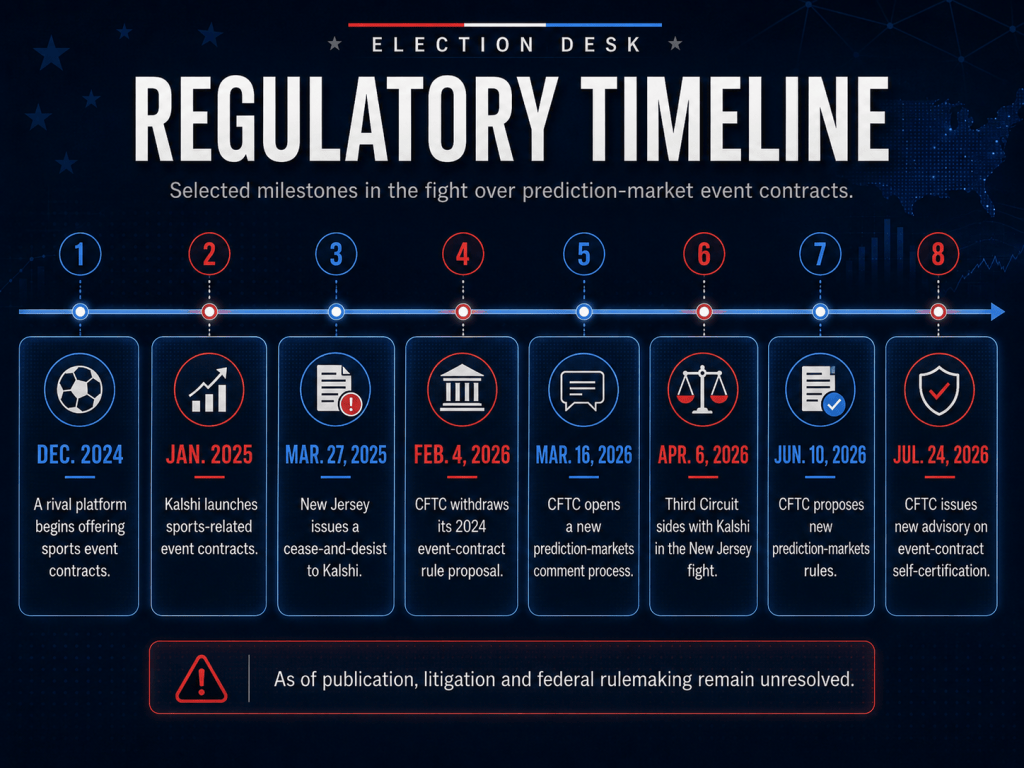
Here’s where it gets genuinely messy. Federal law gives the CFTC exclusive authority over regulated derivatives markets. Kalshi argues its election and sports contracts fall under that umbrella — which would mean states can’t ban them under their own gambling laws. Several states disagree, and the fight has escalated fast.
This isn’t just a New Jersey thing — over the past year, regulators in New Jersey, Nevada, Maryland, Illinois, Montana, Ohio, New York, and Connecticut have all told Kalshi to shut down or face enforcement, and a group of California tribes sued Kalshi and Robinhood separately over sports contracts. New Jersey went first, sending Kalshi a cease-and-desist letter in March 2025; a federal appeals court sided with Kalshi in April 2026, at least for now, and Kalshi’s won similar rulings against Nevada. Arizona went further, filing actual criminal charges against Kalshi in March 2026 over what it calls illegal “election wagering” — the first state to try that route. Weeks later, the Justice Department and the CFTC turned around and sued three states (Illinois, Connecticut, and Arizona) to defend the platforms’ right to operate under federal rules. None of this is resolved.
Meanwhile, the CFTC itself has been swinging between postures. It got more permissive starting in early 2025, walked back a proposed ban on political and sports contracts, then spent early 2026 tightening the screws on a different problem: people trading on inside information, including at least one case involving a candidate who traded contracts on his own race. Both major platforms added new internal rules in March 2026 barring officeholders and athletes from betting on their own contests. In June 2026, the CFTC put out a formal proposed rule that would try to sort all of this out — public comment closed weeks later, and a final rule hasn’t been issued.
But do these markets actually predict elections well?
This is where a lot of the online enthusiasm outruns the actual research.
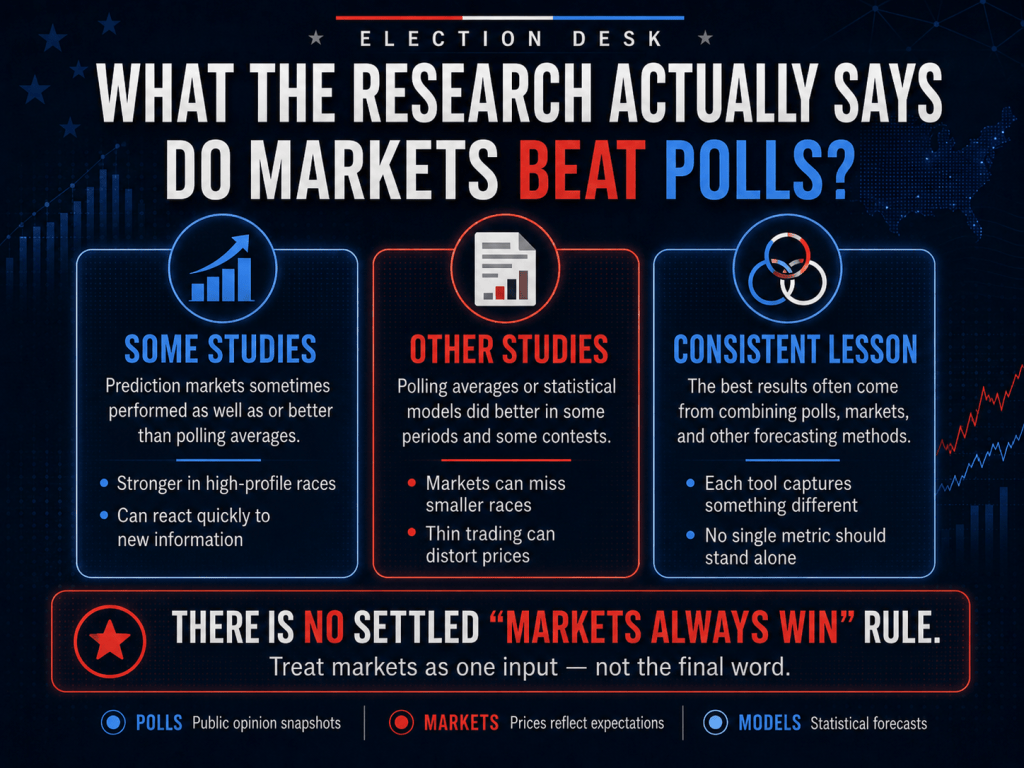
The academic record here is genuinely mixed, not a clean win for markets. Some studies of the Iowa Electronic Markets and the old Intrade platform found they performed on par with, and sometimes better than, polling averages. But one of the more rigorous historical assessments, looking across six presidential cycles, actually found polls had a lower average error than the markets over that stretch — and that combining polls, markets, and other methods beat any single approach.
The 2024 race produced two dueling 2025 studies that land on opposite sides. One, by economist Rajiv Sethi and colleagues, compared Polymarket’s 2024 pricing against major poll-based forecasting models (The Economist, Nate Silver, FiveThirtyEight) and found Polymarket got the top-line presidential call right — but didn’t clearly beat the statistical models on the popular vote or Electoral College, and did noticeably worse on down-ballot congressional races, where trading volume is thinner and prices are easier to distort. Sethi has cautioned against reading too much into one correct call.
The academic record here is genuinely mixed, not a clean win for markets.
A different 2025 study, a not-yet-peer-reviewed working paper out of Vanderbilt, found the opposite: that Polymarket beat the polls outright on the 2024 race, nationally and in swing states. But that paper’s own authors flag real limitations — it’s built on a single platform rather than an aggregate, Polymarket’s user base skews young, male, and crypto-savvy, and their own discussion section notes credible reporting that roughly $30 million in pro-Trump bets that October traced back to one trader running multiple accounts, plus separate wash-trading allegations reported by Fortune.
There’s also a documented quirk specific to political markets: researchers looking at both Kalshi and Polymarket data found political contracts tend to get pulled toward 50-50 even when the real odds are more lopsided — especially on the biggest trades. The likely explanation is that political bettors on both sides trade with strong conviction rather than cold calculation, and their opposing bets cancel each other out near the middle. That’s a structural bias sports markets on the same platforms don’t seem to show.
The whale problem
Big individual traders can move these markets in ways an ordinary poll simply can’t be moved.
Big individual traders can move these markets in ways an ordinary poll simply can’t be moved. The classic case is the so-called “Romney Whale” from 2012 — a single anonymous trader responsible for roughly a third of all bets on Mitt Romney on Intrade, who ultimately lost close to $4 million chasing that position over two weeks. Researchers found no other trader in that market was big enough to counteract the distortion. It’s not just ancient history, either: the Wall Street Journal traced roughly $30 million in pro-Trump bets on Polymarket in October 2024 to a single trader spread across multiple accounts, around the same time researchers cited by Fortune were flagging wash-trading concerns on the platform.
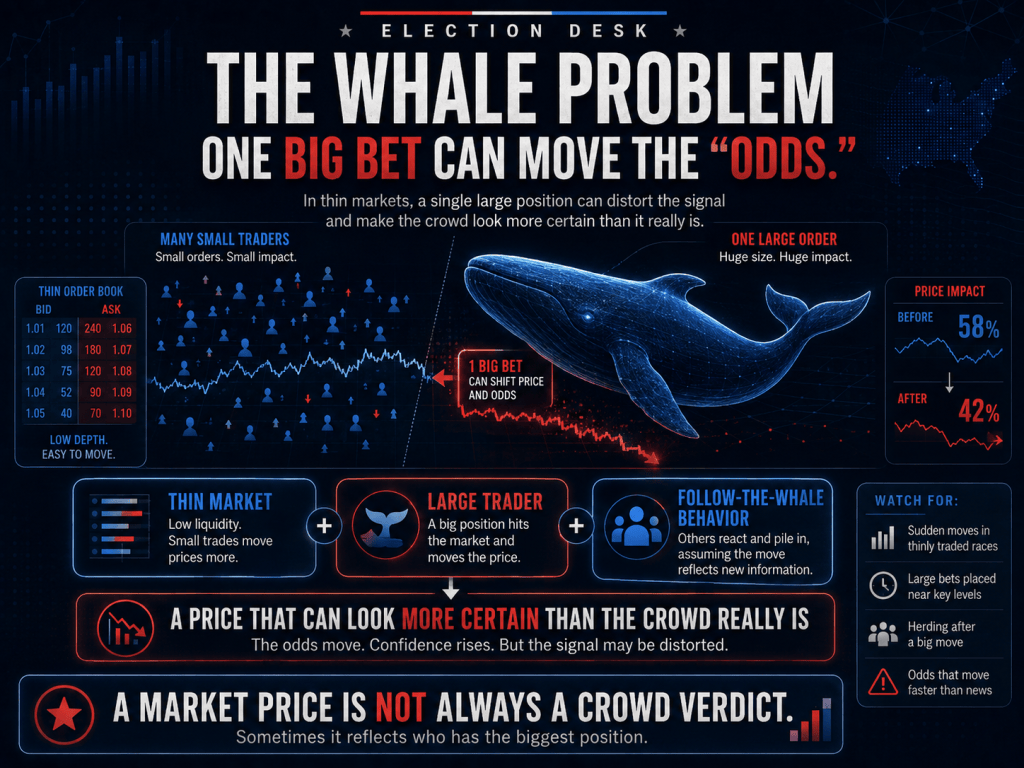
Similar dynamics show up on today’s platforms: smaller traders copying visible “whale” positions, sometimes getting played by whales who plant decoy bets and then quietly take the opposite side once the copycats pile in. And the user base itself skews young, male, and crypto-comfortable — not exactly a representative cross-section of the electorate whose behavior the market is supposedly forecasting.
That number is one input … not a verdict.
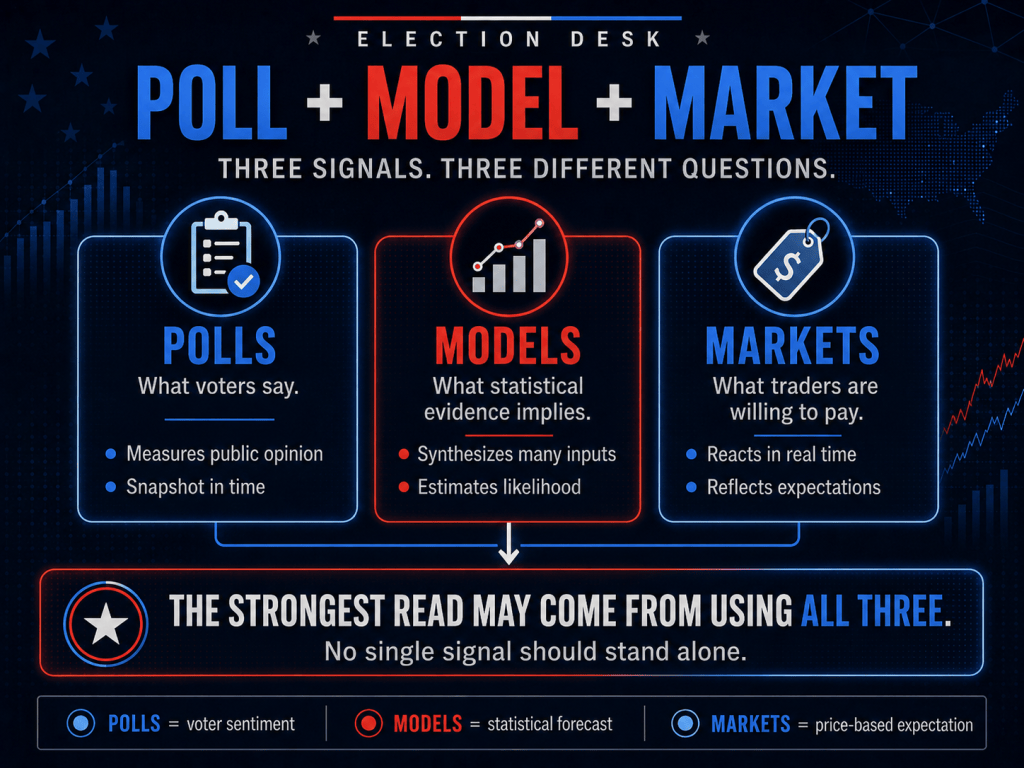
The bottom line
None of this means prediction markets are worthless. In well-traded, high-profile races, the research genuinely supports treating them as a useful data point. But the confidence with which a single number — “58%” — gets passed around online outstrips what the evidence can currently back up, particularly in smaller races where a handful of large bets can swing the price. And the legal ground under the whole industry is still shifting under regulators’ and courts’ feet.
Worth remembering next time a screenshot of Kalshi odds crosses your feed: that number is one input, assembled by traders with money on the line and, in some documented cases, an obvious thumb on the scale — not a verdict.
Sourcing: CFTC advisories and proposed rulemaking, federal court rulings (3rd Circuit; N.D. Ill., D. Conn., D. Ariz.), and legal-industry reporting on the multistate cease-and-desist fight. Research on the 2024 election includes a 2025 analysis by economist Rajiv Sethi and colleagues and a July 2025 Vanderbilt working paper (posted to arXiv, not yet peer-reviewed) that reached the opposite conclusion — both are presented here rather than one being treated as settled. This is a fast-moving legal area; pending litigation and the CFTC’s rulemaking remain unresolved as of publication.


Leave a comment